
WHO WROTE THE SECRET HISTORY OF THE MONGOLS?
By Altanbagana Baatar
DBA Candidate| Independent Historian
ImperialGG Historical Research Seriers
25 November 2026
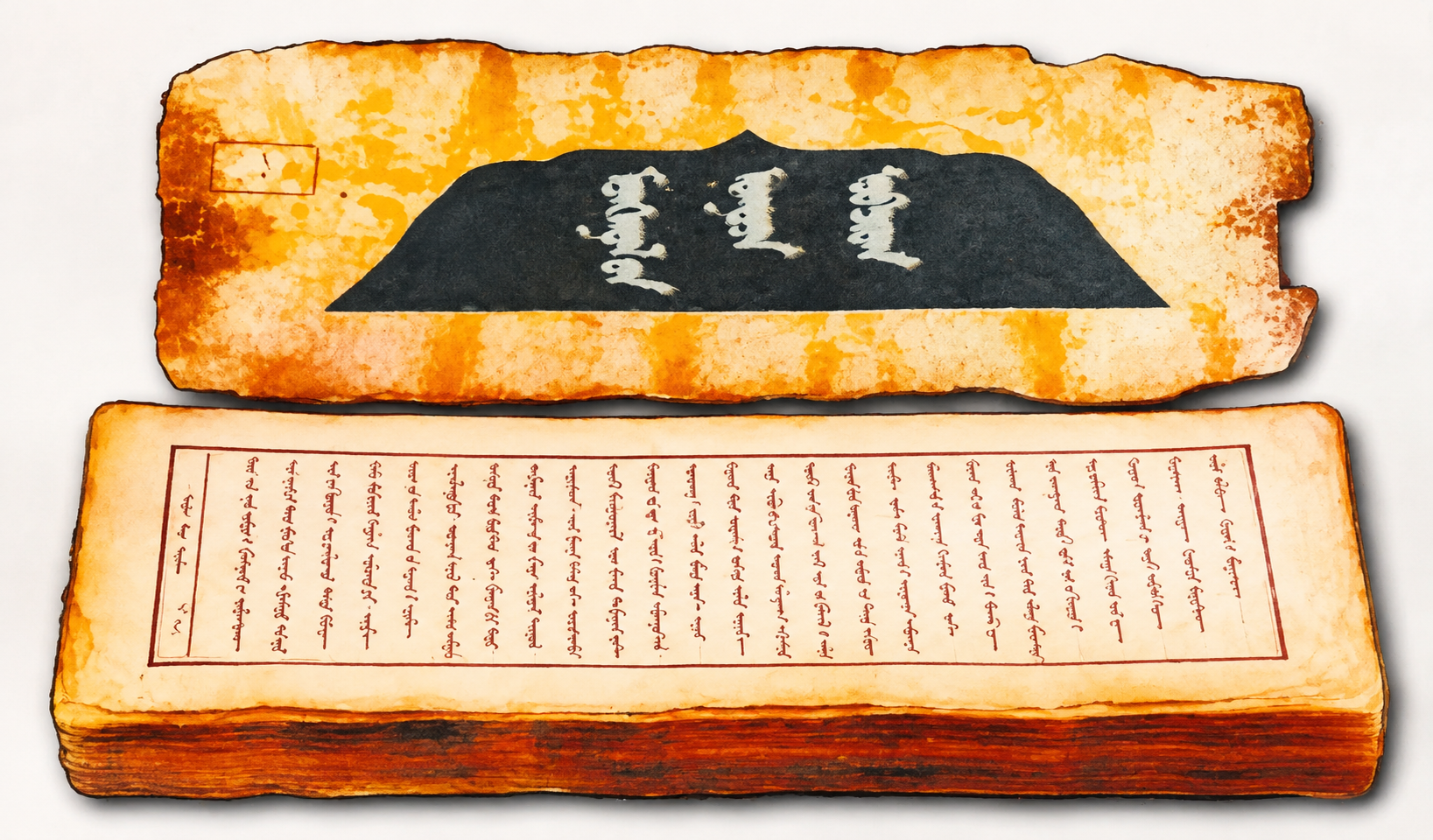
The Narrative Voice of “We,” the Question of Authorship, and the Historical Setting at Khöde’e Aral
An Interdisciplinary Source-Critical Study of the Author, Narrator, Place of Composition, and Date of Completion of The Secret History of the Mongols
By Altanbagana Baatar
ImperialGG Historical Research Series
ABSTRACT
The authorship of The Secret History of the Mongols (Mongγol-un niγuča tobčiyan) remains one of the unresolved questions in Mongolian historiography. Although the work provides an exceptionally detailed account of the formation of Chinggis Khan’s political authority, the genealogy of the ruling house, the military campaigns of the early Mongol state, and the establishment of imperial institutions, it does not identify its author. The final colophon, §282, records the completion of the writing at a Great Assembly, in the Year of the Rat, during the seventh lunar month, at the imperial encampment situated at Dolo’an Boldaq on Köde’e Aral along the Kherlen River. It provides important evidence concerning the geographical setting of the work, but does not name the person responsible for its composition.
This study approaches the authorship question through the relationship between the narrator’s collective voice and the historical community represented in the chronicle. It develops an observation previously raised in the author’s ImperialGG article, “WHO IS ‘WE’? The Missing Companions, the Ready Horses, and the Narrative Voice of the Secret History of the Mongols.” That article examined §§172–173, particularly the expression “our soldiers” and the description of military events from a perspective closely associated with Temüjin’s forces. The present study expands this observation by examining the first-person plural expressions identified by Mongolian historian Ganbatyn Altansukh, who reported twenty-two such narrative instances across eighteen sections and proposed Temüge Otčigin as the likely author of the first ten chapters. The linguistic distinction between first-person plural pronouns, possessive forms, direct speech, and the narrator’s own voice is essential, however, because not every occurrence of “we,” “us,” or “our” necessarily identifies the historical author.
The study compares several major authorship hypotheses, including the proposals associated with Sh. Gaadamba and Khorgasun Qorchi, G. Bilgüdei’s discussion of the 1228 colophon and the Khorgasun hypothesis, G. Altansukh’s argument for Temüge Otčigin, and Igor de Rachewiltz’s preference for Šigi Qutuqu as compiler or author of an earlier textual version. Other proposals involving Tata-Tonga, Činqai, Mönglik, and collective court historians are also considered. Rather than treating these hypotheses as mutually exclusive from the outset, the study distinguishes the possible roles of patron, compiler, eyewitness informant, oral transmitter, and final redactor.
The archaeological landscape of Khöde’e Aral, particularly the site of Avarga and the remains associated with the Great Aurug Palace, is examined as evidence for the political and material environment in which the chronicle may have been composed. The archaeological investigations undertaken by Mongolian and Japanese research teams, together with the UNESCO Tentative List documentation and recent archaeological scholarship, provide a basis for reconstructing the imperial court environment. Nevertheless, archaeological evidence for an imperial palace does not by itself prove that the surviving text was physically written within a particular excavated building.
A separate section addresses the date of completion. The competing Year-of-the-Rat proposals—1228, 1240, 1252, 1264, and 1324—are compared with the political chronology of the Great Assemblies, the reigns of the Great Qa’ans, and the possibility that the chronicle was composed in more than one stage. The 2026 studies by R. F. Fidarov and A. Porsin are considered in detail because they demonstrate that the dating question remains actively contested.
The central argument is that the author of The Secret History of the Mongols should be investigated not merely by asking which historical individual possessed the literary and administrative qualifications to write such a work, but by examining who speaks within the text, whose collective identity is expressed through its first-person language, what kinds of events the narrator appears to know directly, and how that narrative perspective relates to the political and geographical environment recorded in the colophon. The identity of the author may remain uncertain, but the systematic study of the narrator’s voice offers a promising way to narrow the historical possibilities.
Keywords: The Secret History of the Mongols; authorship; narrator; first-person plural; “we”; “our soldiers”; Temüge Otčigin; Šigi Qutuqu; Khorgasun Qorchi; Sh. Gaadamba; G. Bilgüdei; G. Altansukh; Khöde’e Aral; Dolo’an Boldaq; Avarga; archaeology; colophon; Year of the Rat.
1. INTRODUCTION: THE AUTHOR WHO REMAINS HIDDEN
The Secret History of the Mongols occupies a distinctive position among the historical sources of Inner Asia. Unlike later dynastic chronicles, which frequently present the past through the formal voice of a court historian or a retrospective compiler, this work preserves a remarkably vivid narrative of the formation of Chinggis Khan’s authority. It records personal relationships, conflicts among aristocratic families, military decisions, political negotiations, the distribution of authority, and the experiences of individuals whose actions contributed to the emergence of the Mongol Empire.
The chronicle is not simply a sequence of battles and victories. Its narrative contains detailed descriptions of conversations, movements between camps, the behaviour of horses, the preparation of military forces, the treatment of defeated enemies, disputes among members of the ruling family, and the personal conduct of commanders and officials. Some passages appear to preserve information that would have been familiar to people who lived within the political and military environment of Temüjin and his successors. Other passages reveal a sophisticated understanding of dynastic relationships, political legitimacy, and the organization of imperial authority.
Yet the identity of the person or persons responsible for composing the work remains unknown. The text does not provide an author’s signature, and the final colophon does not name an individual writer. Consequently, researchers have proposed several candidates, including Šigi Qutuqu, Tata-Tonga, Činqai, Khorgasun Qorchi, Mönglik, and Temüge Otčigin. Other scholars have considered the possibility that the chronicle was compiled collectively by members of the imperial court or that its different sections were produced at different times by different participants.
The problem is complicated by the fact that the modern concept of an individual author cannot automatically be applied to a thirteenth-century Mongolian court chronicle. The person who preserved the information may not have been the same person who organized it into a narrative. The person who dictated or commissioned the work may not have been the person who physically wrote it. An eyewitness may have supplied information to a court compiler, while a later editor may have incorporated additional material into an earlier text.
For this reason, the question “Who wrote The Secret History of the Mongols?” should be divided into several more precise questions:
Who initiated the project? Who possessed the historical knowledge? Who supplied eyewitness accounts? Who organized the oral and written materials? Who composed the narrative? Who copied or edited the text? And who was responsible for the final form preserved in the surviving tradition?
These questions are related, but they are not identical. A convincing investigation must distinguish them rather than assume that all functions belonged to one person.
The present study proposes that the narrator’s first-person plural language provides an important starting point. The repeated appearance of expressions translated as “we,” “us,” and “our” may preserve the viewpoint of a historical community closely associated with the events being narrated. If these expressions can be connected with particular kinship relationships, military formations, political responsibilities, or geographical positions, they may help identify the social location of the narrator.
The argument does not assume that every first-person expression proves eyewitness authorship. Instead, it treats the narrative voice as evidence that must be examined systematically and compared with the historical candidates.
2. THE FIRST-PERSON COLLECTIVE VOICE: THE QUESTION OF “WE”
2.1. The observation developed in the earlier ImperialGG study
The starting point for this research is the author’s earlier ImperialGG article, “WHO IS ‘WE’? The Missing Companions, the Ready Horses, and the Narrative Voice of the Secret History of the Mongols,” which examined §§172–173.
Those sections describe the events following the fighting at Khar Khaljan Elete. After the withdrawal from the battlefield, the force remains prepared for the possibility of renewed fighting. At daybreak, a roll call reveals that Ögedei, Bo’orchu, and Borokhul are missing. Temüjin expresses confidence that Bo’orchu and Borokhul have remained with Ögedei and will not abandon him. During the night, the soldiers keep their horses ready, anticipating a possible enemy pursuit. Eventually, Bo’orchu returns, and Borokhul arrives carrying the wounded Ögedei.
The earlier article drew attention to the expression translated as “our soldiers.” Its importance lies not merely in the information that the soldiers prepared their horses, but in the grammatical and narrative position from which the event is described. The text presents the soldiers as belonging to a collective identified by the narrator as “ours.”
This observation raises a question that extends beyond §§172–173. If the narrative repeatedly uses collective expressions such as “our soldiers,” “our people,” or first-person plural forms, does it preserve the perspective of a narrator who belonged to the group being described? If so, can the identity of that group be narrowed through the surrounding historical context?
The earlier article did not claim that the expression alone identified the author. Its significance was that the narrator appeared to speak from within the community rather than consistently from an external position. The present study develops that observation into a comparative investigation of the entire chronicle.
2.2. G. Altansukh’s analysis of first-person expressions
An important development in this discussion is the argument presented by Mongolian historian Dr. Ganbatyn Altansukh in an interview published on 8 May 2025. Altansukh identifies the use of first-person expressions as one of the clues for determining the author of the chronicle.
He cites the passage concerning the discovery of a child left behind after the destruction of the Tatars. The narrative states that the child was found by “our soldiers.” Altansukh argues that the expression “our” identifies the narrator with the military group whose actions are being described. He reports that this type of narrative occurs twenty-two times across eighteen sections of the chronicle.[1]
Altansukh’s argument is important because it moves the authorship question from speculation about which historical person possessed sufficient education to compose the work toward an examination of the text’s internal evidence. Instead of beginning with a list of possible literate individuals, he asks what the narrator reveals about himself through the language of the chronicle.
This approach is methodologically valuable. The identity of a narrator can sometimes be investigated through repeated patterns of reference, kinship terminology, spatial position, and access to information. A single expression may be ambiguous, but a consistent pattern across several sections may provide stronger evidence.
However, one issue requires further examination. The expression “our soldiers” is a possessive construction, and it should not automatically be treated as equivalent to a first-person plural subject pronoun. The original Mongolian wording, its grammatical function, and the distinction between direct speech and narrative commentary must be examined individually.
Altansukh’s reported count of twenty-two instances in eighteen sections should therefore be treated as a research finding that requires verification against a critical edition. The complete list of occurrences, their exact Mongolian forms, and their narrative contexts should be published as an appendix to a definitive study.
2.3. The linguistic distinction between “we,” “our,” and collective identity
The study of first-person language requires attention to the grammar of Middle Mongolian. John C. Street’s article, “Nominal Plural Formations in the Secret History,” discusses the historical morphology of the text and identifies different systems of plural formation. His discussion distinguishes the first-person singular forms from plural forms and identifies ba/man- as an exclusive first-person plural form, conventionally translated as “we.”[2]
This linguistic distinction matters because a modern English translation may conceal differences between the original Mongolian forms. The English words “we,” “us,” and “our” can represent different grammatical constructions. A possessive expression may identify a group to which the speaker belongs, but it may also refer to a political or military collective without proving that the narrator personally participated in every event.
A rigorous analysis should therefore classify each occurrence into at least four categories:
First-person plural pronoun: the grammatical subject or object “we/us.”
Possessive collective expression: “our soldiers,” “our people,” or comparable forms.
Direct speech: a character uses “we” while speaking within the narrative.
Narratorial collective expression: the narrator uses a first-person form outside direct speech.
The distinction between the third and fourth categories is particularly important. When a character speaks in the first person, the pronoun identifies that character’s perspective, not necessarily the author’s. Only expressions belonging to the narrator’s own discourse can directly inform the investigation of the narrative voice.
The distinction between inclusive and exclusive “we” is also relevant. A collective pronoun may include the person being addressed or exclude that person, depending on the historical form and context. The precise reference must be established from the original language rather than inferred from an English translation.
Accordingly, the first-person plural expressions should be examined through a concordance of the Mongolian text. Each occurrence should be recorded with its section number, exact original wording, grammatical form, speaker, referent, and relationship to the event being narrated.
2.4. The narrator’s position within the historical event
The next question concerns the narrator’s apparent position in relation to the events. Altansukh draws attention not only to collective expressions but also to descriptions that appear to indicate the narrator’s physical position. He cites the passage concerning the theft of horses and the return of Belgütei from hunting. According to his interpretation, the sequence of actions—seeing the theft, remaining behind, and observing Belgütei’s return—may indicate that the narrator was situated near the household when these events occurred.[3]
This is a significant methodological proposal. Spatial expressions, verbs of movement, visual observation, and the order in which events are described may provide evidence about the narrator’s location.
Nevertheless, a description of an event from a particular spatial perspective does not automatically establish that the author personally witnessed it. A later narrator may reproduce the account of an eyewitness. A compiler may preserve a report from a person who was present. A literary narrative may also construct an observational perspective without the author having been physically present.
The strongest evidence would emerge if several independent passages consistently placed the narrator in a particular social and geographical position, and if that position could be connected with a known historical individual.
The investigation should therefore compare:
The narrator’s use of “we” and “our.”
The physical location implied by descriptions of events.
The narrator’s knowledge of private conversations and military decisions.
The narrator’s familiarity with the internal organization of the ruling household.
The narrator’s use of kinship terms.
The distinction between information available to a participant and information that could have been obtained through later oral transmission.
This approach allows the study to move from grammatical observation toward historical identification without confusing possibility with proof.
3. THE MONGOLIAN SCHOLARLY DEBATE: COMPETING AUTHORSHIP HYPOTHESES
The authorship of The Secret History of the Mongols has been discussed by Mongolian and international scholars for generations. The proposals differ not only in the individuals they identify but also in their assumptions about how the chronicle was produced.
Some hypotheses emphasize the qualifications of a potential writer. Others focus on the political position of the narrator, the structure of the text, or the circumstances of the Great Assembly recorded in the colophon.
G. Altansukh has usefully distinguished between two broad approaches: identifying a historically educated person capable of writing the work, and identifying the author through clues contained within the work itself.[4] The present study combines these approaches while distinguishing the different stages of textual production.
3.1. Sh. Gaadamba and the Khorgasun Qorchi hypothesis
One of the important Mongolian scholarly proposals is associated with Sh. Gaadamba, who presented an authorship hypothesis at an international discussion of The Secret History of the Mongols held in Hohhot in 1988.
According to an interview with Gaadamba’s son, Dr. G. Bilgüdei, Sh. Gaadamba proposed that the author may have been Khorgasun Qorchi, a person associated with the inner court of Chinggis Khan and assigned to serve near Ögelün Mother and Börte Üjin.[5]
This proposal deserves serious consideration because it places the possible author within the intimate environment of the ruling household. A person who served close to the principal women of the Chinggisid family could potentially have had access to genealogical information, family traditions, private conversations, and events not necessarily available to military commanders or external officials.
The hypothesis also raises a question about the relationship between oral memory and court writing. The early history of the Borjigin family was not simply a record of public campaigns. It included family relationships, marriages, disputes, succession questions, and the political roles of members of the household. A person working within the inner court could have been well positioned to preserve this information.
Nevertheless, the identification of Khorgasun Qorchi remains a hypothesis. The evidence currently available does not establish that he physically composed the surviving chronicle, nor does it demonstrate that all the information contained in the work originated from him.
The proposal should therefore be evaluated through three separate questions: whether Khorgasun Qorchi can be securely identified in the historical sources; whether his documented position gave him access to the relevant information; and whether the linguistic and narrative characteristics of the chronicle are consistent with the perspective of someone serving in the inner court.
3.2. G. Bilgüdei: the 1228 interpretation and the transmission of Gaadamba’s hypothesis
Dr. G. Bilgüdei discussed his father’s hypothesis in an interview published by the Mongolian Academy of Sciences in November 2020. He stated that the authorship of the chronicle remained unresolved and described Sh. Gaadamba’s 1988 proposal concerning Khorgasun Qorchi.[6]
Bilgüdei also rejected the conventional dating of the work to 1240. He argued that the Year of the Rat in the colophon should be identified as 1228, when the Chinggisid princes and leading nobles assembled at Khöde’e Aral and Ögedei was elevated to the position of Great Qa’an.
His argument is based on the political circumstances following the death of Chinggis Khan in 1227 and the subsequent assembly of the ruling family. In his interpretation, the reference to the Great Assembly in §282 fits the 1228 political context more convincingly than 1240.[7]
Bilgüdei’s contribution is important in two respects. First, it preserves and communicates a significant Mongolian scholarly hypothesis concerning authorship. Second, it emphasizes that the dating question must be considered in relation to the political context of the assembly recorded in the colophon.
However, the date of the colophon and the identity of the author remain separate problems. Even if 1228 were accepted as the date of completion of an earlier version, that conclusion would not independently establish that Khorgasun Qorchi wrote it.
3.3. G. Altansukh and the Temüge Otčigin hypothesis
In his 2025 interview, Dr. Ganbatyn Altansukh proposed that Temüge Otčigin, the youngest brother of Chinggis Khan, may have been the author of the first ten chapters of The Secret History of the Mongols.[8]
Altansukh’s argument rests on three main categories of evidence.
The first is the use of first-person expressions. He identifies the expression “our soldiers” and reports twenty-two instances of comparable narrative usage across eighteen sections.
The second concerns kinship terminology. The chronicle refers to Ögelün as mother, Menglik as father, Yesügei as father, and Chagadai and Jochi as elder brothers. Altansukh argues that these forms of address may reveal the narrator’s own position within the ruling family.
The third concerns the narrator’s physical location. He interprets certain descriptions of events—particularly the passage involving the theft of horses and Belgütei’s return—as indications that the narrator was physically present at the location from which the events were observed.[9]
Altansukh then connects these clues with the historical position of Temüge Otčigin. Before Chinggis Khan departed on the western campaign in 1219, Temüge remained responsible for the central homeland and the imperial household. During the years 1219–1227, he could have had access to senior members of the family, including Ögelün and Menglik, as well as court personnel such as Khorgasun and Činqai.
Altansukh consequently proposes that Temüge and the literate individuals around him may have been involved in preparing the first ten chapters during this period.[10]
This hypothesis is especially relevant to the present study because it attempts to connect the narrator’s first-person language with a specific member of the ruling family.
Yet it also raises a question that requires further testing. If the first-person expressions are consistently associated with a narrator who refers to Chinggis Khan’s family members as relatives, do all such references fit Temüge Otčigin’s position? The kinship terminology must be checked section by section, and the historical use of these expressions must be distinguished from their possible literary function.
It is also necessary to distinguish the claim that Temüge was the author of the first ten chapters from the claim that he was responsible for the entire surviving work. These are not equivalent propositions.
3.4. Šigi Qutuqu: the compiler and record-keeper hypothesis
An influential international proposal identifies Šigi Qutuqu as a likely candidate for the author or compiler of an earlier version of the chronicle.
In his extensive commentary, Igor de Rachewiltz reviews several earlier theories and argues that Šigi Qutuqu was particularly qualified to organize and preserve the historical materials. Šigi Qutuqu was closely connected with the Chinggisid household and held important judicial and administrative responsibilities. The chronicle itself associates him with the recording and administration of the empire’s affairs.[11]
De Rachewiltz considers the possibility that Šigi Qutuqu was the compiler and author of the Urtext, the earlier textual form of the chronicle. His argument is not simply that Šigi Qutuqu was literate or politically important. It is that his administrative position, his access to records, and his relationship with the ruling family made him a plausible person to organize the historical material.
This hypothesis has a particular advantage: it does not require the assumption that the author was an eyewitness to every event. A senior official could have assembled information from records, oral accounts, genealogical traditions, and reports supplied by participants.
However, the hypothesis is not proven. De Rachewiltz’s identification should be understood as a scholarly reconstruction rather than a documented attribution. The available evidence does not provide an authorial statement naming Šigi Qutuqu.
3.5. Tata-Tonga, Činqai, Mönglik, and collective authorship
Other candidates have also been proposed. Tata-Tonga is associated with the introduction and use of Uyghur writing within the Mongol administration. His knowledge of writing and administrative practice makes him relevant to the history of Mongolian literacy, but such qualifications do not establish that he composed the chronicle.
Činqai was an important administrative figure under Chinggis Khan and his successors. His political and bureaucratic position could have provided access to imperial records and court information. Nevertheless, his role as a possible compiler remains speculative.
Mönglik has also been proposed. De Rachewiltz discusses a theory associated with Coïmaa, who used first-person plural expressions as part of the argument for Mönglik’s authorship.[12] This is particularly relevant to the present investigation because it demonstrates that the first-person plural voice has previously been treated as a clue to authorship by other scholars.
A further possibility is that the chronicle was not produced by one individual in the modern sense. It may have been assembled by a court-based group whose members contributed different kinds of information: genealogical knowledge, military memories, administrative records, oral traditions, and written materials.
This possibility is consistent with the distinction between the historical informant, the compiler, the writer, and the later editor. It also allows the first-person voice to preserve the identity of a particular historical community even if the final text was organized by someone else.
3.6. Comparison of the principal hypotheses
| Candidate or model | Main supporting consideration | Main unresolved problem |
|---|---|---|
| Khorgasun Qorchi | Association with the inner court and access to the ruling household | No direct evidence of authorship |
| Temüge Otčigin | First-person expressions, kinship references, possible spatial position, responsibility for the homeland | The narrative evidence and all kinship forms require systematic verification |
| Šigi Qutuqu | Administrative, judicial, and record-keeping responsibilities; access to imperial information | His role as compiler or author remains inferential |
| Tata-Tonga | Knowledge of writing and administrative literacy | Literacy alone does not prove composition |
| Činqai | High administrative position and access to court affairs | No direct attribution in the text |
| Mönglik | Proposed interpretation of first-person plural expressions | The linguistic evidence does not uniquely identify him |
| Collective court authorship | Explains the diversity of information and possible textual layers | The composition process remains difficult to reconstruct |
The comparison demonstrates that the candidates should not be evaluated solely according to their ability to write. The more important question is whether their historical positions can explain the narrator’s collective identity, access to information, kinship terminology, and geographical knowledge.
4. THE NARRATOR AS A HISTORICAL WITNESS: MEMORY, PARTICIPATION, AND COMPILATION
The most important contribution of the present study is its proposal to distinguish the narrator’s historical position from the identity of the final compiler. A chronicle may contain several kinds of knowledge. Some information may derive from direct observation; other material may originate in oral testimony, administrative records, genealogical lists, or reports transmitted by senior members of the ruling family.
The presence of detailed descriptions does not necessarily mean that one individual witnessed every event. However, a consistent first-person perspective may reveal the social group from which the information originated. This distinction is essential when interpreting The Secret History of the Mongols.
4.1. The eyewitness dimension
Several passages in the chronicle describe events with a level of situational detail that deserves attention. The movements of horses, the condition of military camps, the location of individuals, the order in which people arrive, and the reactions of those present are often narrated with remarkable immediacy.
The passage in §§172–173, examined in the earlier ImperialGG article, is one example. The narrator records the absence of three men, the preparation of horses during the night, the expectation of enemy pursuit, and the return of Bo’orchu and Borokhul with the wounded Ögedei.
Such details may preserve information originating from participants in the event. The narrative could have been based on an eyewitness account supplied by someone who was present with Temüjin’s force. The same question should be asked of other passages involving the ruling household, military movements, private conversations, and the activities of the imperial camp.
4.2. Oral memory and the preservation of the ruling family’s history
The chronicle contains extensive genealogical material and records the relationships among the Borjigin family and other Mongolian aristocratic groups. Such information could have been preserved through oral transmission before being organized into a written narrative. The people who remembered the genealogies and the people who wrote them down may not have been identical.
The preservation of family history was particularly important in a political system where lineage, marriage, seniority, and descent determined access to authority. A court historian or compiler would have required access to people who possessed this knowledge. Senior members of the ruling family, household attendants, commanders, and officials could all have contributed information. This provides another reason to avoid treating the work as necessarily the product of a single writer.
4.3. The possibility of an eyewitness narrator and a later editor
A plausible model is that an earlier narrative preserved the perspective of someone closely connected with the Chinggisid household and military community. Later material may have been added, revised, or organized by a different person or group. This model does not require every section to have been composed at the same time. It also allows the narrator’s first-person voice to survive even when the final editor was not the person who originally witnessed the events.
The hypothesis should be tested through linguistic and narrative analysis. If the first-person expressions are concentrated in particular sections, or if the narrator’s perspective changes between different parts of the chronicle, such patterns may indicate different textual layers or source traditions. If the same collective voice remains consistent across sections dealing with different periods, it may indicate a common narrative identity or a deliberate editorial decision to preserve the perspective of the original informant. At present, the evidence justifies investigation rather than a definitive conclusion.
5. THE ARCHAEOLOGICAL LANDSCAPE OF KHÖDE’E ARAL: THE IMPERIAL COURT AND ITS MATERIAL ENVIRONMENT
5.1. Khöde’e Aral and the geographical setting of the colophon
The final section of The Secret History of the Mongols, §282, records that the writing was completed when a Great Assembly convened and the imperial palaces were established at Dolo’an Boldaq on Köde’e Aral along the Kherlen River. The passage provides a geographical framework that connects the chronicle with the eastern Mongolian landscape and the political environment of the Chinggisid court.
The UNESCO Tentative List documentation describes Khöde’e Aral as a large cultural landscape in Delgerkhaan soum of Khentii Province, situated between the Kherlen River and the Tsenkher River. The area covers more than 100,000 hectares and includes steppe, pastureland, mineral springs, archaeological sites, and historical landscapes.[13]
This geographical setting is important because the Mongol imperial court did not operate exclusively from permanent urban centres. The imperial household, its palaces, military forces, and administrative institutions could be organized within a mobile and seasonal landscape. The archaeological study of Khöde’e Aral therefore provides evidence for the material conditions of imperial government.
5.2. Avarga and the Great Aurug Palace
One of the most important archaeological sites in the area is Avarga, commonly referred to as Avargiin Balgas. The UNESCO Tentative List identifies the ruins as the remains of the Great Aurug Palace, associated with the period of Chinggis Khan. It describes the site as an important political and economic centre of the early Mongol Empire and records its association with the enthronement of Mongol rulers and the conduct of state affairs at the Great Assembly.[14]
The site covers approximately sixty hectares. Archaeological investigations have identified building remains, a large palace complex, forges, reservoirs, agricultural areas, and smaller manufacturing facilities. Geophysical and radiolocation investigations have also identified numerous features interpreted as sacrificial pits around the palace area.[15]
These discoveries are important because they demonstrate that the Khöde’e Aral region was not merely an open landscape used temporarily by a mobile court. It contained substantial structures and facilities associated with political, economic, and ceremonial activities.
The existence of manufacturing areas and ironworking facilities is particularly relevant to the study of the early Mongol state. The organization of military power required the production, repair, and supply of equipment. Archaeological evidence of metalworking can therefore contribute to a better understanding of the material foundations of the imperial system.
Nevertheless, the identification of a palace site must be distinguished from the identification of the exact building in which the chronicle was written. The surviving evidence establishes the importance of the region and its imperial structures; it does not identify a specific writing room or manuscript workshop.
5.3. The history of archaeological investigation
The archaeological study of Khöde’e Aral began well before the recent international projects. The UNESCO documentation identifies Ts. Damdinsüren, B. Rinchen, and Kh. Perlee among the Mongolian scholars who began comprehensive studies of the region from the mid-1940s. It records that an ancient urban ruin was identified near the Avarga Rashaant River in the 1950s and that Kh. Perlee conducted small-scale excavations in 1961, 1966, 1967, and 1976.[16]
In 1992, the Mongolian-Japanese “Three Rivers” project conducted archaeological and geophysical investigations and identified buried building remains distributed across a large area.
The later Mongolian-Japanese “New Century” project continued archaeological research, site registration, conservation, and excavation. The 2015 archaeological conference report records work at Avargiin Balgas and at the Tavan Khailaast site in the Kherlenbayan-Ulaan area. The Mongolian team included B. Tsogtbaatar, L. Ishneren, B. Erenzen, G. Batbold, and other researchers, while the Japanese team included Noriyuki Shiraishi, T. Miyae, and T. Sasada.[17] These investigations are important because they provide a research history extending from early Mongolian archaeological scholarship to international scientific collaboration.
5.4. Noriyuki Shiraishi and the wider archaeological study of the Mongol Empire
In his chapter “Archaeological Sources” in The Cambridge History of the Mongol Empire, Noriyuki Shiraishi emphasizes the growing importance of archaeological evidence for understanding the formation and development of the Mongol Empire.
He identifies Avarga as a major archaeological site and discusses the discovery of an iron workshop associated with the military power of Chinggis Khan. His chapter also places Avarga within the wider archaeological study of the Mongolian plateau, alongside Qaraqorum and other sites.[18]
This research is significant because it connects archaeological discoveries with questions that cannot be answered through written sources alone. The remains of buildings, tools, production facilities, food remains, and other materials provide evidence of everyday life and the practical organization of imperial society.
For the present study, Shiraishi’s work is particularly relevant because it helps reconstruct the institutional environment in which a court chronicle could have been produced. The presence of a substantial palace complex, administrative activity, and specialized production facilities makes the region an appropriate setting for examining the relationship between imperial governance and written historical memory.
5.5. What archaeology can and cannot establish about authorship
The archaeological evidence supports several conclusions.
First, Khöde’e Aral was an important political and economic landscape during the early Mongol Empire.
Second, Avarga was associated with a major palace complex and activities connected with the imperial court.
Third, the region contained the material infrastructure required to support a substantial political and military establishment.
Fourth, the archaeological landscape is consistent with the historical importance assigned to Khöde’e Aral in the written sources.
However, archaeology has not yet identified a manuscript, inscription, writing desk, or other direct evidence that establishes the identity of the author of The Secret History of the Mongols. The archaeological evidence must therefore be used to reconstruct the setting, not to make an unsupported claim that a particular individual wrote the chronicle at a specific excavated structure.
This distinction is essential. The historical significance of Avarga does not depend upon proving that the chronicle was written inside its palace buildings. The archaeological record is already valuable because it demonstrates the political and material environment in which the imperial court operated.
6. THE PLACE OF COMPOSITION: DOLO’AN BOLDAQ, SILGINČEK, AND KÖDE’E ARAL
The geographical statement in §282 deserves a separate examination from the archaeological discussion. The colophon reads, in de Rachewiltz’s transliteration:
Yeke qurilta quriǰu quluqana ǰil quran sarada Kelüren-ü Köde’e-aral-un Dolo’an-boldaq-a Šilginček qoyar ǰa’ura ordos bawuǰu büqüi-tür bičiǰü dawusba.
A cautious translation is:
“The writing of this book was completed at the time when the Great Assembly convened and when, in the Year of the Rat, in the month of the Roebuck, the Palaces were established at Dolo’an Boldaq of Köde’e Aral on the Kherlen River, between Šilginček and [the missing place-name].”[19]
Several elements require attention.
The first is Köde’e Aral, the geographical area associated with the Kherlen River. The second is Dolo’an Boldaq, generally interpreted as “Seven Hills” or “Seven Mounds.” The third is Šilginček, the surviving name of another locality mentioned in the colophon.
De Rachewiltz’s commentary explains that the textual transmission contains a lacuna after Šilginček. Earlier scholars differed in their interpretation of the geographical construction, and Antoine Mostaert argued that a second place-name had been lost during the transmission of the Chinese text.[20] This is a crucial point. The surviving text does not provide a complete list of the two geographical locations. The missing name should not be reconstructed without supporting manuscript evidence.
The colophon therefore identifies the general landscape with considerable precision but does not allow every modern geographical feature to be identified beyond doubt. The place of completion is best understood as the imperial court landscape of Köde’e Aral, associated with Dolo’an Boldaq and the surrounding localities along the Kherlen River. The archaeological identification of Avarga strengthens the historical significance of this region. It does not, however, eliminate the need to distinguish the palace complex from the exact geographical location of Dolo’an Boldaq or the missing locality.
7. THE DATE OF COMPLETION: A SEPARATE HISTORICAL PROBLEM
The date of completion must be examined independently from the place of composition. The colophon identifies the Year of the Rat and the seventh lunar month, but it does not provide a numerical year. Because the Mongolian calendar followed a twelve-year animal cycle, several possible dates have been proposed.
The main candidates include 1228, 1240, 1252, 1264, and 1324.
These dates cannot be treated as interchangeable. Each proposal depends on a different interpretation of the Great Assembly, the reign of the Great Qa’ans, the political content of the chronicle, and the possibility that the text was composed in stages.
7.1. The traditional 1240 interpretation
The dating of the chronicle to 1240 became widely accepted through early twentieth-century scholarship and the Russian translation by S. A. Kozin in 1941. The principal argument was that the chronicle includes information about the reign of Ögedei, who ruled from 1229 until his death in 1241. Since the final section records a Year of the Rat and the text includes events from Ögedei’s reign without mentioning his death, 1240 appeared to be a plausible date.
G. Bilgüdei explains that the 1240 interpretation became established through early scholarly work and was subsequently associated with the commemorative history of the chronicle.[21]
However, the presence of information about Ögedei’s reign creates a problem if the colophon is interpreted as referring to the completion of the entire surviving text in 1228. This problem has encouraged scholars to distinguish between the date of an earlier version and the date of later additions.
7.2. The 1228 interpretation
The 1228 proposal is associated with the Great Assembly held after the death of Chinggis Khan in 1227, when Ögedei was elevated to the position of Great Qa’an.
G. Bilgüdei argues that the colophon’s reference to the Great Assembly fits this political context. He maintains that 1240 is difficult to reconcile with the political circumstances of the Mongol Empire, because the central government and the ruling elite had already developed around Qaraqorum and there was no clearly documented reason for a comparable Great Assembly at Khöde’e Aral in that year.[22]
R. F. Fidarov’s 2026 article, “On the Question of ‘The Secret History of the Mongols’ Date,” also supports the identification of the Year of the Rat as 1228.
Fidarov argues that the chronicle was created in two stages. In his interpretation, the main first part, devoted to the life of Chinggis Khan, was completed in 1228, while the second part, containing information about Ögedei’s reign, was written later, probably after Ögedei’s death. The earlier colophon was retained when the work was enlarged.[23]
This model is important because it offers a possible explanation for the apparent chronological contradiction. It does not require the entire surviving chronicle to have been completed in 1228. Instead, it proposes that the final form preserves an earlier colophon attached to a later composite text.
7.3. The 1252 interpretation and Christopher Atwood
Christopher P. Atwood’s 2007 study, “The Date of the ‘Secret History of the Mongols’ Reconsidered,” reassessed the traditional chronology and considered alternative dates for the composition. Atwood’s work is important because it approaches the problem through a broader comparison of the chronicle’s internal chronology, political context, and the historical events described in the text.[24]
The 1252 proposal is connected with the political circumstances of Möngke’s reign and the possibility that the chronicle’s final form reflects a later stage of dynastic politics. This possibility is relevant to the question of authorship because the political environment in which the text was revised may differ from the environment in which its earlier narrative materials were first collected.
However, a later date for the surviving form would not necessarily identify the original author. It would instead require us to distinguish the first compiler from later editors and political actors.
7.4. The 1264 and 1324 proposals
Other scholars have considered 1264 and 1324 as possible Years of the Rat. These proposals arise from attempts to reconcile the colophon with the political chronology of later Mongol rulers and the historical transmission of the text.
The 1324 proposal, in particular, requires careful examination of the location and activities of the ruler associated with the relevant Great Assembly. De Rachewiltz’s discussion emphasizes the difficulty of connecting the colophon’s geographical and political details with the circumstances of that year.[25]
The existence of these alternatives demonstrates that the dating problem cannot be solved by simply identifying a Year of the Rat. The proposed date must also fit the Great Assembly, the location of the imperial palaces, the historical events included in the chronicle, and the known movements of the ruling court.
7.5. The 2026 debate: Fidarov and Porsin
Two studies published in 2026 demonstrate that the dating debate remains unresolved. Fidarov’s article, published in Golden Horde Review, volume 14, issue 3, pages 528–557, on 8 October 2026, argues for 1228 and supports a two-stage model of composition.[26]
A. Porsin’s article, “Problems of Studying the Secret History of the Mongols as a Historical Source,” published in the Journal of the National Congress of Historians in 2026, takes a more critical position. Porsin examines the historiography of the dating problem, the colophon, the authorship question, and the formation of the text. He argues that none of the proposed dates—1228, 1240, 1252, 1264, or 1324—fits all the evidence contained in the colophon and the chronicle.[27]
Porsin also emphasizes the importance of comparing the Secret History with the Yuan shi, Rashīd al-Dīn, the Koryŏsa, the Altan Tobči, and other historical sources. He argues that the problem should be approached through detailed literary and historical analysis rather than through chronological calculations alone.[28]
These two 2026 studies should not be presented as if they reach the same conclusion. Fidarov supports 1228 as the date of completion of the first part, while Porsin argues that the existing proposals do not resolve the entire problem. Their disagreement is useful because it clarifies the distinction between the date of an earlier textual version and the date of the surviving composite work.
7.6. Why the date matters for authorship
The dating question has direct implications for the authorship debate. If an earlier version was completed in 1228, the possible author or compiler must be considered within the political environment immediately following the death of Chinggis Khan and the enthronement of Ögedei.
If additional material was incorporated later, the author of the earlier narrative may not have been responsible for the final chapters. If the final text reflects a later political environment, the editorial process may have involved people who were not present during the events described in the earlier narrative.
Therefore, the authorship question should not be framed as a search for one person who necessarily wrote all 282 sections at one time. A more historically realistic model may involve an earlier narrative core, the preservation of eyewitness and oral information, later additions concerning Ögedei’s reign, and a final editorial process that retained the original colophon. This remains a hypothesis, but it is consistent with the two-stage model discussed by Fidarov and with the broader textual problems identified by Porsin.
8. THE RELATIONSHIP BETWEEN THE NARRATOR, THE IMPERIAL COURT, AND THE ARCHAEOLOGICAL SETTING
The first-person collective voice and the archaeological setting should be considered together, but they must not be confused. The narrator’s language may reveal a social and political position within the Mongol ruling community. The colophon identifies a geographical setting associated with the imperial court. Archaeology demonstrates that the region contained substantial political and economic structures.
Together, these forms of evidence allow us to reconstruct a possible environment for the production of the chronicle. The court at Khöde’e Aral was not an isolated tent or a temporary gathering without administrative organization. Archaeological research at Avarga indicates the presence of palace structures, production facilities, reservoirs, and other elements of a developed political and economic centre.
Such an environment could have supported the collection of information, the preservation of genealogical knowledge, the participation of senior officials, and the organization of historical materials. The chronicle’s detailed descriptions of military and household affairs may therefore be understood within the wider institutional context of the imperial court.
The presence of officials, commanders, household attendants, princes, princesses, and administrative personnel would have created a community in which different kinds of historical information could be collected and transmitted. This does not mean that the archaeological site identifies the writer. Rather, it provides a material context for understanding how a court-based historical work could have been produced.
9. A NEW RESEARCH MODEL: FROM THE IDENTITY OF THE AUTHOR TO THE IDENTITY OF THE NARRATOR
The present study proposes a more precise research model for investigating authorship. Instead of beginning with the question of which historical individual was most likely to have written the chronicle, the investigation should begin with the internal evidence.
The first stage is to establish a complete list of first-person plural and possessive collective expressions in the Mongolian text.
The second stage is to classify each occurrence according to its grammatical form and narrative function.
The third stage is to identify the referent of each expression. Does “we” refer to Temüjin’s military force, the Borjigin family, the ruling household, a group of commanders, or a later political community?
The fourth stage is to compare these expressions with kinship terminology and spatial descriptions.
The fifth stage is to examine whether the same narrator appears to have direct knowledge of private events, military movements, and the internal affairs of the court.
The sixth stage is to compare the resulting narrative profile with the historical biographies and documented positions of the proposed authors.
The final stage is to compare the results with the colophon, the archaeological setting, and the possible stages of textual composition. This approach would allow the authorship hypotheses to be evaluated according to a common set of criteria rather than according to different and sometimes incompatible assumptions.
10. AUTHOR’S THESIS
The central thesis of this study is that the authorship of The Secret History of the Mongols should be investigated through the historical identity of its narrative voice.
The repeated use of first-person plural and possessive collective expressions may preserve the perspective of a person or group closely connected with the military and political community of Temüjin. The expression “our soldiers,” examined in the author’s earlier ImperialGG article on §§172–173, provides one example of this internal collective position. G. Altansukh’s identification of twenty-two comparable narrative instances across eighteen sections provides an important basis for expanding the investigation.
The linguistic evidence must nevertheless be examined carefully. The grammatical distinction between first-person plural pronouns, possessive forms, direct speech, and the narrator’s own commentary is essential. A character’s use of “we” does not identify the author, and the expression “our soldiers” does not independently prove eyewitness participation.
The authorship hypotheses associated with Khorgasun Qorchi, Temüge Otčigin, Šigi Qutuqu, Tata-Tonga, Činqai, Mönglik, and collective court historians should therefore be tested against the same evidence: the narrator’s language, kinship references, spatial position, access to information, and relationship with the imperial household.
The archaeological evidence from Khöde’e Aral and Avarga demonstrates that the region contained a substantial imperial court environment associated with political, economic, and ceremonial activities. This evidence strengthens the historical context of the colophon but does not independently establish the identity of the writer.
The date of completion must be treated as a separate problem. The 1228, 1240, 1252, 1264, and 1324 proposals reflect different interpretations of the Great Assembly and the possible stages of textual composition. Fidarov’s 2026 argument for a two-stage composition with an earlier 1228 colophon and Porsin’s 2026 criticism of all existing dates demonstrate that the debate remains open.
The most promising approach is therefore to distinguish the historical informant, the narrator, the compiler, the writer, and the later editor. These roles may have belonged to one individual, but they may also have been distributed among several members of the imperial court.
The identity of the author should emerge from the cumulative evidence of the text rather than from an assumption made in advance.
11. CONCLUSION
The Secret History of the Mongols preserves a unique record of the formation of the Mongol state and the political world of the Chinggisid dynasty. Its historical value lies not only in the events it records but also in the perspective from which those events are narrated.
The question of authorship remains unresolved because the surviving text does not identify its writer. Yet the absence of a signature does not mean that the chronicle contains no evidence about the person or community responsible for its composition.
The repeated first-person collective expressions, the use of kinship terminology, the narrator’s apparent spatial position, and the detailed descriptions of military and household affairs provide important clues. The earlier ImperialGG study, “WHO IS ‘WE’?,” identified one such clue in §§172–173. G. Altansukh’s 2025 analysis provides a further basis for systematic examination.
The Mongolian scholarly hypotheses associated with Sh. Gaadamba, G. Bilgüdei, and G. Altansukh should be considered alongside the international research of de Rachewiltz, Atwood, and other Mongolists. The archaeological investigations at Khöde’e Aral and Avarga provide a material context for the imperial court environment, while the colophon in §282 preserves the geographical and calendrical information necessary for studying the place and date of completion.
The separate treatment of the colophon’s geographical and chronological information is essential. The location of the imperial court landscape is more securely indicated than the exact numerical year in which the text was completed. The missing locality in the transmitted colophon and the disagreement over the Year of the Rat must remain explicit parts of the discussion.
The present study does not claim to have established the identity of the author. It argues that a more productive path is to reconstruct the narrator’s historical position and then compare that position with the known individuals who could have supplied, organized, or written the material.
The most important question may therefore be reformulated:
Who is speaking within the Secret History of the Mongols, and what historical community does the narrator represent?
Only after that question has been examined systematically can the search for the author move from speculation toward a more firmly supported historical conclusion.
NOTES AND REFERENCES
[1] U. Chinzorig, interview with Dr. Ganbatyn Altansukh, “Түүхч Г.Алтансүх: ‘Монголын нууц товчоо’-г Чингис хааны отгон дүү Тэмүгэ отчигин зохиосон,” UB Life, 8 May 2025. Altansukh identifies the first-person expression “бидний” and reports twenty-two occurrences of this type of narrative in eighteen sections. The figure is reported here as Altansukh’s finding; it requires independent verification against a critical Mongolian text before being treated as a definitive concordance.
[2] John C. Street, “Nominal Plural Formations in the Secret History,” Acta Orientalia Academiae Scientiarum Hungaricae 44, no. 3 (1990): 345–379, especially 345–346. Street distinguishes the first-person plural forms ba/man- from the singular forms bi/min- and discusses the morphological systems of Early Middle Mongolian.
[3] U. Chinzorig, interview with G. Altansukh, 8 May 2025. Altansukh’s interpretation of the passage concerning the stolen horses and Belgütei’s return is presented as an argument about the narrator’s physical position. It should be tested against the complete original text and alternative narrative explanations.
[4] Ibid. Altansukh distinguishes between authorship research based on the qualifications of possible writers and research based on clues contained within the chronicle itself.
[5] B. Bilgüün, interview with Dr. G. Bilgüdei, “Г.Билгүүдэй: ‘Монголын нууц товчоо’ 1240 онд зохиогдсон гэдэг нь худал,” Mongolian Academy of Sciences, 20 November 2020. Bilgüdei reports that Sh. Gaadamba presented the Khorgasun Qorchi hypothesis at an international discussion held in Hohhot in 1988.
[6] Ibid. The interview records Bilgüdei’s discussion of the unresolved authorship question and his father’s proposal.
[7] Ibid. Bilgüdei argues that the Year of the Rat should be identified as 1228 and connects the colophon with the Great Assembly at Khöde’e Aral following Chinggis Khan’s death.
[8] U. Chinzorig, interview with G. Altansukh, 8 May 2025.
[9] Ibid. Altansukh’s three principal categories of evidence are first-person expressions, kinship terminology, and descriptions that may indicate the narrator’s physical position.
[10] Ibid. Altansukh proposes that Temüge Otčigin may have overseen the preparation of the first ten chapters during Chinggis Khan’s western campaign, with access to senior members of the household and literate court personnel.
[11] Igor de Rachewiltz, The Secret History of the Mongols: A Mongolian Epic Chronicle of the Thirteenth Century, 2 vols. (Leiden: Brill, 2004), introduction, discussion of the authorship hypotheses, especially the section concerning Šigi Qutuqu and the possible compiler of the Urtext. See also de Rachewiltz, vol. 3 (2013), which supplements and revises his earlier discussion of authorship and dating.
[12] de Rachewiltz, Secret History, vol. 1, introduction, discussion of Coïmaa’s proposal concerning Mönglik and the use of first-person plural pronouns.
[13] UNESCO World Heritage Centre, “Archaeological Site at Khuduu Aral and Surrounding Cultural Landscape,” Tentative List, submitted 19 December 2014, State Party: Mongolia. The documented landscape lies in Delgerkhaan soum, Khentii Province, between the Kherlen and Tsenkher rivers.
[14] Ibid. The UNESCO Tentative List identifies Avargiin Balgas with the Great Aurug Palace and describes its political and economic importance during the early Mongol Empire.
[15] Ibid. The documentation reports palace structures, forges, reservoirs, agricultural areas, smaller manufacturing facilities, and geophysical and radiolocation investigations of features interpreted as sacrificial pits.
[16] Ibid. The UNESCO documentation identifies Ts. Damdinsüren, B. Rinchen, and Kh. Perlee among the early scholars of Khöde’e Aral and records Kh. Perlee’s excavations in 1961, 1966, 1967, and 1976.
[17] “Монголын археологи—2015,” proceedings of the archaeological research conference, report on the Mongolian-Japanese “New Century” project and the excavations at Avargiin Balgas and Tavan Khailaast.
[18] Noriyuki Shiraishi, “Archaeological Sources,” in The Cambridge History of the Mongol Empire, ed. Michal Biran and Hodong Kim (Cambridge: Cambridge University Press, 2023; online publication 2024), 1275–1311. DOI: 10.1017/9781316337424.041.
[19] de Rachewiltz, Secret History, vol. 1, §282 and commentary. The translation preserves the lacuna after Šilginček rather than supplying an unattested second place-name.
[20] Ibid., vol. 2, commentary on §282, especially the discussion of Mostaert’s interpretation and the missing place-name after Šilginček.
[21] G. Bilgüdei, interview, Mongolian Academy of Sciences, 20 November 2020. The interview discusses the history of the 1240 dating and the publication of S. A. Kozin’s Russian translation.
[22] Ibid. Bilgüdei’s argument connects the Year of the Rat with the 1228 assembly and the enthronement of Ögedei.
[23] R. F. Fidarov, “On the Question of ‘The Secret History of the Mongols’ Date,” Golden Horde Review 14, no. 3 (2026): 528–557. DOI: 10.22378/2313-6197.2026-14-3.528-557. Fidarov argues for 1228 as the date of the earlier first part and proposes a two-stage composition.
[24] Christopher P. Atwood, “The Date of the ‘Secret History of the Mongols’ Reconsidered,” Journal of Song-Yuan Studies 37 (2007): 1–48.
[25] de Rachewiltz, Secret History, vol. 1, introduction and vol. 2, commentary on §282. See also the discussion of the competing Year-of-the-Rat proposals in the bibliographical survey maintained by Monumenta Altaica.
[26] Fidarov, “On the Question of ‘The Secret History of the Mongols’ Date,” 528–557.
[27] A. Porsin, “Problems of Studying the Secret History of the Mongols as a Historical Source,” Journal of the National Congress of Historians (2026). DOI: 10.65076/3105-0042.2026.4.86.121. Porsin examines the dates 1228, 1240, 1252, 1264, and 1324 and argues that none fully satisfies all the chronological and textual evidence.
[28] Ibid. Porsin emphasizes comparative analysis involving the Yuan shi, Rashīd al-Dīn, Koryŏsa, Altan Tobči, and other historical sources.
SELECTED BIBLIOGRAPHY
PRIMARY SOURCES AND CRITICAL EDITIONS
The Secret History of the Mongols. Translated with a Historical and Philological Commentary by Igor de Rachewiltz. 2 vols. Leiden: Brill, 2004.
The Secret History of the Mongols. Translated by Francis Woodman Cleaves. Cambridge, MA: Harvard University Press, 1982.
The Secret History of the Mongols. Translated by Urgunge Onon. London: RoutledgeCurzon, 2001.
Rashīd al-Dīn. The Successors of Genghis Khan. Translated by John Andrew Boyle. New York: Columbia University Press, 1971.
Yuan shi 元史 [History of the Yuan Dynasty]. Beijing: Zhonghua Shuju.
MONGOLIAN SCHOLARSHIP
Гаадамба, Ш. Нууц товчооны нууцсаас. Улаанбаатар: Улсын хэвлэлийн газар, 1976.
Гаадамба, Ш. Монголын нууц товчооны судлалын зарим асуудал. Улаанбаатар: Улсын хэвлэлийн газар, 1990.
Гаадамба, Ш. Монголын нууц товчооны үг хэллэгийн тайлбар. Улаанбаатар: Соёмбо Принтинг, 2016 edition.
Bilgüdei, G. Interview, “Г.Билгүүдэй: ‘Монголын нууц товчоо’ 1240 онд зохиогдсон гэдэг нь худал.” Mongolian Academy of Sciences, 20 November 2020.
Chinzorig, U. Interview with G. Altansukh, “Түүхч Г.Алтансүх: ‘Монголын нууц товчоо’-г Чингис хааны отгон дүү Тэмүгэ отчигин зохиосон.” UB Life, 8 May 2025.
INTERNATIONAL SCHOLARSHIP
Atwood, Christopher P. “Informants and Sources for the Secret History of the Mongols.” Mongolian Studies 29 (2007): 27–39.
Atwood, Christopher P. “The Date of the ‘Secret History of the Mongols’ Reconsidered.” Journal of Song-Yuan Studies 37 (2007): 1–48.
de Rachewiltz, Igor. “Some Remarks on the Dating of the Secret History of the Mongols.” Monumenta Serica 24 (1965): 185–206.
de Rachewiltz, Igor. The Secret History of the Mongols: A Mongolian Epic Chronicle of the Thirteenth Century. 2 vols. Leiden: Brill, 2004.
de Rachewiltz, Igor. The Secret History of the Mongols, vol. 3: Supplement. Leiden: Brill, 2013.
Fidarov, R. F. “On the Question of ‘The Secret History of the Mongols’ Date.” Golden Horde Review 14, no. 3 (2026): 528–557.
Porsin, A. “Problems of Studying the Secret History of the Mongols as a Historical Source.” Journal of the National Congress of Historians (2026).
Shiraishi, Noriyuki. “Archaeological Sources.” In The Cambridge History of the Mongol Empire, 1275–1311. Cambridge: Cambridge University Press, 2023.
Street, John C. “Nominal Plural Formations in the Secret History.” Acta Orientalia Academiae Scientiarum Hungaricae 44, no. 3 (1990): 345–379.
ARCHAEOLOGICAL AND INSTITUTIONAL SOURCES
UNESCO World Heritage Centre. “Archaeological Site at Khuduu Aral and Surrounding Cultural Landscape.” Tentative List, Mongolia, 19 December 2014.
“Монголын археологи—2015.” Proceedings and research reports concerning Avargiin Balgas and Tavan Khailaast.
Monumenta Altaica. “Secret History of the Mongols: Bibliography.” Research bibliography on editions, translations, dating, authorship, textual criticism, and archaeology.
IMPERIALGG.COM — HISTORY • CULTURE • CIVILIZATION
MYTH & REALITY — HISTORY • PEOPLE • TRUTH