
MILITARY CONQUEST, DIPLOMATIC ALLIANCE, AND THE INCORPORATION OF THE FOREST PEOPLES (OIN IRGED, OIRD)
By Altanbagana Baatar
DBA Candidate| Independent Historian
ImperialGG Historical Research Seriers
07 November 2026
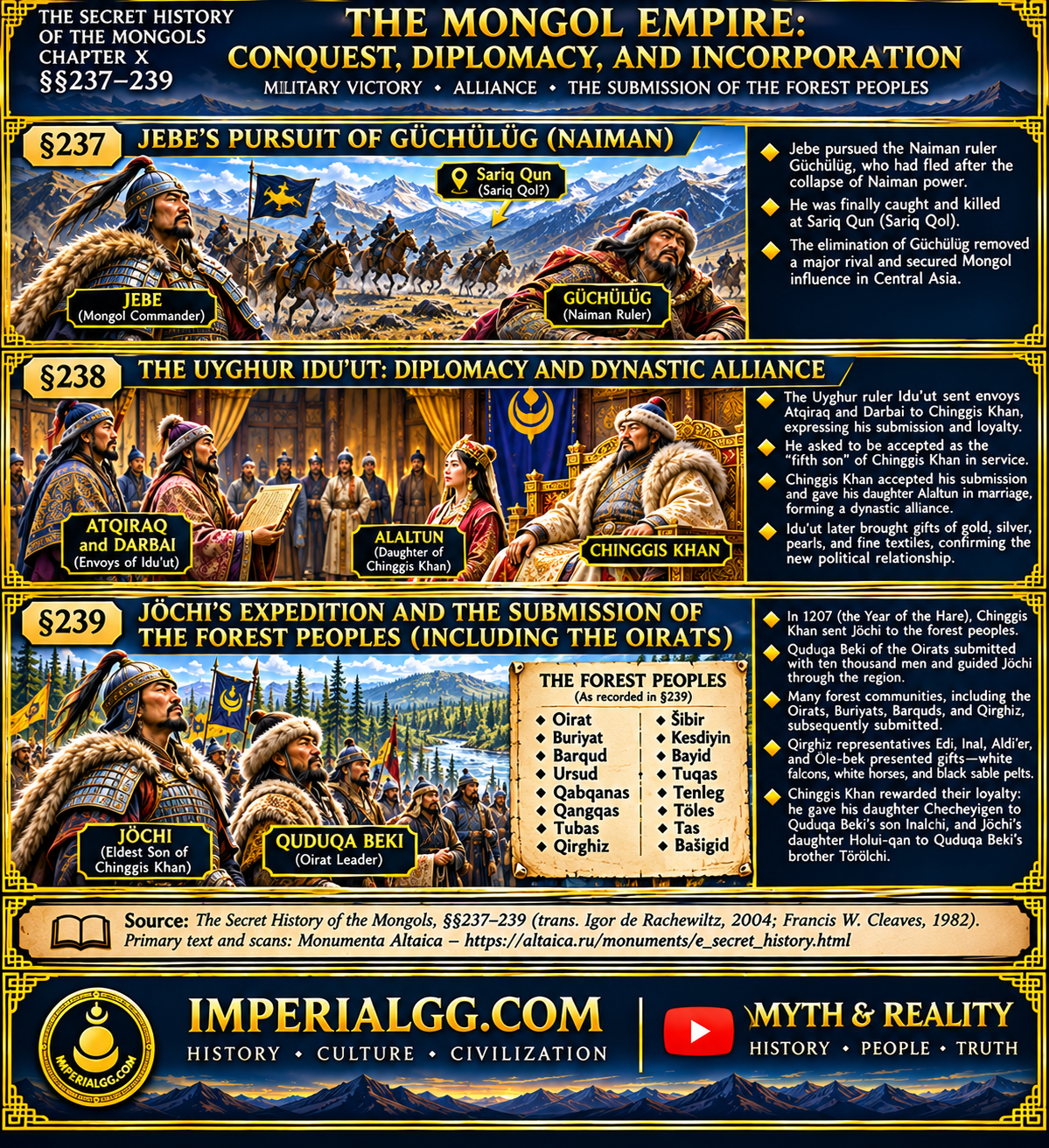
A Historical and Source-Critical Study of The Secret History of the Mongols, §§237–239
INTRODUCTION
The formation of the Mongol Empire cannot be understood solely through the history of military conquest. Its expansion also depended upon negotiated submission, diplomatic communication, political marriage, recognition of local leadership, and the incorporation of communities with different political and economic traditions. These processes are particularly visible in §§237–239 of The Secret History of the Mongols, where three consecutive passages describe the pursuit of the Naiman ruler Güchülüg by Jebe, the submission of the Uyghur Idu’ut through diplomatic envoys, and Jöchi’s expedition among the peoples of the northern forest regions.
Although the passages are brief, they preserve evidence of three different mechanisms of imperial expansion. The defeat of Güchülüg represents the elimination of a competing political authority; the Uyghur Idu’ut’s submission illustrates the incorporation of an established regional ruler through diplomacy and dynastic kinship; and Jöchi’s expedition demonstrates how military mobilization, local guidance, tribute, and negotiated submission could operate together in the incorporation of forest communities.
The principal source for this study is The Secret History of the Mongols, especially §§237–239. Its narrative is compared with the English translations and commentary of Francis Woodman Cleaves and Igor de Rachewiltz. Because the surviving text reflects a Mongol courtly perspective and was transmitted through a complex textual history, its statements must be distinguished from independently established historical facts.
Primary textual resources: Monumenta Altaica — The Secret History of the Mongols · Early printed edition of the Chinese-character text (PDF) · Igor de Rachewiltz — Translation and Commentary (2004, PDF).
I. §237 — JEBE, GÜCHÜLÜG, AND THE ELIMINATION OF A RIVAL POLITICAL AUTHORITY
Section 237 records the pursuit of Güchülüg, the Naiman ruler who had escaped the destruction of the Naiman political order and subsequently established himself within the political world of Central Asia. The passage associates his final defeat with Jebe, one of Chinggis Khan’s leading military commanders, and identifies a place rendered in modern transcription as Sariq Qun. The geographical identification of this place requires caution, since manuscript readings and modern reconstructions do not necessarily coincide.
The historical significance of this passage extends beyond the pursuit of a fugitive ruler. Güchülüg’s survival had represented the continued existence of an alternative center of authority with connections to the former Naiman ruling elite. His defeat therefore contributed to the removal of a rival political claimant from the wider region of Mongol expansion. Yet the narrative should not be interpreted as evidence that every territory previously associated with Güchülüg was immediately incorporated into a uniform imperial administrative structure. Military victory, political submission, and effective administration were related but distinct processes.
An important chronological qualification is necessary. The pursuit and death of Güchülüg are generally associated with Jebe’s campaign of 1218, whereas the surrounding passages of The Secret History discuss events belonging to different years. The sequence of paragraphs is consequently not a strictly chronological campaign register. It is a literary and political arrangement of episodes that collectively illustrate the extension of Chinggis Khan’s authority.
For the original narrative and its scholarly interpretation, see The Secret History, §237, in de Rachewiltz (2004), translation and commentary and the parallel textual resources at Monumenta Altaica.
II. §238 — THE UYGHUR IDU’UT: DIPLOMACY, SUBMISSION, AND DYNASTIC KINSHIP
The following passage offers a striking contrast to the military episode of §237. Rather than describing the defeat of an enemy ruler in battle, §238 recounts the initiative of the Uyghur Idu’ut, who sought to establish a relationship with Chinggis Khan through diplomatic communication. His envoys, whose names are conventionally transcribed as Atqiraq and Darbai, carried a message expressing the ruler’s desire to enter the Mongol sovereign’s service.
The message employs elaborate imagery involving sunlight, clouds, melting ice, and flowing water. These images should not be treated as a verbatim record of an ordinary diplomatic conversation. They belong to the literary presentation of the embassy within The Secret History. Nevertheless, the underlying political declaration is clear: the Idu’ut sought recognition within the emerging imperial hierarchy and offered service and loyalty in return.
Particularly significant is the Idu’ut’s request to be accepted as a fifth son of Chinggis Khan. Such language cannot be reduced to a simple statement of personal affection. Within the political culture represented by the narrative, fictive kinship could express hierarchy, obligation, protection, and belonging. The proposed relationship was unequal in political authority, yet it offered a means by which a previously independent ruler could retain a recognized position under Mongol supremacy.
Chinggis Khan’s favorable response included the acceptance of the Idu’ut into this symbolic familial relationship and the promise of a marriage alliance involving his daughter Alaltun. The Idu’ut subsequently appeared with valuable gifts, including precious metals, pearls, and textiles. These exchanges demonstrate the ceremonial dimension of political incorporation: submission was publicly expressed, accepted by the superior ruler, and reinforced through the language of kinship and material gifts.
MARRIAGE, TRUST, AND THE CONTINUING SIGNIFICANCE OF HUMAN RELATIONSHIPS
The marriage arrangement is among the most revealing elements of §238. In the political circumstances of the thirteenth century, dynastic marriage could create durable obligations between ruling families and provide a socially intelligible form for a new relationship of authority. A marriage promise was therefore not merely an addition to a diplomatic agreement; it could form part of the agreement’s institutional foundation.
The episode also invites a broader reflection on the importance of trust, reciprocity, and commitment in human relationships. These remain significant in modern societies, although the legal, ethical, and personal meanings of marriage have changed profoundly since the thirteenth century. It would be historically misleading to present medieval dynastic marriage as equivalent to contemporary marriage based on individual choice. The appropriate comparison lies instead in the continuing human need for relationships grounded in recognized obligations and mutual expectations.
The distinction matters because the source presents the marriage from the perspective of sovereign authority. It tells us what Chinggis Khan promised and how the Idu’ut’s submission was recognized, but it does not provide an independent account of Alaltun’s personal wishes or experience. A source-critical interpretation must acknowledge that silence rather than attribute sentiments to her that the text does not record.
Source: The Secret History of the Mongols, §238. Compare de Rachewiltz (2004) with the source-text repository. The names, diplomatic imagery, and marriage arrangement should be checked against the selected transliteration before presenting any passage as a direct quotation.
III. §239 — JÖCHI’S 1207 EXPEDITION AND THE SUBMISSION OF THE FOREST PEOPLES
Section 239 provides one of the most important early accounts of Mongol imperial expansion into the northern forest regions. In the Year of the Hare, corresponding to 1207, Chinggis Khan entrusted his eldest son Jöchi with an expedition against the peoples described collectively as the Forest Peoples. This designation was not the name of a single nation or political organization. Rather, it referred to multiple communities inhabiting forest, mountain, riverine, and northern frontier environments whose economic practices, political leadership, and relationships with the steppe differed from one another.
The expedition is significant because it reveals that the extension of Mongol authority into these regions did not proceed exclusively through direct combat. The narrative gives particular prominence to Quduqa Beki (Худага бэхи), the Oirat leader, who submitted ahead of other groups and assisted Jöchi in navigating the region. His actions illustrate the importance of local knowledge and regional leadership in the expansion of imperial power. Military mobility alone did not guarantee effective access to unfamiliar territories; commanders also depended upon guides, alliances, intelligence, and cooperation from individuals already familiar with the political geography of the forest regions.
The passage identifies Buqa as a guide associated with the expedition. Quduqa Beki subsequently came forward with the Oirat and offered his submission. He then assisted Jöchi in reaching the territory of the forest communities. This sequence deserves attention because it demonstrates that submission could change the role of a local ruler from potential adversary to intermediary. Quduqa Beki did not merely acknowledge Chinggis Khan’s authority; according to the narrative, he actively facilitated the extension of that authority to neighboring populations.
THE PEOPLES NAMED IN THE SOURCE
The names preserved in §239 are indispensable historical evidence. They should not be replaced by the generalized expression “northern tribes,” since doing so would erase distinctions retained in the original narrative. Depending on the transcription and translation employed, the passage identifies the Oirat, Buriyat, Barqud, Ursud, Qabqanas, Qangqas, Tubas, and Qirghiz, followed by additional names associated with the wider forest region, including Šibir, Kesdiyin, Bayid, Tuqas, Tenleg, Töles, Tas, and Bašigid.
These names require individual philological examination. Their appearance in a medieval text does not automatically establish an uninterrupted ethnic identity with modern populations bearing similar names. Some names may refer to tribal confederations, territorial communities, political groups, or populations whose composition changed considerably over time. Their historical importance lies first in the fact that the narrative identifies them as distinct communities encountered or incorporated during the northern expansion.
The Qirghiz occupy a particularly important position in this account. The source records named representatives of their leadership, conventionally rendered as Edi, Inal, Aldi’er, and Öle-bek. Their appearance should be interpreted as evidence of political representation within the narrative, rather than as proof that all Qirghiz communities were governed by a single centralized authority. The envoys brought valuable gifts, including white falcons, white horses, and black sable pelts. These objects were not incidental details: in the context of steppe diplomacy, their presentation communicated submission, respect, political recognition, and the establishment of obligations between the parties.
The gifts also reveal something about the economic geography of the northern regions. Falcons, horses, and furs belonged to different but interconnected spheres of prestige, exchange, and elite consumption. The appearance of sable pelts is particularly relevant to the relationship between forest environments and imperial demand for valuable animal products. Nevertheless, the gifts mentioned in §239 should not automatically be interpreted as evidence of a fully developed or standardized taxation system at the moment of submission. They are first and foremost recorded as diplomatic offerings.
QUDUQA BEKI, INALCHI, TÖRÖLCHI, AND THE MARRIAGE ALLIANCES
The account continues beyond the military and diplomatic submission of the forest communities. Chinggis Khan rewarded Quduqa Beki’s cooperation through marriage alliances involving members of the ruling family. The narrative associates Quduqa Beki’s son Inalchi with Chinggis Khan’s daughter Checheyigen and also records a marriage arrangement involving Törölchi and Jöchi’s daughter Holui-qan.
These relationships are historically important because they demonstrate that the integration of regional elites could be reinforced through dynastic kinship. A local leader who submitted and assisted the Mongol expansion might gain not only recognition but also a new position within a network of relationships extending to the imperial family. Such marriages had implications for prestige, political obligation, succession, and the position of descendants.
The episode should be compared directly with the submission of the Uyghur Idu’ut in §238. In both passages, the Mongol ruler is represented as accepting submission and reinforcing the resulting political relationship through marriage. The two cases differ in their geographical and political circumstances, but their proximity within The Secret History allows us to identify a recurring principle: imperial incorporation could be expressed through the transformation of political outsiders into recognized participants in a hierarchy of kinship and allegiance.
The narrative does not, however, permit us to assume that every community accepted Mongol authority voluntarily or on identical terms. The presence of an army remained an important element of the political situation. Submission, military pressure, local negotiation, and dynastic alliance were not mutually exclusive. They could operate simultaneously.
Primary evidence for §239: de Rachewiltz, The Secret History of the Mongols, shorter version, Chapter X (PDF) · Cleaves, The Secret History of the Mongols (1982), digitized edition. The complete names and transliterations should be compared across these editions rather than silently standardized.
Archive.org+1
IV. FROM MILITARY SUBMISSION TO IMPERIAL INTEGRATION: A COMPARATIVE ANALYSIS
Taken together, §§237–239 illustrate three mechanisms by which Chinggis Khan’s expanding political order confronted and incorporated external powers. The defeat of Güchülüg removed a rival ruler by military force; the Uyghur Idu’ut sought inclusion through diplomatic initiative and symbolic kinship; and the forest expedition combined armed mobilization with the cooperation of regional leaders, formal submission, diplomatic gifts, and marriage alliances.
These episodes complicate any interpretation of the Mongol Empire as an institution created through military destruction alone. The capacity to defeat opponents was indispensable to its expansion, but the establishment of lasting political authority also required methods for recognizing, incorporating, and managing populations after the initial confrontation. The use of marriage alliances is especially notable because it appears in consecutive passages dealing with distinct regions and different political communities.
At the same time, these accounts should not be romanticized as evidence of an entirely consensual political order. The Secret History was composed within a tradition closely associated with Mongol imperial authority, and its portrayal of submission frequently emphasizes the legitimacy and prestige of Chinggis Khan. It preserves valuable information about political negotiations while providing much less evidence about the experiences of ordinary people, the autonomy of women involved in dynastic marriages, or the long-term consequences of incorporation for individual communities.
A rigorous interpretation must therefore preserve both dimensions of the evidence: the extraordinary organizational flexibility of Mongol imperial expansion and the unequal relationships of power within which that expansion occurred.
V. AUTHOR’S THESIS — THE POLITICAL INTEGRATION OF DIVERSE PEOPLES THROUGH POWER, RECOGNITION, AND KINSHIP
The central thesis of this article is that §§237–239 preserve a compact but historically significant representation of Mongol imperial state formation. Their importance lies not simply in the individual campaigns and submissions they describe, but in the relationship between military authority, diplomatic recognition, local cooperation, and dynastic kinship.
Jebe’s campaign demonstrates the removal of competing sovereignty through force. The Uyghur Idu’ut’s embassy demonstrates the political value of voluntary diplomatic initiative under conditions of expanding Mongol supremacy. Jöchi’s northern expedition demonstrates how regional leaders such as Quduqa Beki could become indispensable intermediaries in the incorporation of territories and populations beyond the immediate experience of the steppe-centered imperial leadership.
The repeated use of marriage alliances suggests that political incorporation was not understood solely as territorial possession. It could also involve the creation of recognized personal and familial obligations between ruling houses. In the language of the narrative, a political relationship could be expressed as a relationship between father and son, while marriage provided another means of connecting formerly separate elites.
The enduring relevance of these passages is therefore not that medieval political marriage should serve as a model for contemporary personal relationships. Rather, they demonstrate a broader historical principle: the stability of relationships between individuals, communities, and political institutions depends not only upon power, but also upon recognition, obligations, communication, and the credibility of commitments.
This interpretation is offered as the author’s analytical thesis, not as a direct statement made by the anonymous compiler of The Secret History. Further comparison with Persian, Chinese, and Uyghur sources is necessary to determine how these relationships were understood outside the Mongol courtly narrative.
CONCLUSION
Sections 237–239 of The Secret History of the Mongols illuminate three interrelated dimensions of the early Mongol Empire: the military elimination of political rivals, the diplomatic submission of established regional rulers, and the incorporation of northern forest communities through a combination of military authority, local mediation, and kinship alliances.
The accounts of Jebe, Güchülüg, the Uyghur Idu’ut, Jöchi, Quduqa Beki, and the named leaders of the forest communities should therefore be studied as connected evidence of imperial expansion, while preserving their individual historical contexts and chronological distinctions. The names of peoples, rulers, envoys, and marriage partners are not incidental ornaments of the narrative. They constitute essential evidence for reconstructing the political relationships through which the Mongol Empire emerged.
The larger historical lesson is that imperial expansion involved more than conquest. It also required mechanisms by which defeated, allied, or submitting communities could be incorporated into a new order. The surviving narrative offers an important Mongol perspective on that process, but its claims must continue to be tested against the broader documentary record.
HISTORICAL SOURCE MATERIALS AND ILLUSTRATION REFERENCES
FIGURE 1 — THE SECRET HISTORY: CHINESE-CHARACTER TEXTUAL TRADITION
Source material for checking the original transcription, names, and paragraph divisions.
FIGURE 2 — CENTRAL ASIA AND THE MONGOL EXPANSION
Historical geographical context for Jebe’s pursuit of Güchülüg. De Rachewiltz’s shorter edition includes maps of Mongolia around 1200 and Eurasia around 1210, on printed pages 270–271.
FIGURE 3 — THE UYGHUR KINGDOM OF QOCHO
The archaeological landscape associated with the Uyghur political world. This is contextual imagery, not a contemporary depiction of the Idu’ut’s embassy.
UNESCO — Silk Roads: Chang’an–Tianshan Corridor, including Qocho
Editorial note: These are illustrative visual references, not authenticated photographs of specific events in §§237–239. Before publication, the exact image file, photographer or collection, date, and reuse permission must be recorded for each selected illustration.
REFERENCES
de Rachewiltz, Igor. The Secret History of the Mongols: A Mongolian Epic Chronicle of the Thirteenth Century. Leiden: Brill, 2004. Bibliographic and digitized edition record.
de Rachewiltz, Igor, translated; John C. Street, edited. The Secret History of the Mongols, shorter version, 2015. Open-access PDF.
Cleaves, Francis Woodman, translated. The Secret History of the Mongols. Cambridge, Massachusetts: Harvard University Press, 1982. Internet Archive digitized edition.
Yuan Chao Bi Shi — Chinese-character textual tradition of The Secret History. Historical text scan.
Monumenta Altaica, digital research resources for The Secret History of the Mongols. Open textual repository.
ImperialGG.com | MYTH & REALITYHistorical Research • Primary Sources • Mongolian Civilization