
THE KHISHIGTEN (ХИШИГТЭН)
By Altanbagana Baatar
DBA Candidate| Independent Historian
ImperialGG Historical Research Seriers
03 November 2026
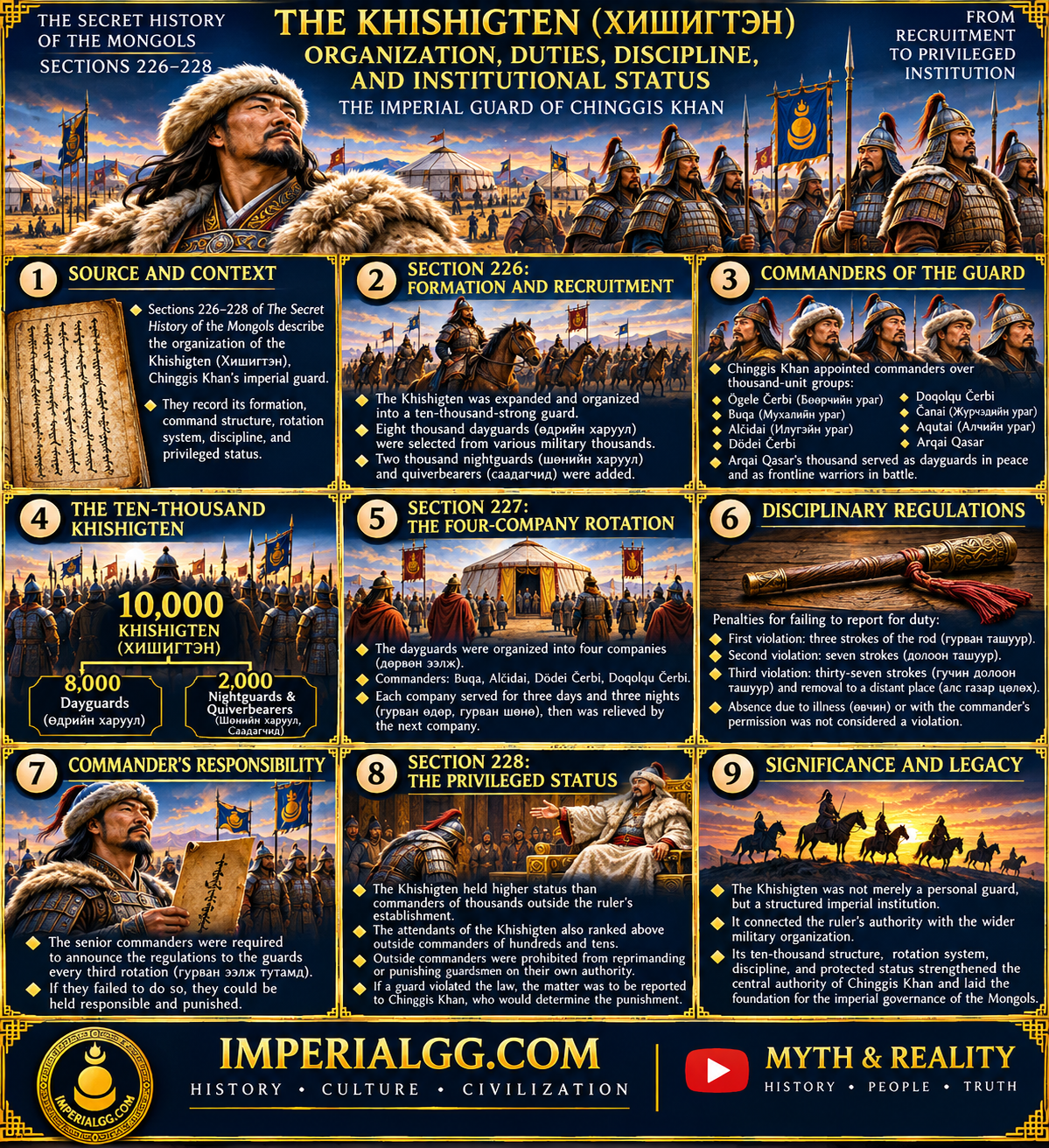
THE ORGANIZATION OF THE IMPERIAL GUARD, ITS DUTIES, DISCIPLINE, AND STATUS
ABSTRACT
Sections 226–228 of The Secret History of the Mongols provide essential evidence for understanding the institutional organization of the Khishigten (Хишигтэн), the imperial guard established under Chinggis Khan. These passages describe the formation of an expanded guard force, the appointment of commanders, the organization of rotating shifts, disciplinary regulations, and the special status granted to guardsmen within the Mongol political and military hierarchy.
Section 226 records the formation of a ten-thousand-strong guard establishment, comprising eight thousand dayguards and two thousand nightguards and quiverbearers. Section 227 establishes the four-company rotation system and defines the obligations and penalties associated with guard duty. Section 228 protects the institutional status of the Khishigten by defining their rank in relation to military commanders outside the ruler’s immediate establishment.
Together, these provisions demonstrate that the Khishigten was not merely a personal protective force. It was a structured institution that connected military recruitment, command, discipline, and political authority at the center of the Mongol state.
Keywords: Khishigten; Chinggis Khan; Mongol Empire; imperial guard; military organization; recruitment; military discipline; command hierarchy; The Secret History of the Mongols.
1. INTRODUCTION
The consolidation of Chinggis Khan’s authority required the creation of institutions capable of maintaining order and protecting the central political establishment. Among these, the Khishigten occupied a particularly important position.
The Khishigten was not simply a group of armed men assigned to protect the ruler. Its organization involved the recruitment of personnel from different military units, the appointment of commanders, the division of guards into functional groups, and the establishment of regulations governing service and discipline.
Sections 226–228 of The Secret History of the Mongols provide a concentrated account of these arrangements. They reveal how the guard was expanded into a ten-thousand-strong institution, how its members performed duty through a rotating system, and how their special position was protected by the authority of Chinggis Khan.
This article examines the three sections as connected stages in the institutional development of the Khishigten: organizational formation, regulation of service, and recognition of institutional status.
2. SECTION 226: THE FORMATION OF THE TEN-THOUSAND KHISHIGTEN
Section 226 records Chinggis Khan’s order to expand the dayguards and appoint commanders over their respective units.
Ögele Čerbi, who had previously enrolled dayguards and belonged to the family of Bo’orču, was placed in command of a thousand. Further thousand-unit commands were assigned to the following individuals:
Ögele Čerbi, from the family of Bo’orču;
Buqa, from the family of Muqali;
Alčidai, from the family of Ilügei;
Dödei Čerbi;
Doqolqu Čerbi;
Čanai, from the family of Jürčedei;
Aqutai, from the family of Alči;
Arqai Qasar.
Arqai Qasar received a particularly distinctive responsibility. His thousand was composed of selected brave warriors. During periods of peace, they were to serve as dayguards; during battle, they were to stand before Chinggis Khan and fight as warriors.
This instruction demonstrates that the dayguards were not necessarily restricted to ceremonial or protective functions. At least one designated unit was expected to perform a direct military role in battle.
The chronicle then provides the overall numerical structure:
Eight thousand dayguards were selected from the various military thousands.
Two thousand nightguards and quiverbearers formed the other component.
Ten thousand guards constituted the complete establishment.
Chinggis Khan ordered that these ten thousand guards serving close to him should be strengthened and become the main body of the army.
This final instruction is especially significant. It connects the ruler’s personal guard with the wider military organization of the Mongol state. The Khishigten was therefore not an isolated household force but an institution whose organization had direct implications for the central military structure.
The eight commanders named in this section also illustrate how the guard was integrated into the existing network of military leadership and prominent families.
3. SECTION 227: THE FOUR-COMPANY ROTATION SYSTEM
Section 227 describes the organization of the dayguards into four companies and establishes the commanders responsible for their rotation.
Chinggis Khan appointed four senior commanders:
Buqa;
Alčidai;
Dödei Čerbi;
Doqolqu Čerbi.
Each commander was responsible for assembling and arranging the guards assigned to his company before personally taking his turn of duty.
The rotation followed a specific schedule: each company served for three days and three nights before being relieved by the next company.
This arrangement established continuity in the protection of the ruler while distributing the responsibilities of service among the four companies.
The section also defines a progressive disciplinary system for guardsmen who failed to report for their assigned duty.
The penalties were as follows:
First violation: three strokes of the rod.
Second violation: seven strokes of the rod.
Third violation: thirty-seven strokes of the rod, followed by removal to a distant place.
The third penalty applied when a guardsman repeatedly failed to perform his duty without being physically ill and without first consulting the commanders of his company.
The distinction between legitimate illness and unauthorized absence is important. The regulations did not treat every failure to appear as identical; they recognized that physical condition and communication with the appropriate commander mattered.
The commanders also had an obligation to communicate the regulations. The senior officers of the companies were required to proclaim the order to the guards every third rotation. Failure to announce the order could itself result in punishment.
This provision demonstrates that responsibility for discipline was shared between ordinary guardsmen and their commanders. The latter were not merely supervisors; they were accountable for ensuring that the rules were properly communicated and implemented.
The rotation system therefore combined three essential elements: scheduled service, hierarchical command, and enforceable discipline.
4. SECTION 228: THE PRIVILEGED STATUS OF THE KHISHIGTEN
Section 228 addresses the position of the Khishigten within the wider military hierarchy.
Chinggis Khan declared that his guards held higher standing than military commanders of thousands serving outside his immediate establishment. The attendants of his guards were likewise assigned higher standing than outside commanders of hundreds and tens. The decree also prohibited outside commanders from using their seniority or numerical command rank as grounds for reprimanding guardsmen who served under the ruler’s direct authority.
If a guard violated the law, the matter was to be reported to Chinggis Khan. The authority to determine punishment remained with the ruler. The passage further warned that commanders who took disciplinary action against guardsmen without the ruler’s permission could themselves face punishment. This regulation establishes an important distinction between military command and institutional status.
A commander of a thousand exercised authority over a substantial military unit. However, a member of the Khishigten possessed a special rank because of his direct service within the ruler’s establishment. The decree therefore made the Khishigten’s position independent of the ordinary numerical hierarchy of military units.
It also protected the guardsmen against unauthorized interference by outside commanders. Their discipline was to be handled through the authority and procedures established by Chinggis Khan. This was not simply a privilege granted to individuals. It was a formal recognition of the institutional position of the Khishigten.
5. THREE FOUNDATIONS OF THE KHISHIGTEN INSTITUTION
The three sections reveal three connected foundations of the Khishigten.
5.1. Organizational structure
Section 226 establishes the ten-thousand-strong guard and identifies the commanders responsible for its different units.
The organization included distinct categories of service rather than a single undifferentiated body. The eight thousand dayguards and the two thousand nightguards and quiverbearers together constituted the ten-thousand establishment.
5.2. Operational discipline
Section 227 demonstrates that service was governed by a defined rotation, assigned command responsibilities, and progressive penalties.
The three-day-and-night rotation ensured the regular replacement of guard companies. The disciplinary provisions established accountability for both guardsmen and their commanders.
5.3. Institutional status
Section 228 defines the special standing of the Khishigten in relation to military commanders outside the ruler’s immediate establishment. Its members and attendants were protected by the ruler’s decree, and disciplinary authority over them could not be exercised arbitrarily by outside commanders.
These three foundations—organization, discipline, and status—demonstrate the institutional character of the Khishigten.
6. HISTORICAL SIGNIFICANCE: THE KHISHIGTEN AND THE CONSOLIDATION OF IMPERIAL AUTHORITY
The Khishigten represented a significant connection between the ruler and the wider military structure. Its recruitment drew personnel from different military units. Its commanders were selected from prominent military families and established leadership networks. Its operational responsibilities were regulated through rotating shifts and disciplinary rules.
At the same time, its special rank distinguished it from ordinary military units.
This arrangement strengthened the ruler’s direct relationship with the military establishment. The Khishigten served as a central institution through which Chinggis Khan could maintain personal security, organize military service, and establish a distinct hierarchy of authority.
The instruction that the ten thousand guards should become the main body of the army is especially important. It demonstrates that the institution was conceived within the larger framework of military organization rather than as a force entirely separate from it.
Nevertheless, the chronicle should not be interpreted as evidence that all ten thousand guards performed identical duties or that every member was deployed in battle. The text explicitly distinguishes the functions of different groups and identifies Arqai Qasar’s selected warriors as a unit with a particularly clear dual role.
The Khishigten must therefore be understood through its internal differentiation and its relationship with the wider military system.
7. SOURCE-CRITICAL CONSIDERATIONS
Several distinctions are necessary when interpreting these passages.
First, the numerical structure must be preserved accurately. Section 226 identifies eight thousand dayguards and two thousand nightguards and quiverbearers, making a total of ten thousand guards. These categories should not be confused with one another.
Second, the four-company rotation described in §227 concerns the dayguards. It should not automatically be assumed that every category of the Khishigten followed an identical rotation schedule.
Third, the disciplinary regulations are presented as orders issued by Chinggis Khan. They establish the prescribed rules of service, but the chronicle does not provide a separate record of how consistently every penalty was applied in practice.
Fourth, the elevated status described in §228 concerns the institutional rank of guardsmen and their attendants in relation to outside commanders. It should not be interpreted as proof that guardsmen automatically possessed greater authority in every military or administrative matter.
Finally, the term Khishigten is retained in its Mongolian form in this article. English expressions such as “imperial guard” are used only as explanatory equivalents, not as replacements for the historical Mongolian institution.
8. CONCLUSION
Sections 226–228 of The Secret History of the Mongols provide detailed evidence for the organization and institutional status of the Khishigten under Chinggis Khan.
Section 226 establishes the ten-thousand-strong guard and identifies the commanders of its principal units. Section 227 defines the four-company rotation system and introduces a progressive disciplinary framework. Section 228 protects the special rank of guardsmen and their attendants by restricting unauthorized intervention from outside military commanders.
Together, these provisions demonstrate that the Khishigten was an organized institution built upon recruitment, command, discipline, and a privileged relationship with the ruler.
Its historical significance lies not merely in protecting Chinggis Khan personally, but in connecting the central authority of the ruler with the military and administrative structure of the expanding Mongol state.
AUTHOR’S THESIS
The Khishigten was one of the essential institutions through which Chinggis Khan transformed personal authority into an organized system of imperial governance. Its ten-thousand-strong structure, differentiated service categories, four-company rotation, disciplinary regulations, and protected institutional status demonstrate that the Khishigten was not merely a personal bodyguard force. It was a central component of the political and military organization of the Mongol state.
PRIMARY SOURCE
The Secret History of the Mongols, §§226–228.
REFERENCES
de Rachewiltz, Igor, trans. 2004–2013. The Secret History of the Mongols: A Mongolian Epic Chronicle of the Thirteenth Century. 3 vols. Leiden: Brill.
de Rachewiltz, Igor, trans. 2015. The Secret History of the Mongols: A Mongolian Epic Chronicle of the Thirteenth Century. Shorter version edited by John C. Street. Western Washington University.
Onon, Urgunge, trans. 2001. The Secret History of the Mongols: The Life and Times of Chinggis Khan. Richmond: Curzon.
Kozin, S. A., trans. Сокровенное сказание. Russian translation.