
THREE FORMS OF SERVICE IN THE SECRET HISTORY OF THE MONGOLS
By Altanbagana Baatar
DBA Candidate| Independent Historian
ImperialGG Historical Research Seriers
29 October 2026
QUNAN, JELME, AND TOLUN
Abstract
Section 210 of The Secret History of the Mongols identifies four men—Qunan, Kökö Čos, Degei, and Old Üsün—whose defining quality was their refusal to conceal what they had seen or heard from Chinggis Khan. Although the passage also recognizes Qunan’s service and appoints him to command the Geniges under Jochi, its broader significance lies in the explicit recognition of truthful reporting as a foundation of political trust. This article examines the four men not merely as loyal followers, but as representatives of a principle essential to the operation of the early Mongol polity: the ruler needed people who would communicate information faithfully, even when circumstances were difficult. By examining the passage’s imagery, its instructions concerning consultation, and its appointment of Qunan, the article argues that §210 connects personal loyalty with the practical requirements of governance. At the same time, it distinguishes the chronicle’s stated claims from broader interpretations about Mongol political institutions.
Keywords: The Secret History of the Mongols; Chinggis Khan; Qunan; Kökö Čos; Degei; Old Üsün; truthful counsel; political trust; Mongol governance.
1. Introduction
The consolidation of Chinggis Khan’s authority depended on more than military victories and the personal allegiance of his followers. It also required reliable information, sound counsel, and confidence that those close to the ruler would not distort what they observed. Section 210 of The Secret History of the Mongols offers an unusually direct statement of this principle by identifying four individuals who did not conceal from Chinggis Khan what they had seen or heard.
The four men are Qunan of the Geniges, Kökö Čos, Degei, and Old Üsün. The chronicle’s wording is significant because it distinguishes their shared quality from the individual military or administrative achievements for which particular followers were rewarded. Rather than praising these four exclusively for battlefield courage, it emphasizes their reliability as sources of information.
This article argues that §210 presents truthful reporting as a practical foundation of political trust. The passage does not provide a formal theory of government or establish that the Mongol Empire possessed a modern system of accountability. It does, however, show that the chronicle regarded the faithful communication of information as sufficiently important to be explicitly recognized by the ruler and associated with the appointment of trusted individuals to positions of authority.
2. The Four Men and the Principle of Truthful Reporting
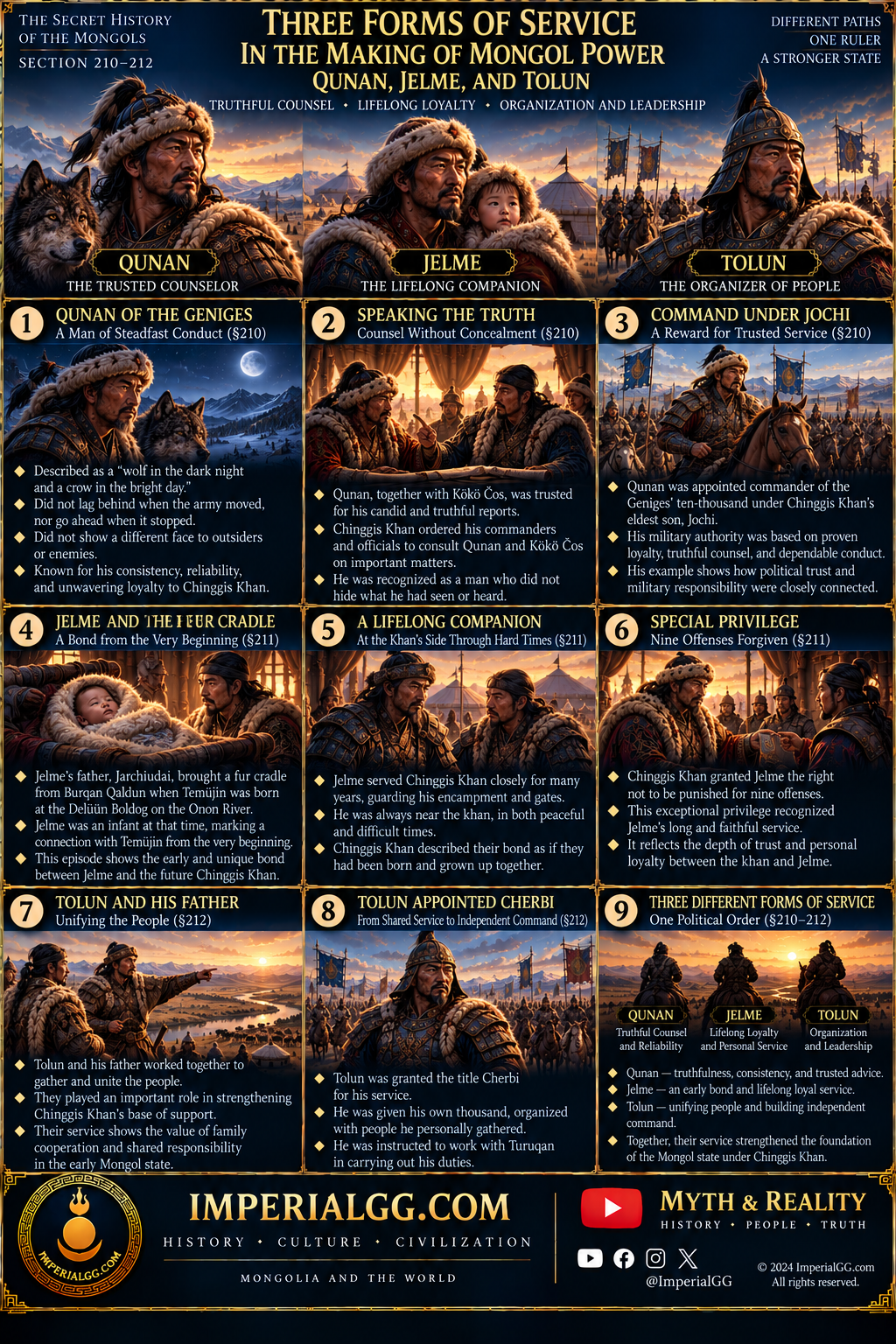
In §210, Chinggis Khan addresses Qunan, a leader of the Geniges, before the narrative identifies the four men who shared the quality of not concealing information from him.
The passage’s concluding statement names Qunan, Kökö Čos, Degei, and Old Üsün as four individuals who never hid what they had seen or concealed what they had heard. This is the central statement around which the section should be interpreted.
The distinction between seeing and hearing matters. Seeing refers to what a person directly observes; hearing may include information received from other people. By referring to both, the chronicle presents the four men as reliable in communicating information acquired through different channels. It does not, however, explain how they verified reports or distinguish systematically between eyewitness testimony and secondhand information. Those procedures should not be attributed to the text without further evidence.
The emphasis falls on concealment. The chronicle does not simply say that the four men were brave, obedient, or personally devoted to Chinggis Khan. It identifies a specific form of conduct: they did not withhold information from the ruler.
This quality has political significance. A ruler who receives incomplete or deliberately altered information may misunderstand the actions of his followers, misjudge a threat, or make decisions on a false premise. Although §210 does not spell out these consequences, its explicit praise of truthful reporting suggests that the chronicle considered this conduct important to the functioning of Chinggis Khan’s authority.
The four men’s shared distinction therefore concerns more than personal virtue. It concerns their usefulness in a political environment where the ruler’s decisions depended, in part, on information supplied by trusted people.
3. Qunan: Personal Reliability and Military Authority
Although the passage identifies four men, Qunan occupies a particularly prominent position in its narrative. Chinggis Khan praises him before Bo’orču, Muqali, other commanders, and the cherbi, the officials associated with the ruler’s household and service.
Qunan is described through the imagery of a wolf in the dark night and a crow in the bright day. The chronicle then characterizes his conduct through a balanced pair of statements: when the ruler and his followers were moving, Qunan did not stop; when they halted, he did not move ahead.
These images emphasize consistency and coordination. Qunan neither abandoned the group during movement nor acted independently of it during a halt. The passage’s meaning is not limited to physical endurance. In context, the imagery contributes to a broader portrayal of a man whose conduct remained dependable under changing circumstances.
The chronicle further states that Qunan did not put on a different face before outsiders or enemies. The precise nuance of this metaphor requires care: translations differ in their wording, and the expression should not be treated as an unambiguous technical term. In the context of the passage, however, it reinforces the portrait of a person whose outward conduct did not change opportunistically according to his audience.
Chinggis Khan then instructs his commanders and officials not to act without consulting Qunan and Kökö Čos. This instruction gives the passage an institutional dimension. The two men are not merely praised for their character; their judgment is explicitly incorporated into the ruler’s decision-making arrangements.
Finally, Chinggis Khan orders that his eldest son, Jochi, should have Qunan as the commander of the Geniges’ ten-thousand-unit. The appointment places Qunan within the hierarchy of the ruling family’s military organization.
The sequence is important. The narrative moves from recognition of Qunan’s personal conduct to an instruction about consultation and then to a formal command appointment. It thereby connects demonstrated reliability with political responsibility.
4. Kökö Čos, Degei, and Old Üsün: Trust Beyond a Single Commander
The final statement of §210 prevents the passage from being read solely as a biography of Qunan. Kökö Čos, Degei, and Old Üsün are named alongside him as members of a group distinguished by the same principle of truthful reporting.
Kökö Čos receives additional attention earlier in the passage because Chinggis Khan specifically directs his commanders to consult with both Qunan and Kökö Čos. This gives Kökö Čos a clear role in the ruler’s deliberative environment. The text does not explain every matter on which the two men were consulted, so the precise scope of their advice remains uncertain.
Degei and Old Üsün appear in the concluding enumeration. Their inclusion establishes that the quality being recognized was not exclusive to Qunan or to the individual whom the khan had just ordered his commanders to consult. Instead, it belonged to a wider group of trusted people.
The passage does not provide equal biographical detail for all four individuals in this section. It would therefore be misleading to invent equivalent careers or claim that all four held identical offices. What unites them in the text is a particular standard of conduct: they did not hide what they had seen or conceal what they had heard from Chinggis Khan.
Their collective recognition is nevertheless significant. It suggests that truthful reporting was not treated as an isolated personal achievement but as a quality that could characterize several individuals within the ruler’s circle.
5. Loyalty, Information, and the Exercise of Authority
Section 210 invites a distinction between two forms of loyalty.
The first is loyalty expressed through action: remaining with the ruler, carrying out commands, and fulfilling assigned duties. Qunan’s imagery of movement and rest illustrates this dimension of dependable service.
The second is loyalty expressed through truthful communication. The four men’s refusal to conceal what they saw or heard demonstrates that loyalty also involved providing the ruler with information rather than merely following instructions.
These forms of loyalty reinforce one another, but they are not identical. A follower may obey a command without offering an honest assessment of a situation. Conversely, a person may communicate information accurately while lacking the authority to carry out the decisions that follow. The chronicle’s recognition of these four men highlights the political value of combining personal dependability with reliable reporting.
The instruction to consult Qunan and Kökö Čos makes this relationship especially clear. Consultation requires more than the existence of advisers: it depends on the ruler’s willingness to hear them and on their willingness to communicate what they know. The passage presents these men as sufficiently trusted for their participation to be explicitly required.
This does not mean that §210 describes a modern civil service, an independent advisory council, or an institutional guarantee of free speech. Such conclusions would exceed the evidence. The text portrays a personal and hierarchical political order in which access to the ruler, recognized service, and the ruler’s confidence were closely connected.
Nevertheless, the principle remains historically important. The chronicle explicitly links the ruler’s trust to the conduct of people who communicate information faithfully. Truthful reporting appears not merely as a private moral quality but as a practical requirement of governance.
6. Source Criticism: What the Chronicle Says and What It Does Not
A careful interpretation must distinguish the passage’s direct statements from modern analytical conclusions.
First, the text explicitly names Qunan, Kökö Čos, Degei, and Old Üsün as men who did not conceal what they had seen or heard. This is the firmest basis for the article’s argument.
Second, it gives Qunan particular recognition, instructs other officials to consult Qunan and Kökö Čos, and appoints Qunan to command the Geniges under Jochi. These are distinct narrative elements and should not be collapsed into a claim that all four men held the same military rank.
Third, the chronicle does not provide a detailed account of the information these men reported, the circumstances in which they reported it, or the consequences of particular reports. It is therefore not possible from this passage alone to reconstruct specific intelligence operations or establish a formal reporting procedure.
Finally, the text is a historical narrative with a political and literary perspective, not a neutral administrative register. Its praise of Chinggis Khan’s followers reveals the values the narrative chooses to emphasize, but it does not independently establish that every individual consistently behaved according to that ideal.
These limitations do not diminish the passage’s significance. They define it more precisely: §210 preserves a clear statement of the ruler’s appreciation for people who did not conceal relevant information from him.
7. Conclusion
Section 210 of The Secret History of the Mongols identifies Qunan, Kökö Čos, Degei, and Old Üsün as four men distinguished by their refusal to conceal what they had seen or heard from Chinggis Khan. Their recognition provides evidence that truthful reporting was an explicitly valued quality within the political world represented by the chronicle.
Qunan’s story adds another dimension to this principle. His consistent conduct is praised, consultation with him and Kökö Čos is required, and he is appointed to command the Geniges under Jochi. His case connects personal reliability with military responsibility, while the naming of all four men shows that the underlying principle extended beyond a single commander.
The historical importance of the passage lies in this relationship between loyalty and information. The ruler’s need was not simply for followers who would obey, but also for trusted people who would tell him what they had seen and heard. The chronicle does not formulate a modern theory of accountability, yet it clearly preserves the recognition of truthful communication as a foundation of political confidence.
The four men’s shared distinction can therefore be understood as a principle of governance expressed through personal relationships: authority depended, in part, on the ability of the ruler to trust the information reaching him. In this respect, §210 offers a concise but revealing account of how the Mongol political order valued candor, consultation, and dependable service.
References
Cleaves, Francis Woodman, trans. 1982. The Secret History of the Mongols: For the First Time Done into English out of the Original Tongue and Provided with an Exegetical Commentary. Cambridge, MA: Harvard University Press.
de Rachewiltz, Igor, trans. 2004–2013. The Secret History of the Mongols: A Mongolian Epic Chronicle of the Thirteenth Century. 3 vols. Leiden: Brill.
Onon, Urgunge, trans. 2001. The Secret History of the Mongols: The Life and Times of Chinggis Khan. Richmond: Curzon.
Primary source: The Secret History of the Mongols, §210.
Source-critical note: The discussion follows §210 in the translations by de Rachewiltz, Cleaves, and Onon. Personal names and the metaphor concerning the wolf and crow vary in transliteration and interpretation across editions. The article therefore treats the passage’s central statement about truthful reporting as its principal evidence and avoids assigning undocumented activities or identical offices to the four men.