
SÜBEGEDEI’S EXPEDITIONARY DECREE
By Altanbagana Baatar
DBA Candidate| Independent Historian
ImperialGG Historical Research Seriers
24 October 2026
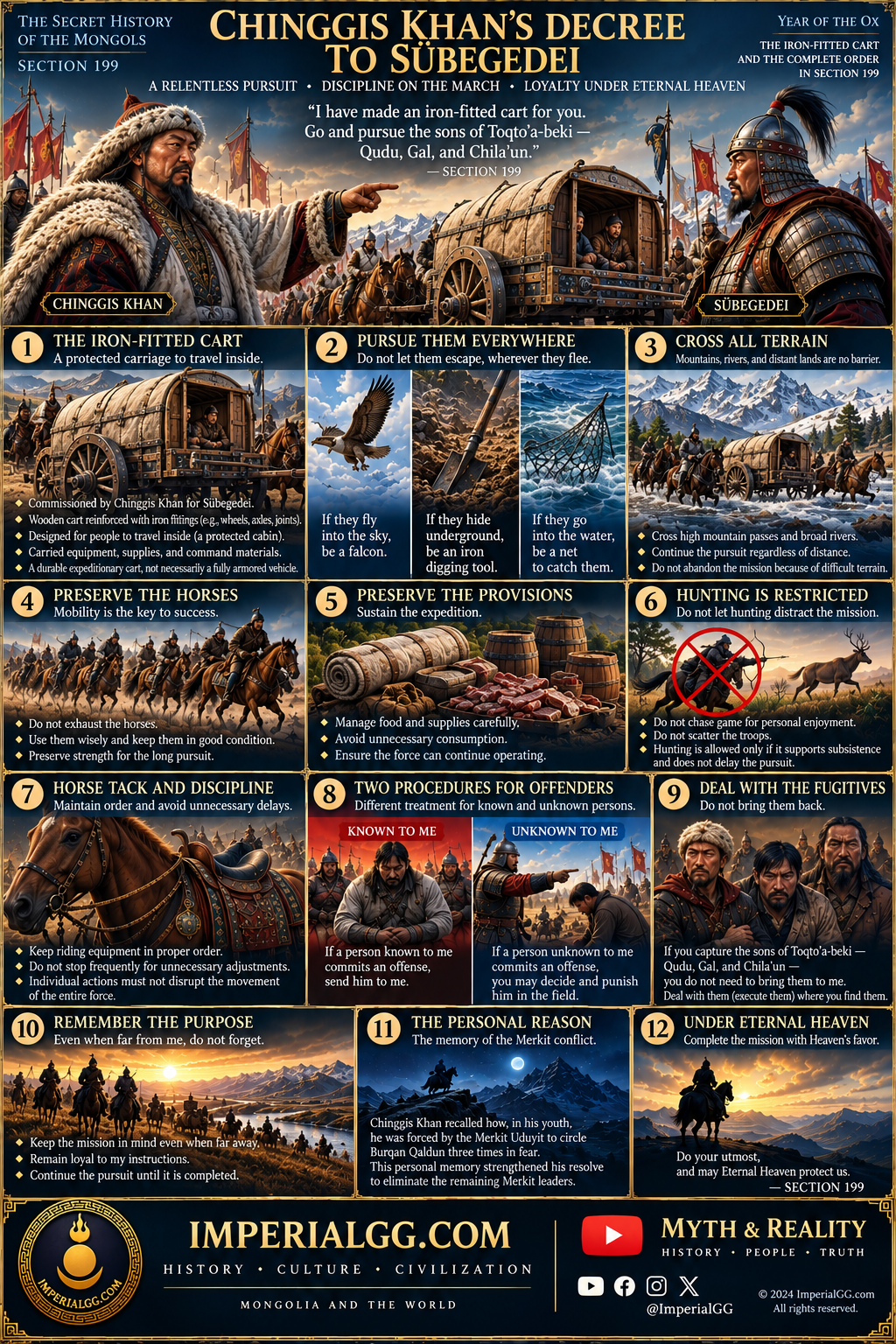
THE IRON-FITTED CART, MILITARY DISCIPLINE, AND CHINGGIS KHAN’S AUTHORITY
ABSTRACT
Section 199 of The Secret History of the Mongols recounts how Chinggis Khan commissioned an iron-fitted cart for Sübe’edei and dispatched him to pursue the sons of Toqto’a-beki. Yet the significance of this passage extends beyond the pursuit of fleeing enemies. The decree addresses the preservation of horses and provisions, the regulation of hunting, the maintenance of military discipline, the punishment of violations, and the distinction between offenders who were to be brought before the khan and those whose cases could be decided in the field. It concludes within a framework of loyalty to the khan and the favor of Eternal Heaven.
This article examines §199 through the perspectives of military history, logistical organization, political authority, and textual criticism. It distinguishes what the chronicle explicitly states from interpretations that require further corroboration, particularly concerning the construction and function of the iron-fitted cart. The analysis argues that the decree presents a coordinated system of expeditionary preparation, resource management, disciplinary enforcement, and delegated decision-making, while also preserving the personal and political motivations underlying Chinggis Khan’s pursuit of the Merkit fugitives.
Keywords: The Secret History of the Mongols; Sübe’edei; Chinggis Khan; iron-fitted cart; military logistics; discipline; delegated authority; Eternal Heaven.
INTRODUCTION: MORE THAN AN ORDER TO PURSUE
Section 199 of The Secret History of the Mongols records that Chinggis Khan commissioned an iron-fitted cart for Sübe’edei and sent him to pursue the sons of Toqto’a-beki, including Qudu, Gal, and Chila’un. The khan then delivered an extended decree outlining how the pursuit was to be conducted.
The decree combines vivid imagery with practical instructions. Sübe’edei is commanded to pursue the fugitives regardless of where they flee, cross high passes and broad rivers, preserve his horses and provisions, avoid becoming distracted by hunting, maintain discipline among his troops, and enforce the khan’s orders. The decree also distinguishes between certain categories of offenders, specifying when individuals were to be brought before the khan and when punishment could be carried out in the field.
Read as a whole, the passage reveals several interconnected dimensions of Mongol expeditionary warfare.
First, it addresses material preparation. The specially commissioned cart and the instructions concerning horses and provisions suggest that the expedition required preparation beyond the issuing of a military objective.
Second, it establishes operational discipline. Hunting, unnecessary delays, and violations of orders are treated as matters that could interfere with the pursuit.
Third, it defines the relationship between central authority and delegated command. Chinggis Khan retains authority over certain cases while granting Sübe’edei the power to resolve others during the expedition.
Finally, the decree connects these practical arrangements to the khan’s personal memories of the Merkit conflict and to the invocation of Eternal Heaven.
These dimensions should not be treated as independent subjects. Together, they illuminate how the chronicle represents the preparation, conduct, and political meaning of a long-distance military pursuit.
I. THE IRON-FITTED CART: PREPARATION FOR A SPECIALIZED EXPEDITION
The opening of §199 contains an unusual detail: Chinggis Khan had an iron-fitted cart made for Sübe’edei before dispatching him on the pursuit. The reference deserves particular attention. It suggests that the khan did not merely assign an objective but also arranged a specific piece of equipment for the expedition. Nevertheless, the precise construction and function of this cart remain questions of interpretation.
Christopher P. Atwood’s 2023 translation and commentary discusses the possibility that the reference concerns a wooden cart reinforced with iron, particularly at the wheels, rather than a vehicle constructed entirely of iron. The terminology has also prompted discussion of whether the cart had a specialized military function.
Three questions must therefore be distinguished.
The first is textual: what exactly does the Mongolian chronicle say about the cart?
The second is technical: what did the term denote in the material and linguistic context of the period?
The third is functional: what purpose did the cart serve during Sübe’edei’s expedition?
The first question rests on the wording of the source. The other two require comparison with historical terminology, parallel accounts, and evidence concerning medieval transport and military equipment.
It would therefore be premature to describe the cart definitively as an armored combat vehicle. Its iron fittings do not, by themselves, establish that it was designed to protect Sübe’edei from enemy attacks. Nor does the passage provide a detailed inventory of its cargo or explain precisely how it was used.
A more cautious interpretation is that the cart represented a form of specialized preparation for a demanding expedition. Its mention raises questions about transport, durability, and the movement of equipment over long distances, although the chronicle does not specify which of these considerations determined its design.
The broader significance lies in the relationship between military objectives and material preparation. A commander tasked with pursuing an enemy over difficult terrain required more than determination. The expedition also depended on equipment, transport, provisions, and the ability to preserve operational capacity over time.
II. PURSUING THE ENEMY IN EVERY DIRECTION
The decree employs striking images to express the requirement that the fugitives be pursued wherever they might escape. If they flew into the sky, Sübe’edei was to become a falcon; if they burrowed underground, an iron digging tool; if they entered the water, a net to catch them.
These images should not be read as literal descriptions of military technology. They are rhetorical expressions of an uncompromising objective: the fugitives were not to escape merely by changing their direction or exploiting a different environment.
The imagery nevertheless carries operational significance. It communicates that the pursuit was not to be abandoned when the fugitives crossed natural boundaries or adopted unfamiliar routes. The commander’s responsibility extended beyond defeating an enemy in a single engagement to continuing the pursuit until its objective had been achieved.
The decree subsequently refers to high mountain passes and broad rivers. These are not merely figurative obstacles. They identify geographical conditions that could complicate the movement of troops, horses, and transport.
The passage thus combines two forms of expression. Its animal and environmental imagery conveys determination, while its references to terrain, provisions, and discipline address the practical conditions under which that determination had to be sustained.
The distinction matters. The decree’s rhetoric should not be mistaken for a technical operational manual, but neither should its practical instructions be reduced to literary ornament.
III. MOUNTAIN PASSES AND RIVERS: THE GEOGRAPHY OF PURSUIT
The command to cross high passes and broad rivers places geographical difficulty at the center of the expedition’s planning. Mountainous terrain and major waterways could affect the speed of a pursuing force, the condition of its horses, the movement of carts, and the availability of provisions. Crossing one obstacle did not guarantee that the force would remain capable of crossing the next.
This context provides a reasonable basis for examining the cart alongside the decree’s other logistical instructions. Transport, horses, food, and movement were interconnected concerns in any extended expedition.
However, the source does not explain how the cart was used at river crossings or on mountain routes. It would be speculative to claim that it was specifically designed for these situations without independent evidence.
What can be established more securely is that the decree anticipates an extended pursuit across difficult terrain and emphasizes the need to preserve the force’s ability to continue moving.
The geographical instructions should therefore be read in conjunction with the provisions concerning horses, food, and discipline. The expedition’s success depended not only on reaching the fugitives but also on maintaining the capacity to pursue them over distance.
IV. PRESERVING THE HORSES: THE MANAGEMENT OF MOBILITY
One of the decree’s most important practical concerns is the preservation of the horses. In a mounted military system, horses were central to mobility. They enabled rapid movement, sustained pursuit, communication, and the ability to cover long distances. Their condition directly affected the force’s operational capacity.
Exhausting the horses prematurely could compromise not only the immediate stage of the journey but also the expedition’s subsequent progress. A force that moved rapidly at first but depleted its mounts might lose the ability to maintain pressure on a retreating enemy.
The instruction to preserve the horses can therefore be understood as a principle of resource management. The immediate demands of movement had to be balanced against the longer-term requirement to complete the mission.
This does not mean that the horses were never to be strained. An expedition necessarily imposed physical demands on its animals. The point was to avoid unnecessary depletion and to preserve sufficient capacity for the pursuit to continue.
The decree’s concern with horses thus reveals an important relationship between tactical ambition and logistical restraint. The pursuit was to be relentless in its objective, but the resources required to sustain it were not to be wasted.
V. PRESERVING PROVISIONS: SUSTAINING THE EXPEDITION
The instructions concerning provisions complement those concerning horses. An extended expedition could not depend entirely on the assumption that food would always be readily available. Supplies had to be managed in relation to the distance ahead, the conditions encountered, and the duration of the pursuit.
The decree’s emphasis on conserving provisions does not necessarily imply that consumption was to be minimized under every circumstance. Rather, supplies had to be used in a way that allowed the force to continue operating. This distinction is important. Conservation is not the same as refusing to use resources. It means avoiding unnecessary consumption while ensuring that essential needs are met.
Read alongside the instruction to preserve the horses, the provision clause points toward a broader principle: the force had to retain its operational capacity throughout the expedition rather than exhaust its resources during its initial stages.
The decree does not provide a detailed rationing system, quantities, or a schedule of resupply. It should therefore not be treated as a complete logistical manual. Nevertheless, its attention to provisions demonstrates that sustaining the pursuit was a central concern of the order.
VI. HUNTING: FOOD, DISTRACTION, AND MILITARY DISCIPLINE
The decree’s treatment of hunting is particularly revealing because it addresses an activity that could serve both a practical purpose and a disruptive one. Hunting might provide additional food. Yet uncontrolled pursuit of game could also delay the expedition, scatter soldiers, consume the strength of the horses, and divert attention from the assigned objective.
The decree therefore places hunting within the broader framework of military discipline. The central issue is not simply whether hunting was permitted or prohibited. It is whether hunting remained subordinate to the expedition’s purpose.
Two considerations emerge.
First, hunting could contribute to the force’s subsistence under appropriate circumstances.
Second, individual soldiers could not be allowed to pursue game whenever and wherever they wished if doing so interfered with collective movement and command.
The distinction is essential. A blanket prohibition on hunting would be an overly broad interpretation unless supported by the precise wording of the relevant passage. The decree is better examined in terms of its effort to prevent hunting from undermining the pursuit.
This provision illustrates how military discipline extended beyond the battlefield. The khan’s instructions regulated the everyday conduct of soldiers, including their use of time, their movement, and their interaction with the environment. The pursuit was to remain the governing priority.
VII. HORSE TACK AND THE CONTROL OF MOVEMENT
The decree also includes detailed instructions concerning mounted movement and the handling of equipment. In Atwood’s English translation, the relevant passage addresses conduct associated with hunting and the use or adjustment of riding equipment, including the saddle, reins, and bridle. The precise technical terminology should be checked against the Mongolian text and other translations before definitive conclusions are drawn.
The broader point, however, is clear: the decree sought to prevent unnecessary actions that could interfere with the expedition’s movement. The regulation of horse tack was not merely a matter of equipment maintenance. In a force moving over long distances, individual actions could affect the movement of the larger group. If soldiers repeatedly stopped, altered their equipment, or pursued activities unrelated to the objective, the cohesion and pace of the expedition could suffer.
This is why the equipment-related instructions should be read alongside the prohibition against uncontrolled hunting. Both address the relationship between individual behavior and collective mobility.
It would be anachronistic to equate these instructions directly with a modern military doctrine. Nevertheless, they demonstrate that the decree addressed the practical details of mounted movement as part of the larger problem of maintaining discipline.
VIII. DISCIPLINARY VIOLATIONS AND THE ENFORCEMENT OF ORDERS
The decree does not rely solely on exhortation. It also addresses the consequences of violating its instructions. This is significant because an expedition operating far from the khan could not depend on his direct supervision of every soldier. The commander needed both the authority and the responsibility to enforce the rules established by the decree.
Three elements can be distinguished.
First, the khan defines the objective and establishes the required conduct.
Second, Sübe’edei is responsible for implementing these instructions in the field.
Third, violations carry consequences, making the decree an enforceable command rather than a statement of preference.
The exact categories of misconduct and the punishments attached to them must be established from the original wording. Not every violation should automatically be treated as the same kind of offense, and the provisions concerning ordinary discipline must be distinguished from those addressing more serious cases.
The decree’s treatment of offenders becomes particularly important when it specifies who should be brought before the khan and who could be punished by Sübe’edei himself.
IX. KNOWN AND UNKNOWN OFFENDERS: THE LIMITS OF DELEGATED AUTHORITY
One of the most revealing provisions in §199 concerns the distinction between offenders known to the khan and those unknown to him. In Atwood’s translation, persons known to Chinggis Khan were to be sent to him, whereas those unknown to him could be executed by Sübe’edei in the field.
This distinction raises important questions about political authority and military administration.
Offenders known to the khan
The instruction to bring such individuals before the khan indicates that their cases were not to be resolved entirely at the commander’s discretion.
The term “known” should not automatically be interpreted in the narrow modern sense of personal facial recognition. In the political and military environment of the Mongol court, it might refer to individuals known within the khan’s personal, administrative, or political network. The precise scope of the term requires comparison with the Mongolian wording and other translations. Whatever the exact social category, the procedure preserves the khan’s authority over these cases.
Offenders unknown to the khan
For individuals falling outside that category, the decree permits a different procedure: Sübe’edei could decide their cases in the field. Such delegation was significant in the context of a distant expedition. Requiring every case to be referred to the khan could delay decisions and interfere with the conduct of the campaign. The decree instead established a distinction between cases reserved for the khan and those that could be resolved by the commander.
The provision therefore suggests a division of responsibility. Chinggis Khan retained authority over a particular category of persons, while Sübe’edei received the power to act directly in other cases.
This should not be equated with a modern judicial system, with its separate courts, evidentiary procedures, and legal safeguards. The chronicle describes a system of command and punishment operating within the political authority of the khan.
The significance of the provision lies in the way it connects military discipline with the organization of authority. Sübe’edei’s power was substantial, but it was exercised within distinctions established by Chinggis Khan’s decree.
X. DISTANCE FROM THE KHAN: REMAINING FAITHFUL TO THE OBJECTIVE
The decree emphasizes the need to remember the assigned mission even when the commander and his troops were far from the khan. This concern reflects a practical difficulty of long-distance campaigning. The farther an expedition moved from the center of authority, the more frequently its commander had to make decisions without immediate supervision.
The decree addresses this problem by reinforcing the importance of maintaining the objective across changing circumstances. The commander was not simply to follow a sequence of instructions mechanically; he was expected to continue pursuing the assigned goal even when separated from the khan by mountains, rivers, and considerable distances.
This should not be equated directly with a modern doctrine of mission command. The terminology and institutional assumptions differ. Nevertheless, the passage demonstrates that the chronicle presents distance from the khan as a condition requiring sustained loyalty, discipline, and commitment to the assigned task.
The decree’s repeated instructions can thus be understood as complementary forms of control: explicit rules regulate conduct, while the commander’s continued commitment preserves the purpose of the expedition beyond the reach of direct supervision.
XI. THE FUGITIVES WERE NOT TO BE BROUGHT BACK
The decree further specifies that if Sübe’edei captured the sons of Toqto’a-beki, he did not need to bring them back to the khan but could deal with them at the place where they were found. Atwood’s translation interprets this instruction as authorizing their execution. This provision differs from the earlier instructions concerning offenders whose cases were to be referred to Chinggis Khan.
The distinction is important. The earlier provision concerns the punishment of persons who violated the khan’s orders during the expedition. The instruction concerning Toqto’a-beki’s sons concerns the specific objective of the pursuit.The decree therefore combines a general disciplinary framework with a particular directive against named political enemies. These should not be conflated.
The order also clarifies the expedition’s intended outcome. Sübe’edei was not merely expected to locate the fugitives and return with a report. He was charged with completing the pursuit according to the khan’s explicit instructions.
The precise implications of this provision should be interpreted within the political and military context of the Merkit conflict, rather than generalized into a claim about how every captured enemy was treated.
XII. BURQAN QALDUN: PERSONAL MEMORY AND POLITICAL MOTIVATION
The later portion of §199 connects the pursuit to Chinggis Khan’s recollection of his earlier conflict with the Merkits. He recalls the experience of being forced, in his youth, to circle Burqan Qaldun three times in fear of the Merkit Uduyit. This recollection gives the decree a personal dimension. The pursuit is not presented solely as an impersonal military operation. It is also connected to the khan’s memory of earlier humiliation, danger, and conflict.
Two dimensions should be distinguished.
The first is strategic and political. The surviving Merkit leaders and their followers represented an unresolved enemy force whose continued existence could threaten the khan’s authority.
The second is personal and historical. Chinggis Khan’s recollection of the earlier episode links the present campaign to a longer history of hostility.
These motives may have reinforced one another, but they should not be collapsed into a single explanation. The personal memory helps explain the emotional and political intensity of the decree; the instructions concerning equipment, horses, provisions, and discipline explain how the pursuit was to be sustained. The passage thus brings together the personal history of the ruler and the practical requirements of military action.
XIII. ETERNAL HEAVEN: LOYALTY, COMMAND, AND DIVINE FAVOR
The decree concludes by invoking the favor of Eternal Heaven and emphasizing the importance of remaining faithful to the khan’s instructions even when physically distant from him.
This ending should not be dismissed as a conventional blessing detached from the rest of the text. The preceding instructions have established the practical requirements of the expedition: equipment, provisions, the preservation of horses, the regulation of hunting, disciplinary enforcement, and the pursuit of the fugitives.
The closing invocation places these requirements within a broader framework of authority and legitimacy. The commander must remember the khan’s purpose, preserve the discipline of his troops, and complete the mission despite the difficulties of distance. The reference to Eternal Heaven then connects the fulfillment of the command with a transcendent source of favor.
This interpretation should remain limited to the passage. A single invocation cannot establish the entirety of Chinggis Khan’s religious beliefs or the full structure of Mongol religious practice. It can, however, demonstrate that the chronicle presents the khan’s command, the commander’s loyalty, and the favor of Eternal Heaven as related elements of the expedition’s meaning.
XIV. THE PROBLEM OF CHRONOLOGY: WHICH YEAR OF THE OX?
Section 199 begins with a reference to the Year of the Ox. The date requires careful treatment because the chronology of the pursuit has been questioned in modern scholarship.
Atwood’s commentary notes a discrepancy between the chronology in The Secret History of the Mongols and information associated with Chinese accounts of Sübe’edei’s career. The chronicle connects the events with the Year of the Ox conventionally identified as 1205, while other evidence has been used to associate the pursuit of the Merkit fugitives with the campaign of 1216–1217.
Atwood also suggests that the passage may preserve two decrees composed or issued at different moments, subsequently combined in the narrative. If so, the reference to an earlier episode and the instructions for the later pursuit may reflect different chronological layers.
This remains a scholarly interpretation, not an uncontested conclusion. The discrepancy should therefore be presented as a problem requiring comparison among sources rather than resolved by simply choosing one date.
The issue is important because the chronicle is both a narrative of events and a literary-political work. Its arrangement of speeches and decrees may preserve historical material without necessarily reproducing the chronology of the events in a strictly documentary sequence.
CONCLUSION: LOGISTICS, DISCIPLINE, AND THE STRUCTURE OF AUTHORITY
Section 199 of The Secret History of the Mongols presents Sübe’edei’s pursuit as a complex undertaking governed by more than the determination to defeat an enemy.
The iron-fitted cart points toward specialized preparation, although its precise construction and function remain uncertain. The instructions concerning horses and provisions emphasize the preservation of operational capacity. The regulation of hunting and mounted movement shows that the decree extended military discipline into the everyday conduct of the troops.
The provisions concerning offenders reveal a further dimension. Chinggis Khan distinguished between cases that were to be referred to him and those that Sübe’edei could resolve in the field. The commander possessed considerable authority, but that authority operated within boundaries established by the khan.
The specific instruction concerning the sons of Toqto’a-beki must also be distinguished from the general disciplinary rules. It defined the intended outcome of the pursuit, while the later recollection of Burqan Qaldun connected that objective to the khan’s personal and political history.
Finally, the invocation of Eternal Heaven placed the expedition within a framework of loyalty and divine favor.
Taken together, these elements suggest that §199 should be read not simply as an order to pursue fleeing enemies, but as a representation of expeditionary warfare in which material preparation, resource management, discipline, delegated authority, political purpose, and religious language were closely intertwined.
The chronicle does not provide a complete manual of Mongol military administration, nor does every technical detail permit a definitive reconstruction. Its value lies instead in the specific relationships it preserves between the khan’s objectives, the commander’s responsibilities, the conduct of the troops, and the material conditions of a long-distance pursuit.
REFERENCES
Atwood, Christopher P., trans. The Secret History of the Mongols: A Mongolian Epic Chronicle of the Thirteenth Century. Penguin Classics, 2023.
Damdinsüren, Tsendiin, trans. The Secret History of the Mongols. Mongolian text and translation. The precise edition and publication details should be supplied for the version used in the final publication.
Onon, Urgunge, trans. The Secret History of the Mongols: The Life and Times of Chinggis Khan. Richmond, Surrey: Curzon Press, 2001.
Source note: Before publication, the Mongolian wording of §199 should be checked against the selected edition, especially the terminology for the iron-fitted cart and riding equipment, the two procedures for handling offenders, the authorization concerning Toqto’a-beki’s sons, and the closing invocation of Eternal Heaven. The chronology should likewise be presented with reference to the specific scholarship used, distinguishing the chronicle’s dating from proposed historical reconstructions.