
REORGANIZATION, PURSUIT, AND COLLAPSE ON THE IRTYSH
By Altanbagana Baatar
DBA Candidate| Independent Historian
ImperialGG Historical Research Seriers
23 October 2026
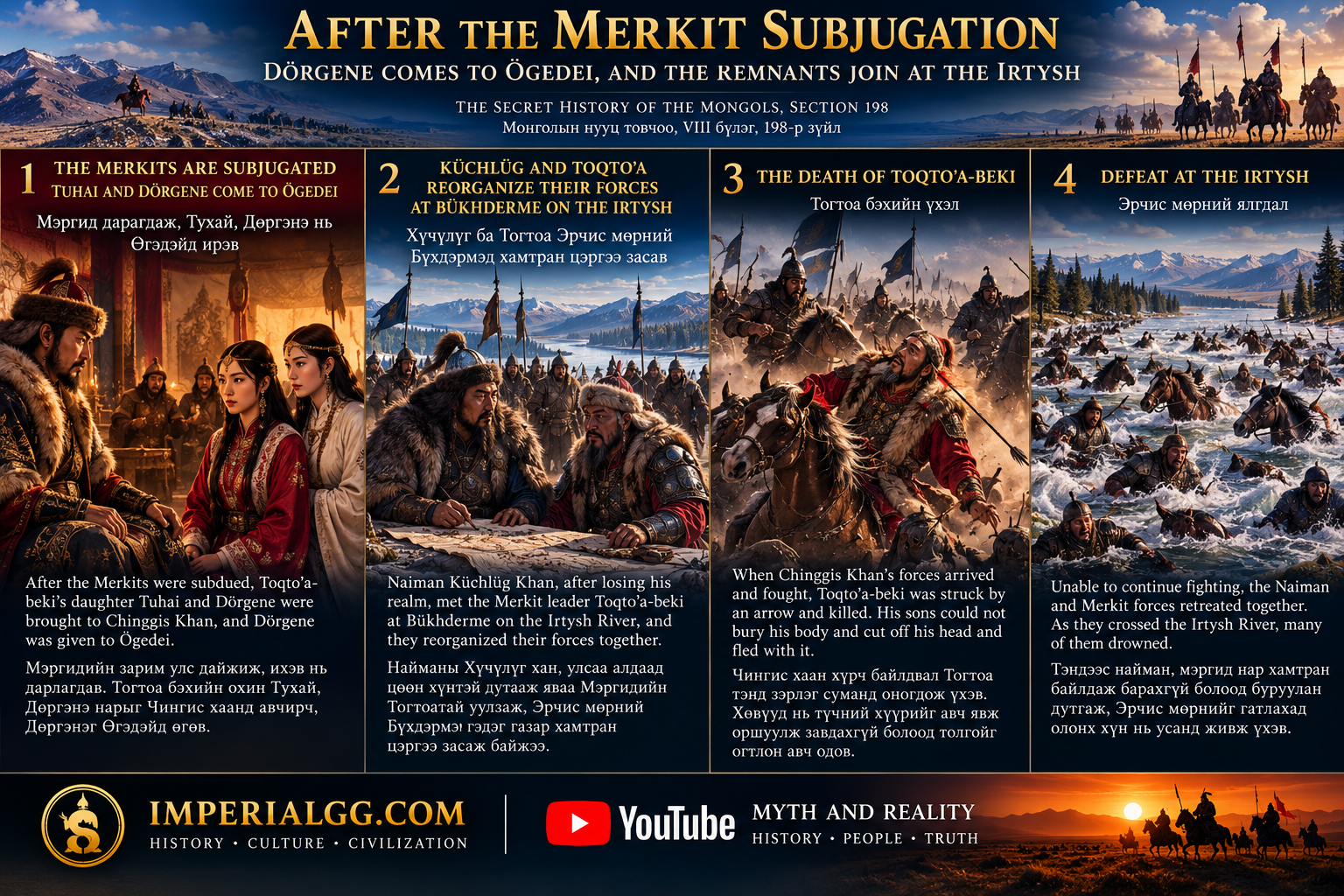
A REASSESSMENT OF THE SECRET HISTORY OF THE MONGOLS, §198
Abstract
Section 198 of The Secret History of the Mongols records a critical episode in the destruction of organized Naiman and Merkit resistance: the incorporation of Merkit captives, the flight of Toqto’a-beki and his sons, the attempted reorganization of the surviving forces alongside Küchlüg Khan, Toqto’a’s death in combat, and the catastrophic loss of life during the subsequent crossing of the Irtysh River. This article examines the episode through a close reading of the Mongolian text and a comparison with the historiographical tradition associated with Rashīd al-Dīn’s Jāmiʿ al-tawārīkh and modern scholarship on Mongol military expansion. It argues that the Irtysh episode should be understood not merely as a defeated army’s accidental misfortune but as a sequence in which renewed military organization, Mongol pursuit, battlefield defeat, and the geographical constraints of retreat interacted to produce a decisive collapse. The source does not explicitly establish that Chinggis Khan deliberately forced the enemy toward a particular river crossing. Nevertheless, its narrative sequence provides a basis for investigating how Mongol operational mobility and the terrain of the western steppe may have contributed to the destruction of a renewed Naiman–Merkit coalition. Differences in chronology among the sources also demonstrate the need to distinguish textual evidence from modern historical reconstruction.
Keywords: The Secret History of the Mongols; Chinggis Khan; Toqto’a-beki; Küchlüg Khan; Naiman; Merkit; Irtysh River; pursuit warfare; Mongol military history; Rashīd al-Dīn.
1. Introduction
The consolidation of Chinggis Khan’s power did not end with the defeat of the principal Naiman and Merkit forces in Mongolia. Their surviving leaders and followers continued to resist Mongol supremacy, and their movement westward created the possibility that previously defeated political and military groups might reorganize beyond the immediate reach of Chinggis Khan’s authority.
Section 198 of The Secret History of the Mongols is particularly important because it connects several stages of this process. It begins with the incorporation of Merkit captives and the assignment of Dörgene to Ögedei. It then describes the resistance of Merkit groups at Taiqal, the flight of Toqto’a-beki and his sons, and the pursuit that eventually brings the narrative to the Irtysh River. There, Toqto’a encounters Küchlüg Khan, the surviving Naiman ruler, and the two leaders attempt to reorganize their forces. The Mongolian account subsequently describes Chinggis Khan’s arrival, Toqto’a’s death, and the drowning of many Naiman and Merkit fighters during their retreat across the river.
The sequence raises an important military-historical question: why did the attempt to restore a joint Naiman–Merkit force fail so decisively?
The answer should not be reduced to the superior fighting ability of one army or to the accidental dangers of crossing a river. The account instead invites an examination of the relationship between the reorganization of defeated forces, the continuation of Mongol pursuit, the timing of renewed engagement, and the physical constraints imposed by the river crossing.
This article advances three related arguments. First, the phrase hamtran tsereg-ee zasaj baijee—they were reorganizing their forces together—indicates that the Naiman and Merkit remnants had not simply dispersed into unrelated groups. Second, the sequence of pursuit, engagement, leadership loss, and retreat suggests that their attempt to restore military cohesion was overtaken by Chinggis Khan’s campaign. Third, the heavy losses at the Irtysh may be interpreted as the interaction of military pressure and geographical conditions, although the text does not prove that the Mongols deliberately engineered the river disaster.
2. The Mongolian Text as the Primary Source
The Mongolian account should remain the foundation of the analysis. Section 198 begins by describing the subjugation of the Merkit people and the disposition of members of Toqto’a-beki’s family. It then records the resistance of certain Merkit groups who withdrew to the fortified position of Taiqal. Chinggis Khan ordered Chimbai, son of Sorqan-shira, to take the left-wing troops and surround the Merkit forces.
The narrative next turns to Toqto’a-beki and his sons Qudu and Chila’un, who escaped with a small following. Chinggis Khan pursued them, wintered on the southern side of the Altai, and continued his campaign in the spring of the Ox Year, identified by the text as 1205.
The decisive passage reads, in the Mongolian version supplied for this study:
“… найманы Хүчүлүг хан, улсаа алдаад цөөн хүнтэй дутааж яваа мэргидийн Тогтоатай уулзаж, Эрчис мөрний Бүхдэрмэ гэдэг газар хамтран цэргээ засаж байжээ.”
The passage identifies the meeting between Küchlüg Khan and Toqto’a-beki and locates it at Bükhderme on the Irtysh River. Its most significant statement is that they were reorganizing their forces together.
This wording matters. The narrative does not portray the two leaders as merely encountering one another while fleeing. It explicitly describes a joint military reorganization. Their meeting therefore represents an attempt to restore some degree of collective resistance after the loss of their previous political and military bases.
The next sentence states that Chinggis Khan arrived and fought them, after which Toqto’a was struck by an arrow and died. His sons were unable to carry away and bury his body; instead, they cut off his head and escaped with it.
The account then describes the joint Naiman–Merkit force as unable to continue fighting. They retreated across the Irtysh, where many drowned. The survivors crossed the river and dispersed. Küchlüg moved toward the Qarluq Uyghurs and eventually sought refuge with the Gur Khan of the Qara Khitai, while Toqto’a’s sons and other Merkit groups continued westward.
The sequence establishes the central framework for interpretation: reorganization, renewed engagement, leadership loss, retreat, and catastrophic losses during the crossing.
3. Dörgene and the Incorporation of the Defeated
Although the Irtysh encounter provides the principal military focus of this article, the opening of §198 also deserves attention. The text records that Dörgene, one of the women associated with Toqto’a-beki’s family, was given to Ögedei.
This detail places the military campaign within a broader process of political incorporation. Conquest involved not only the defeat of armed opponents but also the redistribution and incorporation of members of defeated ruling families into the social and political structure emerging around Chinggis Khan’s household.
The narrative does not provide enough evidence to conclude that this particular union was part of a formally articulated diplomatic policy. Nevertheless, the placement of the episode at the beginning of the section shows that the treatment of defeated elites and the continuing suppression of armed resistance formed parts of the same larger historical process.
The account then distinguishes between Merkit groups already subjected to Mongol authority and those who continued to resist from fortified positions or escaped under their own leaders. This distinction is essential: political subjugation did not necessarily mean the immediate disappearance of military resistance.
The survival of Toqto’a-beki and his sons, together with Küchlüg’s continued resistance, demonstrates that the defeat of a principal force could leave behind mobile and potentially dangerous remnants. The Irtysh campaign should therefore be understood in the context of an unfinished process of military consolidation.
4. Reorganization at Bükhderme: A Renewed Naiman–Merkit Coalition
The statement that Küchlüg and Toqto’a reorganized their forces together is the analytical center of §198.
Küchlüg had lost his previous position as Naiman ruler and was traveling with only a small following. Toqto’a and his sons had likewise escaped with a limited number of supporters. Their meeting at Bükhderme offered an opportunity to combine surviving personnel, leadership, and military resources.
The source does not specify the number of soldiers they assembled, the exact organization of their forces, or the time required for the reorganization. It would therefore be unjustified to describe the coalition as a fully restored army of its former size. The text establishes an attempt at renewed organization, not the precise strength or readiness of the resulting force.
Nevertheless, the phrase hamtran tsereg-ee zasaj indicates that their meeting had a military purpose. The surviving leaders were attempting to recover the capacity for collective action rather than simply seeking individual refuge.
This is significant for understanding the persistence of resistance after the collapse of major steppe powers. Political defeat did not necessarily eliminate military organization. Surviving leaders could still bring together followers, establish temporary cooperation, and attempt to resume resistance in a new geographical setting.
The Irtysh episode consequently reveals both the resilience and the vulnerability of displaced political groups. Their ability to reorganize created a renewed challenge to Chinggis Khan, but the resulting force remained vulnerable to pursuit before it could establish a secure and durable base.
5. Chinggis Khan’s Pursuit and the Death of Toqto’a-beki
The text next states that Chinggis Khan arrived and fought the reorganized forces. Toqto’a was struck by an arrow and died. The narrative does not describe the full tactical arrangement of the battle. It does not identify the positions of the opposing formations, the direction of the Mongol approach, or the specific movements that led to Toqto’a’s death. Those details should not be supplied as established facts without additional evidence.
What the account does establish is that Chinggis Khan’s pursuit continued beyond the defeat of the Merkits in Mongolia. Toqto’a’s escape did not remove him from the strategic objectives of the Mongol campaign. His continued existence as a leader, particularly after joining forces with Küchlüg, meant that the resistance had the potential to re-emerge.
Toqto’a’s death was therefore more than the loss of an individual commander. It removed one of the central figures capable of sustaining Merkit resistance and coordinating its surviving followers.
The response of his sons further conveys the urgency of their situation. Unable to take the body away for burial, they cut off his head and fled. This detail suggests that the defeated group lacked the time or security needed to conduct a normal burial. It is consistent with a retreat under severe military pressure, although the source does not explicitly explain the sons’ decision in those terms.
The episode illustrates a central characteristic of the Mongol campaigns against displaced opponents: the pursuit of defeated leaders could continue long after their original political bases had fallen. By denying those leaders time and space to reorganize, a pursuing army could prevent a military defeat from turning into a temporary setback.
6. The Irtysh Crossing: Terrain, Pursuit, and Military Collapse
The most consequential statement in §198 concerns the losses sustained while crossing the Irtysh. The text says that the Naiman and Merkit, unable to continue fighting together, retreated and that many drowned while crossing the river. This passage invites a geographical and operational interpretation.
A river crossing during an orderly movement is not equivalent to a crossing undertaken by a defeated army under pressure. Retreating forces may have to negotiate the river while protecting their leaders, maintaining contact between units, moving horses and equipment, and avoiding renewed engagement. If the crossing is difficult or the available routes are limited, these demands can become mutually conflicting.
The Irtysh therefore appears in the narrative not merely as a geographical landmark but as a setting in which the consequences of military defeat became substantially more severe. The loss of cohesion preceding the crossing and the deaths that occurred during it are presented as parts of the same sequence.
The distinction between a natural hazard and a strategically significant military outcome is important. The source explicitly states that many people drowned, but it does not establish that Chinggis Khan deliberately selected the river as a trap or intentionally drove the enemy into a predetermined crossing point.
The more defensible interpretation is that Mongol pursuit and the geographical constraints of the river crossing may have interacted to magnify the defeat. Once the joint force could no longer sustain resistance, the river became a dangerous obstacle to its withdrawal. Military pressure and terrain may thus have transformed an already serious defeat into a much more destructive collapse.
This interpretation also identifies a promising direction for further research. If the location of Bükhderme and the relevant Irtysh crossing can be established with greater confidence, geographical evidence could be used to investigate the number and accessibility of crossing points, local terrain, river channels, seasonal conditions, and possible routes of retreat. Such evidence would help determine whether the geography supports the hypothesis of a constrained or particularly hazardous withdrawal.
Until those questions are investigated, however, the deliberate exploitation of a specific crossing must remain a hypothesis rather than a demonstrated fact.
7. Rashīd al-Dīn and the Problem of Chronology
A comparison with Rashīd al-Dīn’s Jāmiʿ al-tawārīkh is essential, but the two traditions should not be treated as interchangeable accounts.
Rashīd al-Dīn compiled his history in the early fourteenth century, drawing on Mongolian historical materials, information transmitted at the Ilkhanid court, and other traditions. Modern scholarship has emphasized both the importance of Mongolian sources in his work and the need to examine how those materials were selected, combined, and presented. The Jāmiʿ al-tawārīkh is therefore an indispensable comparative source, but it must be assessed critically rather than assumed to reproduce the Secret History in a different language.
A significant problem concerns chronology. The Mongolian text of §198 places the pursuit and meeting at Bükhderme in the spring of the Ox Year, 1205. In contrast, modern reconstructions based on Rashīd al-Dīn and other historical traditions have associated the defeat of Naiman and Merkit forces near the Irtysh with a later campaign, commonly dated to around 1208–1209.
Timothy May discusses the difficulties involved in reconciling these accounts. His study notes that Rashīd al-Dīn’s chronology and descriptions of the flight of Küchlüg and Toqto’a do not align neatly with the sequence preserved in the Secret History. The possibility that different campaigns or episodes were combined in later historical narration has consequently been raised.
This discrepancy has important implications for the present argument. It means that the narrative sequence in §198 can be analyzed directly, but the exact date and historical identification of the Irtysh battle require comparison across sources. It would be premature to assume that every detail in the Mongolian account and the later Persian chronicle necessarily refers to a single event in precisely the same year.
The divergence also demonstrates why a close reading of the Mongolian text is indispensable. The specific statement that Küchlüg and Toqto’a reorganized their forces together at Bükhderme belongs to the narrative evidence that must be explained, not silently replaced by a modern chronology.
At the same time, the Mongolian account should not be used in isolation to settle every chronological question. A reliable reconstruction must distinguish the sequence represented in the text from the date and geographical identification that historians derive by comparing multiple traditions.
8. The Modern Historiography of Mongol Pursuit Warfare
Modern scholarship on the rise of the Mongol Empire has emphasized the importance of mobility, sustained campaigning, the pursuit of opposing leaders, and the incorporation of conquered populations into Chinggis Khan’s expanding political order.
Timothy May’s work on the mechanics of Mongol conquest provides a useful framework for interpreting the Irtysh episode. His reconstruction treats the defeat of the Naiman and Merkit remnants as part of a longer process rather than an isolated battle. It also highlights the continued danger posed by leaders who escaped the initial defeats and the strategic significance of preventing them from establishing a secure base beyond Mongolia.
This framework supports a broader reading of §198. The Mongol objective was not necessarily fulfilled by defeating an army once. As long as surviving leaders could gather followers and re-establish military organization, resistance could continue. Pursuit was therefore an important part of the process by which earlier victories were consolidated.
The Irtysh episode is particularly revealing because it combines three conditions:
A surviving enemy leadership: Küchlüg and Toqto’a retained the capacity to bring together followers after their earlier defeats.
Continued Mongol pursuit: Chinggis Khan’s forces reached and engaged the reorganized opposition.
A hazardous retreat: Following their inability to sustain the fight, the Naiman and Merkit suffered major losses during the river crossing.
Taken together, these conditions suggest that the destruction of resistance resulted from more than a single tactical encounter. The failure of the joint force to withstand renewed engagement was followed by a retreat in which the natural environment may have intensified the consequences of defeat.
However, modern military concepts should not be projected uncritically onto the thirteenth-century narrative. The available text does not prove the use of a formal operational map, a prearranged river trap, or a specific encirclement plan. Such interpretations would require independent evidence, including more precise geographical reconstruction and a careful comparison of the accounts of the campaign.
The stronger conclusion is that the narrative illustrates the potential relationship between mobility, pursuit, terrain, and the destruction of a retreating force. It provides a basis for investigating Mongol operational practice without claiming more than the sources demonstrate.
9. Conclusion
Section 198 of The Secret History of the Mongols preserves an important account of the continuing struggle to eliminate Naiman and Merkit resistance after their earlier defeats.
Its narrative moves from the incorporation of conquered Merkit elites and the suppression of resistance at Taiqal to the pursuit of Toqto’a-beki and his sons. It then records the meeting of Toqto’a and Küchlüg at Bükhderme, where they reorganized their forces together. Chinggis Khan subsequently engaged them; Toqto’a died in combat, his sons fled with his severed head, and many Naiman and Merkit fighters drowned while crossing the Irtysh.
The most important analytical insight lies in the connection between these events. The Naiman and Merkit remnants attempted to restore their military organization, but their renewed resistance did not survive the Mongol pursuit. The ensuing retreat exposed them to the dangers of the river crossing, turning military defeat into a broader human and organizational catastrophe.
The text does not demonstrate that Chinggis Khan deliberately engineered the drowning of his opponents. It does, however, support an interpretation in which the pressure of pursuit and the geographical conditions of withdrawal may have combined to magnify the consequences of defeat. This is a significant distinction: the argument concerns the possible strategic exploitation of terrain, not an unproven claim that the river disaster was deliberately planned.
The chronology remains a separate issue. The dating in the Secret History and the reconstructions associated with Rashīd al-Dīn and modern scholarship do not align without difficulty. This discrepancy should be addressed through source comparison rather than concealed by imposing a single chronology upon all accounts.
Ultimately, the Irtysh episode demonstrates how a military defeat could become decisive through the interaction of leadership loss, failed reorganization, continued pursuit, and the constraints of the physical environment. It offers a valuable case study in the relationship between historical narrative and military geography during the formation of the Mongol Empire.
References
Atwood, Christopher P. 2020. “Rashīd al-Dīn’s Ghazanid Chronicle and Its Mongolian Sources.” In New Approaches to Ilkhanid History, 53–121. Brill.
Kamola, Stefan. 2019. Making Mongol History: Rashid al-Din and the Jamiʿ al-Tawarikh. Edinburgh: Edinburgh University Press.
May, Timothy. 2004. The Mechanics of Conquest and Governance: The Rise and Expansion of the Mongol Empire, 1185–1265. PhD dissertation, University of Wisconsin–Madison.
Rashīd al-Dīn Fażl Allāh Hamadānī. Jāmiʿ al-tawārīkh [Compendium of Chronicles]. Mongol-history sections; editions and translations cited in modern scholarship.
Монголын нууц товчоо. VIII бүлэг, §198. Монгол эхийн хэвлэлд тулгуурлав.
Methodological note: The exact location of Bükhderme, the identification of the relevant Irtysh crossing, and the reconciliation of the 1205 chronology with later accounts require further source-based geographical and historiographical investigation. The strategic interpretation presented here is therefore a hypothesis grounded in the narrative sequence, not a claim that the source explicitly records a deliberately planned river trap.