
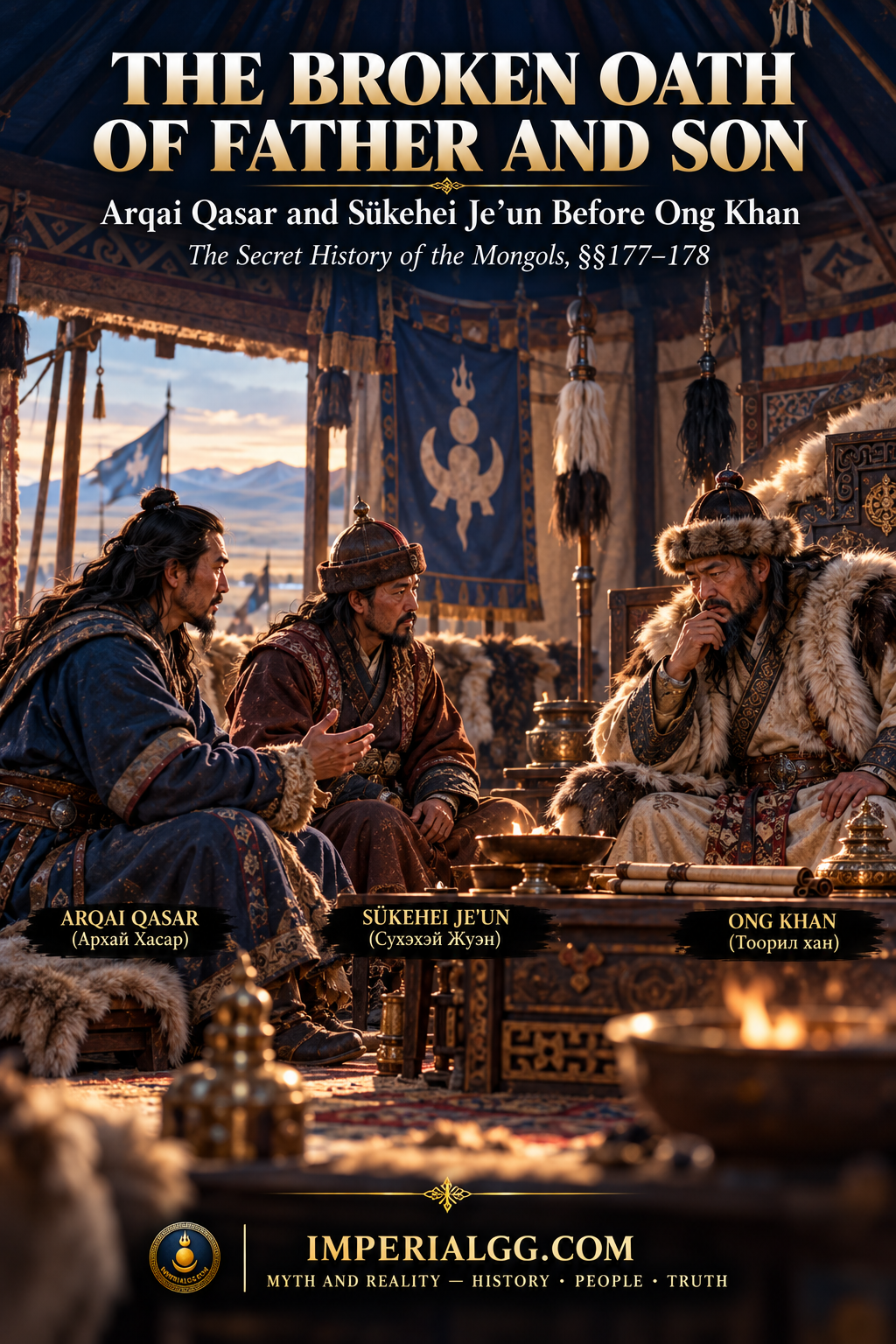
The Secret History of the Mongols (Монголын нууц товчоо), §§177–178
ABSTRACT
Sections 177–178 of The Secret History of the Mongols present one of the most consequential confrontations between Temüjin (Тэмүжин) and Ong Khan (Ван хан): Temüjin’s attempt to hold his sworn father accountable for abandoning the personal covenant that had bound them together. Following the confrontation at Khar Khaljan Elete (Хархалзан элээт), Temüjin sends envoys with a long message recalling their agreement to meet face to face whenever malicious intermediaries attempted to create division, the assistance provided by his father Yesügei Ba’atur (Есүхэй баатар) when Ong Khan had lost his political position, and Temüjin’s own dispatch of the Four Steeds (Дөрвөн хүлэг) to rescue Senggüm (Сэнгүм), Ong Khan’s family, and his dispersed subjects. The central question is not merely why a political alliance collapsed, but why Ong Khan abandoned the very procedure of personal consultation and reciprocal trust that he and Temüjin had explicitly affirmed. Ong Khan’s response acknowledges the moral consequences of his separation from Temüjin and culminates in a blood oath intended to reaffirm his paternal bond. A comparison of the Mongolian text with Christopher P. Atwood’s translation and Urgunge Onon’s English version shows how the passage frames political conflict through the language of kinship, remembered service, and violated obligation, while leaving the precise balance between personal remorse and political calculation open to historical interpretation.
Keywords: The Secret History of the Mongols; Ong Khan; Temüjin; Yesügei Ba’atur; Senggüm; father–son covenant; Four Steeds; political legitimacy; oath; diplomatic rupture.
1. THE CENTRAL QUESTION: WHY DID ONG KHAN ABANDON THEIR COVENANT?
The principal issue in §§177–178 emerges from Temüjin’s insistence that Ong Khan had violated an agreement whose purpose was to protect their relationship against malicious speech and political manipulation. At the Red Hills of Jorqalqun (Зоргал хоны Улаан болдог), according to the Mongolian text, the two had agreed that if a hostile intermediary attempted to create division between them, they would not accept accusations at face value but would meet and speak directly in order to resolve the matter. Temüjin recalls this agreement in the form of a reproach: if they had promised to consult one another face to face, why had Ong Khan withdrawn from their relationship without first meeting him and discussing the accusations?
The wording matters because Temüjin does not frame his complaint merely as an objection to military hostility. He challenges the procedure by which Ong Khan reached his decision. The problem, from Temüjin’s perspective, is that their relationship had been governed by an explicit rule of communication, yet Ong Khan had allowed the words of others to determine his conduct without following that rule. Atwood’s translation preserves the essential contrast between being provoked by an intermediary and refusing to be deceived by accusations until the two parties have spoken in person; Onon likewise translates the passage as a direct appeal to the father figure to explain why he has separated from Temüjin without personal consultation.
The chronicle does not offer a single detached explanation of Ong Khan’s motives. Instead, it allows Temüjin to reconstruct the history of their relationship and to place the present rupture against a series of earlier obligations. This is an important narrative distinction: Temüjin’s speech is a political argument addressed to Ong Khan, not an impartial narrator’s final verdict on the dispute. Its historical value lies both in the events it recalls and in the way Temüjin uses those events to establish that Ong Khan’s present conduct contradicts the relationship he had previously acknowledged.
2. YESÜGEI BA’ATUR’S ASSISTANCE: THE FIRST FOUNDATION OF RECIPROCITY
Temüjin begins his historical argument by recalling the circumstances in which Ong Khan’s relationship with his father, Yesügei Ba’atur, had been established. Ong Khan had experienced political defeat, displacement, and the loss of his position; according to Temüjin’s account, he appealed to Yesügei for assistance against his paternal uncle, Gür Khan (Гүр хан). Yesügei responded by organizing military support under commanders identified in the text as Hunan and Bahaji of the Taichi’ut (Тайчууд), and Ong Khan was able to recover his political position.
The significance of this recollection is not simply that Yesügei had once helped Ong Khan. Temüjin presents the assistance as the beginning of a relationship that carried obligations beyond the lifetime of the individuals who first established it. Ong Khan had expressed gratitude and promised that the benefit would be remembered across generations. The later father–son relationship between Ong Khan and Temüjin therefore rested, in Temüjin’s argument, on an inherited bond of assistance and gratitude rather than on a purely new political arrangement.
This is why the recollection of Yesügei is central to the speech. Temüjin is not merely saying that his father was a powerful ally; he is reminding Ong Khan that his own position had once depended on assistance from Temüjin’s family. The father–son relationship should consequently be understood as a political and moral obligation, sustained by remembered services and reciprocal commitments. By invoking the earlier rescue, Temüjin makes the current rupture appear not as an isolated disagreement but as a departure from a relationship whose obligations had already been acknowledged by Ong Khan himself.
3. TEMÜJIN’S OWN ASSISTANCE: THE FOUR STEEDS RESCUE SENGGÜM AND ONG KHAN’S PEOPLE
Temüjin then turns from his father’s assistance to his own. After Ong Khan again suffered defeat and was deprived of people and property by the Naiman forces under Kökse’u-Sabraq (Хүгсэү сабраг), he appealed to Temüjin to send his Four Steeds: Bo’orchu (Боорчи), Muqali (Мухулай), Borokhul (Борохул), and Chila’un Ba’atur (Чулуун баатар). Temüjin emphasizes that he did not respond with the same distrust or abandonment that he now accuses Ong Khan of displaying. Instead, he organized support and dispatched the four commanders with troops.
The message specifically recalls that Senggüm had been fighting at Hula’an-Qut (Улаан хус) when an arrow wounded his horse’s hindquarters, leaving him in danger of capture. The Four Steeds arrived and rescued him, then recovered Ong Khan’s women and children, subjects, and other members of his political household. Temüjin reminds Ong Khan that he had responded gratefully to this assistance, acknowledging that his son Temüjin had restored the people he had lost. Both Atwood and Onon preserve the essential structure of this recollection: the Four Steeds rescue Senggüm and the wider Kereit group, and Temüjin then asks why he is now being reprimanded or accused.
This appeal is particularly significant because Senggüm is not an incidental figure in the story. His hostility toward Temüjin had contributed to the political crisis, yet he himself had previously been rescued by Temüjin’s commanders. Temüjin uses that fact to expose the contradiction between the practical history of cooperation and the present accusations. The person whose faction now treats Temüjin as a threat had once depended on Temüjin’s military assistance for his survival.
The argument also demonstrates the political meaning of the Four Steeds. They are not simply celebrated warriors in an episode of battlefield rescue; their mission represents Temüjin’s ability to preserve Ong Khan’s political community at a moment when its cohesion was threatened. By recalling their service, Temüjin claims that he has fulfilled the obligations of the father–son relationship through concrete action, while Ong Khan has failed to apply the same standard of trust to him.
4. FROM PERSONAL OATH TO POLITICAL PROCEDURE
Temüjin’s message repeatedly returns to the question of direct consultation. The agreement at Jorqalqun’s Red Hills had been designed to prevent a hostile third party from manipulating the relationship between the two leaders. Temüjin’s complaint is therefore more precise than a general accusation of betrayal: he insists that Ong Khan allowed hostile speech to replace the procedure they had agreed to follow.
This is the central political issue in the passage. The father–son relationship was expressed through kinship language, but its practical stability depended on a procedure for resolving disputes. The agreement to speak in person was intended to prevent slander from becoming a substitute for evidence. Once Ong Khan accepted the claims of others and withdrew without direct consultation, the personal bond lost the mechanism that was supposed to protect it.
Temüjin’s appeal is thus both moral and diplomatic. It reminds Ong Khan of the promises that defined their relationship, but it also asks him to restore a workable channel of communication. Temüjin requests that Ong Khan send envoys, naming Qulbari-Quri (Хулбари-хури) and Itürgen (Итүргэн), or at least send one of them, to explain the reason for his anger. This demand is significant because Temüjin does not simply ask for reconciliation without explanation; he asks Ong Khan to account for the accusation through an acknowledged diplomatic process.
The chronicle therefore presents the collapse of the relationship as a failure of both trust and procedure. Kinship language alone could not prevent conflict when the parties no longer followed the agreed means of verifying claims. The episode suggests that political alliances built upon personal bonds remained vulnerable whenever intermediaries, competing interests, and military anxieties displaced direct communication.
5. ONG KHAN’S RESPONSE: REMORSE AND THE BLOOD OATH
Section 178 records a striking response. After receiving Temüjin’s message, Ong Khan expresses regret, acknowledging in the Mongolian text that by separating from his good or worthy son he has damaged his own proper course of conduct. He then declares that if he sees Temüjin and thinks badly of him, he will let his blood flow as proof of his sincerity. He pierces the tip of his little finger with a knife, allows the blood to drip into a small container, and sends it to Temüjin.
The physical gesture gives the response a ceremonial and personal character. Ong Khan does not answer Temüjin with another military threat or a detailed counterargument. Instead, he acknowledges the seriousness of the separation and uses his own blood to affirm the sincerity of his renewed commitment. Onon’s translation explicitly describes the blood oath, while Atwood renders Ong Khan’s regret as recognition that he has separated from what is right and from his duty.
The wording should not be flattened into the claim that Ong Khan simply admits every accusation made by Temüjin. His response expresses remorse and a renewed oath, but it does not provide an exhaustive explanation of why he had initially accepted the accusations or withdrawn from the relationship. Nor does the passage establish that the political crisis has been permanently resolved. The blood oath marks a moment of attempted restoration, not proof that the underlying rivalry and factional pressures have disappeared.
The scene is especially revealing because it returns the reader to the original nature of the relationship. The father–son bond was created through a remembered history of assistance and confirmed by personal agreement; now, after that bond has been damaged, Ong Khan seeks to restore it through a physical act of oath-taking. The gesture underscores the importance of personal commitment while simultaneously revealing its limitations: a renewed oath can express sincere regret, but it cannot by itself eliminate the political forces that produced the rupture.
6. COMPARING DAMDINSÜREN, ATWOOD, AND ONON
The Mongolian text in the Ц. Дамдинсүрэн edition provides the primary basis for this analysis. Its presentation of Temüjin’s speech emphasizes the agreement to meet face to face, the recollection of Yesügei’s assistance, the services rendered by Temüjin and the Four Steeds, and the direct question of why Ong Khan has become angry. The speech’s poetic structure and repeated formulations reinforce the cumulative nature of Temüjin’s argument: the present dispute is measured against a long record of assistance and explicit promises.
Atwood’s translation makes the procedural dimension especially visible by repeatedly contrasting hostile intermediaries with personal conversation. His rendering of Ong Khan’s response also emphasizes the moral consequences of the separation, presenting the ruler’s regret as a recognition that he has abandoned the right course and his duty. This makes the passage particularly useful for interpreting the relationship between political obligation and personal loyalty.
Onon’s translation similarly preserves Temüjin’s detailed recollection of the Four Steeds and his demand for an explanation through envoys. His rendering of Ong Khan’s blood oath makes the physical act explicit and supplies explanatory notes on the use of a small birch-bark container and the oath’s symbolic significance. These details help readers understand that the blood is not incidental to the narrative; it is the material sign through which Ong Khan attempts to affirm his commitment.
The translations differ in some choices of wording, including how they render the terms of accusation, the father–son relationship, and the moral language of Ong Khan’s regret. Those differences should be recorded when examining the original Mongolian, rather than treated as proof that one translation necessarily captures every nuance. For this article, the strongest common ground across the Mongolian text, Atwood, and Onon is the structure of the argument: Temüjin recalls the oath, demonstrates reciprocal service, demands an explanation, and receives a blood oath of renewed commitment.
7. HISTORICAL INTERPRETATION: WHY DID THE OATH FAIL?
The chronicle does not provide a single, definitive psychological explanation for Ong Khan’s earlier conduct. A historically cautious interpretation must therefore distinguish the reasons explicitly given by Temüjin from the broader political circumstances that make the rupture understandable. Temüjin attributes the separation to hostile intermediaries and slander, insisting that Ong Khan should have spoken to him directly. This is the accusation articulated in the text. The political context, however, includes Senggüm’s hostility, the concerns of the Kereit ruling circle, the growing importance of Temüjin’s followers, and the uncertainty surrounding the future of Ong Khan’s authority.
The father–son relationship had become more than a private bond. Temüjin had helped restore Ong Khan’s position, provided military assistance, and rescued Senggüm and the Kereit household. These services strengthened the relationship, but they also demonstrated Temüjin’s growing independent military capacity. The chronicle does not explicitly state that Ong Khan abandoned the oath because he feared Temüjin’s power; that interpretation should therefore remain a hypothesis rather than a fact. It is nevertheless reasonable to investigate whether the growing imbalance between the two leaders made a relationship originally framed as reciprocal fatherhood increasingly difficult to sustain.
The most defensible conclusion is that the oath failed in practice when Ong Khan allowed the claims of his own political circle to override the procedure of direct consultation. Temüjin’s message challenges that decision by appealing to the shared history of their relationship and demanding that Ong Khan explain himself through envoys. Ong Khan’s blood oath acknowledges the moral force of this appeal, but the larger political conflict remains unresolved. The episode illustrates the limits of personal agreements when the interests of factions, questions of succession, and competing political power become more consequential than the promises that originally bound the leaders together.
8. AUTHOR’S THESIS
Sections 177–178 portray the rupture between Temüjin and Ong Khan as a failure to uphold a covenant of direct communication and reciprocal obligation. Temüjin’s argument rests on three connected elements: the agreement not to accept hostile accusations without meeting face to face, the earlier assistance provided by Yesügei Ba’atur when Ong Khan had lost his political position, and Temüjin’s own dispatch of the Four Steeds to rescue Senggüm and restore Ong Khan’s dispersed people. These recollections transform the question of personal betrayal into a question of whether the parties have honored the obligations established by their shared history.
Ong Khan’s response, expressed through regret and a blood oath, acknowledges the moral consequences of separation but does not establish that the underlying political tensions have disappeared. The passage therefore reveals both the power and the limits of the father–son relationship: remembered assistance and ceremonial oaths can provide a language for restoring trust, yet they cannot guarantee political stability when competing interests and hostile interpretations have displaced direct communication.
The central question remains: if Ong Khan and Temüjin had explicitly agreed to meet face to face and resolve accusations through direct speech, why did Ong Khan allow the accusations of others to determine his actions before consulting his sworn son? The chronicle presents Temüjin’s challenge clearly; the precise weight of factional pressure, succession concerns, and political calculation must be assessed cautiously from the wider narrative.
SOURCE NOTE
Primary text: Ц. Дамдинсүрэн, Монголын нууц товчоо, §§177–178, especially the Mongolian text corresponding to the envoys’ message and Ong Khan’s blood oath. Comparative English translations: Christopher P. Atwood, The Secret History of the Mongols: A Mongolian Epic Chronicle of the Thirteenth Century; Urgunge Onon, The Secret History of the Mongols: The Life and Times of Chinggis Khan.
ImperialGG — HISTORY • PEOPLE • TRUTH