
FROM ANDA TO ALLIANCE
By Altanbagana Baatar
DBA Candidate| Independent Historian
ImperialGG Historical Research Seriers
29 September 2026
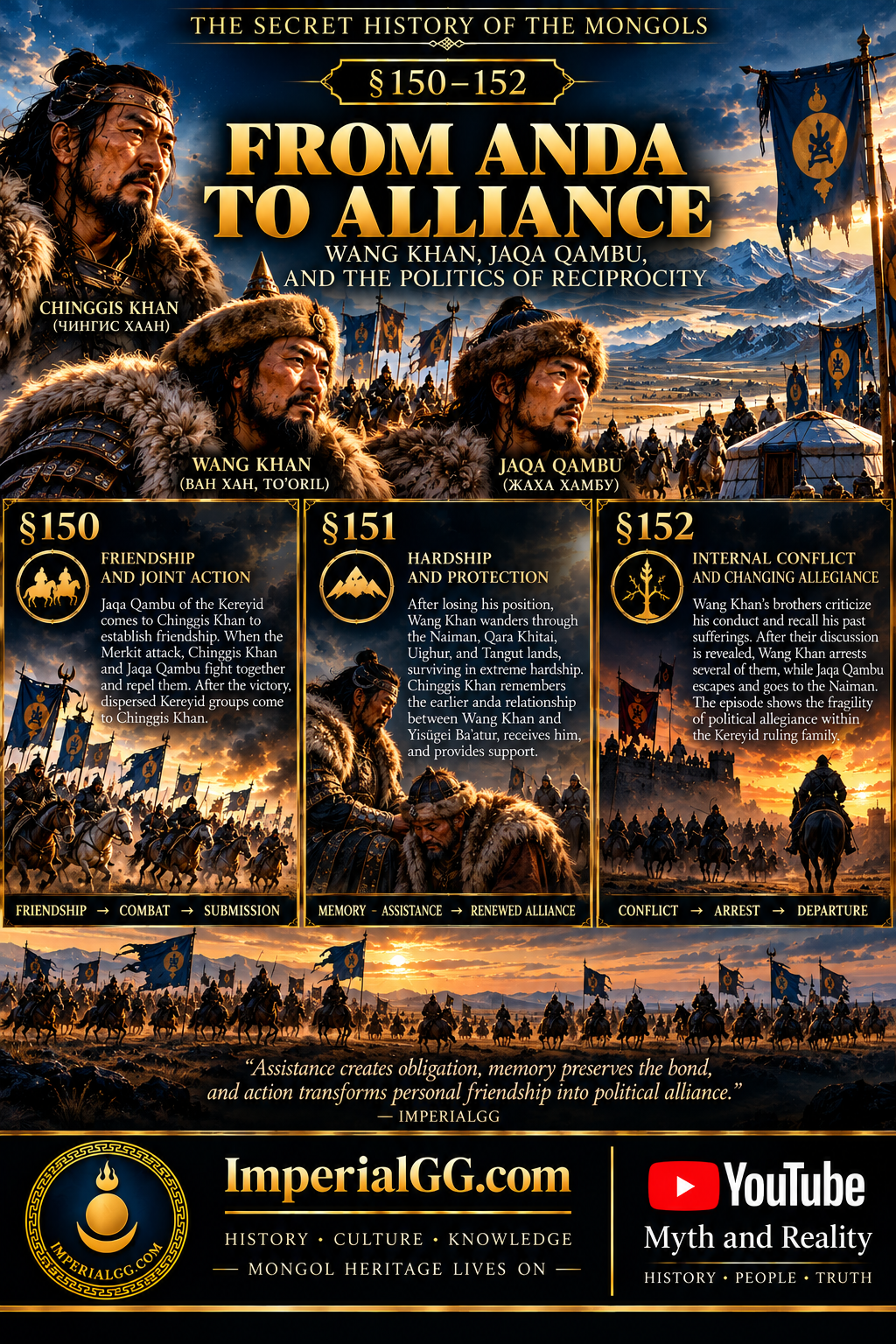
Wang Khan, Jaqa Qambu, and the Politics of Reciprocity in The Secret History of the Mongols §§150–152
AUTHOR’S THESIS
Sections 150–152 of The Secret History of the Mongols present the relationship between Chinggis Khan and the Kereyid ruler Wang Khan (Ван хан, To’oril) through a political ethic of reciprocity, memory, protection, and renewed alliance. The narrative first recalls how Yisügei Ba’atur aided Wang Khan when he had lost his political position and thereby established an anda relationship (андын холбоо) with him. A generation later, Chinggis Khan remembers this earlier bond and receives Wang Khan when he again falls into extreme hardship. At the same time, Wang Khan’s brother Jaqa Qambu (Жаха хамбу) comes to Chinggis Khan to establish friendship (нөхөрлөхөөр ирэх) and immediately participates in military action alongside him. The three sections therefore show how personal relationships could develop into wider political alliances (улс төрийн холбоо), while also demonstrating that such relationships remained dependent upon continuing loyalty and political stability.
I. WANG KHAN AND YISÜGEI BA’ATUR
Section 150 opens with Jaqa Qambu coming to Chinggis Khan at Dersüd to establish friendship (нөхөрлөхөөр ирэв). When the Merkit subsequently attack, Chinggis Khan and Jaqa Qambu fight together and repel them, after which dispersed Kereyid groups come over to Chinggis Khan in submission (дагаар ирэв). The narrative then moves backward to explain the earlier relationship between Wang Khan and Yisügei Ba’atur, thereby providing the historical background for the political relationship between the Kereyids and Chinggis Khan. This retrospective structure is important because the Secret History does not treat Chinggis Khan’s relationship with Wang Khan as an isolated contemporary alliance; instead, it places it within a relationship inherited from the preceding generation. Rachewiltz’s edition likewise treats these passages within the broader political narrative of Chinggis Khan’s rise and his changing alliances. De Gruyter Brill
Wang Khan had previously entered into conflict with his paternal uncle Gür Khan and, after suffering defeat, escaped with only a small following before seeking assistance from Yisügei. Yisügei received him, personally mobilized troops, drove Gür Khan away, and restored Wang Khan’s subjects and property. The Secret History explicitly concludes that, because of this assistance, the two became anda (анд бололцсон). The significance of the passage therefore lies not simply in the existence of an anda relationship but in the circumstances through which it was created: political collapse, personal assistance, military intervention, and restoration. The bond is presented as something produced through action rather than merely declared through words.
II. THE MEMORY OF ANDA RELATIONSHIP
Section 151 repeats this pattern in the next generation. Wang Khan again loses his political position, first fleeing from his brother Erke Qara and subsequently passing through the territories of the Naiman and Qara Khitai before wandering through Uighur and Tangut lands. The narrative emphasizes the severity of his condition by describing his dependence upon five goats and camel blood for survival. His transformation from a ruling khan into an impoverished wanderer establishes the circumstances in which Chinggis Khan’s response acquires political and moral significance.
The text explicitly states that Chinggis Khan remembered Wang Khan’s earlier anda relationship with Yisügei Ba’atur. He first sends Daqai Ba’atur and Sükegei Je’ün to meet him and subsequently goes himself to receive Wang Khan, providing him with provisions and incorporating him into his own camp. The narrative thus creates a clear generational parallel: Yisügei once aided Wang Khan when he had fallen from power; Chinggis Khan later remembers that relationship and aids him when he again reaches a condition of extreme vulnerability. This is the point at which anda becomes more than a personal bond: it becomes a remembered political obligation (улс төрийн үүрэг, харилцан хариуцлага).
III. FROM FRIENDSHIP TO MILITARY COOPERATION
Jaqa Qambu introduces a second form of political connection. Unlike Wang Khan, whose relationship with Chinggis Khan is explicitly connected to the earlier bond between Yisügei and Wang Khan, Jaqa Qambu comes directly to Chinggis Khan to establish friendship (нөхөрлөхөөр ирэх). The relationship is then immediately tested through military action, as the two men fight together against the Merkit. The sequence is significant because the Secret History places personal relationship and practical cooperation side by side: friendship is followed by shared military action, and shared military action is followed by the movement of Kereyid people into Chinggis Khan’s political sphere.
It would nevertheless be too strong to conclude from this passage alone that Chinggis Khan deliberately engineered the political fragmentation of the Kereyids. The text does not make such a claim. What it documents is more precise: Jaqa Qambu voluntarily approaches Chinggis Khan, establishes a relationship with him, fights alongside him, and is subsequently situated within a broader movement of Kereyid people toward Chinggis Khan. The political consequence is therefore visible in the narrative even where a deliberate strategic intention is not explicitly stated.
IV. RECIPROCITY AND POLITICAL MEMORY
The relationship between Yisügei, Wang Khan, and Chinggis Khan becomes particularly significant because the narrative connects assistance across generations. Yisügei’s intervention restores Wang Khan when his political position has collapsed; Chinggis Khan later remembers that history and responds to Wang Khan in a comparable moment of vulnerability. The Secret History therefore presents political memory as an active force. To remember who assisted a ruler when he was powerless is to recognize an obligation that can continue beyond the lifetime of the original participants.
This principle becomes even clearer in §152, where Wang Khan’s brothers criticize his conduct by recalling his earlier hardships. They recount his captivity among the Merkit, his dependence upon others, his flight from the Naiman, and his subsequent wandering through Uighur and Tangut territories. Their criticism rests upon the claim that Wang Khan has forgotten the suffering through which he himself passed. Thus the narrative establishes a significant contrast: Chinggis Khan remembers Wang Khan’s past dependence, while Wang Khan’s brothers accuse him of forgetting his own past.
Memory consequently becomes a political and moral category. Assistance received during weakness creates an expectation of reciprocal recognition, while forgetting such assistance becomes evidence of political failure within the narrative’s own moral framework.
V. JAQA QAMBU AND THE INSTABILITY OF ALLEGIANCE
The final movement of §152 demonstrates that political relationships could also change rapidly. After Wang Khan learns of the discussion among his brothers, he arrests those involved, while Jaqa Qambu escapes and goes to the Naiman. The development is significant when read alongside §150: the man who had previously come to Chinggis Khan in friendship and fought beside him is now displaced from the Kereyid political environment and seeks another political center.
This does not invalidate the relationship established in §150; rather, it reveals the unstable political environment in which such relationships operated. Kinship alone did not guarantee political unity, and an alliance could not be assumed to remain permanent without continuing political circumstances capable of sustaining it. The movement of Jaqa Qambu therefore demonstrates that personal allegiance, family politics, military cooperation, and political survival were closely interconnected.
VI. FROM ANDA TO ALLIANCE
Taken together, §§150–152 reveal a progression from personal friendship (нөхөрлөл) to military cooperation (хамтын цэргийн ажиллагаа), from remembered anda relationship (андын холбоо) to renewed protection (тэтгэн хамгаалах), and from individual relationships to wider political incorporation (улс төрийн хүрээнд нэгтгэгдэх).
The narrative begins with Jaqa Qambu’s arrival and the immediate demonstration of friendship through combat; it then turns backward to establish why Wang Khan had become Yisügei’s anda; subsequently, it shows Chinggis Khan remembering that relationship when Wang Khan again becomes destitute; finally, it enters the internal crisis of the Kereyid ruling family. The three sections are therefore not merely a collection of biographical episodes but a connected examination of how political relationships are created, remembered, renewed, and disrupted.
CONCLUSION
Sections 150–152 present anda not simply as a ceremonial friendship between individuals but as a relationship whose political meaning emerges through reciprocal assistance, memory, and action. Wang Khan’s repeated experiences of political collapse provide the narrative setting in which this principle becomes visible. Yisügei assists him during his first major crisis, and Chinggis Khan later remembers that earlier relationship when Wang Khan again appears as a displaced and impoverished ruler.
Jaqa Qambu provides a complementary example. His decision to come to Chinggis Khan (нөхөрлөхөөр ирэх) is followed immediately by military cooperation, while the later breakdown of the Kereyid political environment forces him to leave and seek refuge elsewhere. Through these parallel movements, the Secret History shows that personal relationships could become channels of political alliance, but that their durability depended upon the continuing conditions of loyalty, reciprocity, and political order.
The central argument of §§150–152 can therefore be stated concisely: In the political world of the Secret History of the Mongols, an anda relationship acquires its deepest significance not when power is secure, but when one party has lost it; assistance creates obligation, memory preserves the bond, and renewed action transforms personal friendship into political alliance.
PRIMARY SCHOLARLY REFERENCE
For the English comparison, the principal scholarly reference should be Igor de Rachewiltz, The Secret History of the Mongols: A Mongolian Epic Chronicle of the Thirteenth Century, translated with historical and philological commentary, Brill, 2004–2013. The ANU Mongolia Institute describes the edition as the standard English version, while the bibliographic record confirms the three-volume Brill publication. ANU Mongolia Institute
For our ImperialGG series, I would keep this standard going forward: English scholarly term first, important Mongolian original in parentheses, while the actual interpretation remains tied to the Mongolian text and Rachewiltz comparison.