
LOYALTY, OMEN, AND ORDER
By Altanbagana Baatar
DBA Candidate| Independent Historian
ImperialGG Historical Research Seriers
28 September 2026
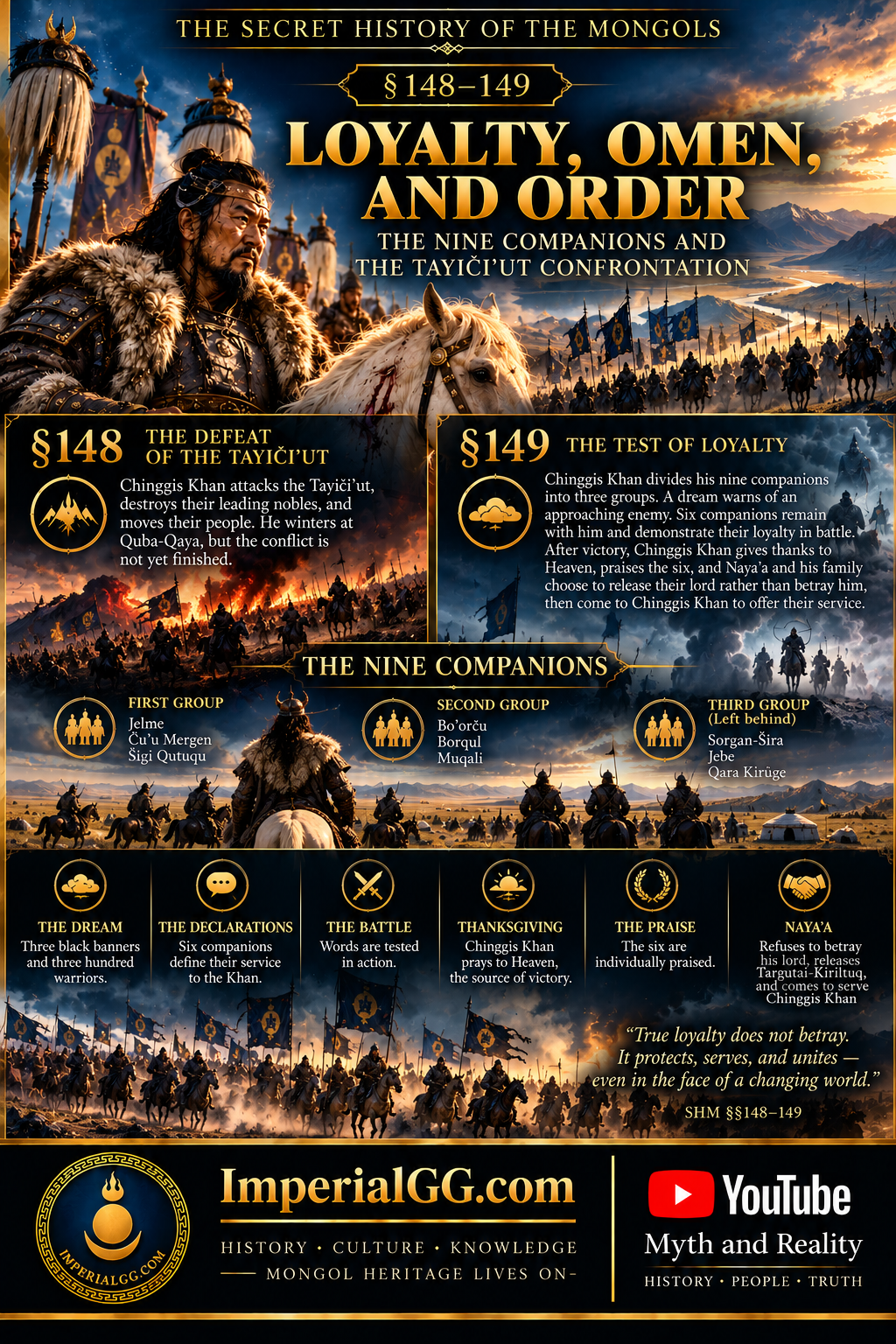
Reading Sections 148–149 of The Secret History of the Mongols
AUTHOR’S THESIS
Sections 148–149 of The Secret History of the Mongols form a tightly constructed narrative about the relationship between political loyalty, martial service, divine favor, and the emergence of a unified order under Chinggis Khan.
Section 148 establishes the immediate political background: Chinggis Khan has defeated the Tayiči’ut and destroyed members of their ruling elite. Section 149 then moves from the defeat of an enemy to a more intimate examination of the qualities required within Chinggis Khan’s own political community. The nine senior companions are divided into three groups; Chinggis Khan receives a disturbing dream; six companions respond by defining the particular forms of service they can offer; their words are subsequently tested in battle; and, after victory, Chinggis Khan praises them individually and attributes his sovereignty and victory ultimately to the favor of Heaven. The episode then extends its examination of loyalty through Naya’a, who refuses to betray his own rightful lord, Targutai-Kiriltuq, even while choosing to offer his strength to Chinggis Khan.
The structure is therefore significant. The text does not present loyalty merely as obedience. It presents loyalty as a collection of demonstrated capacities: perception, courage, counsel, protection, sacrifice, military effectiveness, and fidelity to one’s lord. These qualities are first spoken, then tested, then praised. The narrative finally resolves the movement from uncertainty to order when Chinggis Khan defeats the Tayiči’ut force and returns home in peace.
1. SECTION 148: THE POLITICAL BACKGROUND
Section 148 is remarkably concise. Chinggis Khan attacks the Tayiči’ut and destroys their leading figures, including A’uchu Ba’atur, Qodun Orčan, and Qudu’udar. Their people are then moved, and Chinggis Khan winters at Quba-Qaya, identified in Damdinsüren’s modern Mongolian text as Uqa Qaya.
The importance of §148 lies partly in its brevity. The Tayiči’ut have already been defeated, yet the following section does not treat that conflict as politically finished. Instead, §149 returns to the Tayiči’ut as a renewed military threat.
The two sections thus create a narrative transition:
defeat of the enemy → testing of the ruler’s inner circle → renewed confrontation → victory and political integration.
Section 148 therefore functions as the historical and political frame within which the much more elaborate drama of §149 unfolds.
2. NINE COMPANIONS AND THE THREEFOLD DIVISION
At the beginning of §149, Chinggis Khan travels with his nine senior companions. He orders them to divide into three groups because an enemy may approach from any direction.
The nine are divided as follows:
Jelme, Ču’u Mergen, and Šigi Qutuqu;
Bo’orču, Borqul, and Muqali;
Sorgan-Šira, Jebe, and Qara Kirüge.
The third group remains at the camp while Chinggis Khan proceeds with the other six.
This division has an important narrative function. The nine men form a single body of service, but the text immediately distributes them into separate tactical units. Their physical separation does not diminish their common relationship to the ruler. Instead, it demonstrates that a unified political order can operate through differentiated roles.
The structure of three groups of three also prepares the reader for the later concentration upon six men. The six who remain with Chinggis Khan will face the immediate crisis; the three who remain behind constitute the other part of the same trusted circle.
The text thus introduces loyalty as both collective and functional.
3. THE DREAM: OMEN BEFORE CONFLICT
After killing a wild goat, Chinggis Khan orders the meat to be roasted while he goes to observe the surrounding country. He falls asleep against his horse and dreams.
In the dream, his heart trembles and his ribs shake. He sees an approaching enemy: three black banners and three hundred warriors, led by a mounted warrior in armor carrying a bow. He wakes and immediately asks the six companions what they would do if the dream proves true.
The dream is not presented merely as an isolated supernatural episode. It functions structurally as a warning before the test.
The sequence is:
dream → question → declarations of loyalty → verification → battle.
The ruler does not simply announce the dream and wait for events. He turns the omen into a question directed at his companions. Their responses therefore become a preliminary test of character.
4. SIX MEN, SIX FORMS OF SERVICE
The six companions do not answer in identical language. Each defines service according to his own capacity.
Šigi Qutuqu: PERCEPTION
Šigi Qutuqu emphasizes his ability to see far and near and distinguish different peoples. His service is based on observation and recognition. His defining capacity is therefore discernment: seeing what the ruler cannot immediately see and identifying the enemy correctly.
Jelme: SACRIFICE AND VIGILANCE
Jelme declares that he will not spare either his life or his possessions. He will attack the enemy, seize its banners, destroy its warriors, and deprive it of the ability to rise again. His service is unconditional commitment.
Ču’u Mergen: COUNSEL AND PRACTICAL COMPETENCE
Ču’u Mergen offers a different kind of loyalty. He does not claim that he is necessarily the first man to launch an assault. Instead, he describes his ability to strengthen what has been established, repair what has been damaged, and provide useful counsel to his ruler.
His statement is important precisely because it is not a simple boast of physical courage. It presents honest self-knowledge, practical competence, and counsel as forms of service.
Bo’orču: PROTECTION
Bo’orču promises to block the enemy’s path, protect the life of his lord, and follow the golden reins without separation. His loyalty is expressed through personal protection and inseparable attachment to the ruler.
Borqul: SELF-SACRIFICING DEFENSE
Borqul describes himself as the shield against arrows and weapons, placing his own body between the enemy and his lord. His ideal is bodily sacrifice for the protection of the ruler.
Muqali: VICTORY AND COMPLETION
Muqali promises not merely to fight but to defeat the enemy, secure the spoils, break the attacking force, pursue those who retreat, and return with the news of victory. His service is therefore effective execution and completion of the military task.
Together, these six declarations create a remarkably broad conception of loyal service. A ruler needs not merely brave warriors, but men capable of seeing, advising, protecting, sacrificing, pursuing, and completing.
5. THE OMEN BECOMES REAL
Chinggis Khan sends Šigi Qutuqu forward to determine whether the dream corresponds to reality. Šigi Qutuqu reaches the designated area and discovers the enemy. He recognizes that the force before him resembles the enemy Chinggis Khan had described in his dream. The six companions then prepare for battle.
The narrative has now transformed the dream from a private experience into a public military reality. The significance is not simply that Chinggis Khan possesses supernatural foresight. Rather, the dream initiates a chain of action:
the ruler perceives danger → the trusted companion verifies it → the warriors act.
The relationship between ruler and companions is therefore represented as a system of complementary capacities.
6. THE BATTLE: LOYALTY BECOMES PERFORMANCE
The battle provides the test that the earlier speeches require. Bo’orču confronts the enemy and demands that they identify themselves. Šigi Qutuqu recognizes them as Tayiči’ut. Borqul takes up his shield to protect the ruler. Jelme attacks from the side and captures the enemy banners.
Ču’u Mergen initially lacks arrows, but when Chinggis Khan gives him an arrow from his own quiver, he returns to the fight, kills the enemy leader, and brings his horse to the khan. Borqul is struck in the head by an arrow but retrieves his bow and continues fighting. The narrative thus creates a direct relationship between promise and performance.
The six men have already told the ruler what kind of service they can provide. The battle now demonstrates those qualities in action. The final pursuit is equally important. After catching the fleeing enemy, the Mongol force kills one hundred men, while two hundred escape, and captures one hundred horses and fifty suits of armor. The episode is therefore not merely a heroic encounter. It is a demonstration that the ruler’s trusted men can transform individual capacities into collective military success.
7. HEAVEN AND THE SOURCE OF SOVEREIGNTY
After the victory, Chinggis Khan climbs a high rise to pray to Heaven. His prayer explicitly rejects the idea that his authority derives solely from personal courage or from the strength of his companions. He attributes his position as ruler and his victory over his enemies to the favor of Heaven the Father. This is a crucial transition. The companions have fought. They have won.
But the ruler interprets the victory within a larger cosmological framework. The narrative therefore establishes a hierarchy of causation:
human loyalty and military action operate within the favor of Heaven. The companions are indispensable, but sovereignty is ultimately placed under a transcendent order.
8. THE PRAISE OF THE SIX
Only after the battle does Chinggis Khan praise the six companions individually. This ordering is significant. The text does not merely present a static list of virtues. Each man first declares what he will do; each is then tested by circumstances; and only afterward is his characteristic service praised.
Šigi Qutuqu is praised for recognizing the enemy.
Jelme is praised for vigilance, intelligence, care for the ruler, and long service.
Ču’u Mergen is praised for obeying commands and striking the enemy leader.
Borqul is praised for serving as a shield and continuing despite injury.
Muqali is praised for defeating the enemy, securing its possessions, and leaving nothing behind.
Bo’orču receives the longest praise. His service stretches back to Chinggis Khan’s youth, and his character is described through repeated contrasts: peaceful and gentle among companions, but fierce when facing enemies; humble in ordinary life, but willing to sacrifice himself in battle.
The praise therefore functions as a catalogue of exemplary service. The ideal companion is not defined by one virtue alone. He must be able to see, think, advise, protect, endure, fight, pursue, and remain faithful.
9. “NINE GREAT (URLUG) MINISTERS”: FROM INDIVIDUALS TO POLITICAL COMMUNITY
After praising the six companions, Bo’orču turns the praise toward Chinggis Khan himself. He describes his ruler as one who possesses nine great ministers, together with his father Yesügei Ba’atur, his mother Hö’elün, and his sons Ögödei and Tolui. He then calls for unity among the followers: they should not be deceived by false words, should act together, should defeat external enemies, and should not spare their lives in battle.
This passage is especially important for interpreting the phrase “nine great ministers.” The text has just praised six men individually, but Bo’orču restores the wider political image of the nine companions introduced at the beginning of §149.
The narrative therefore moves:
nine → three groups → six tested → six praised → nine restored as a political collective.
This is not simply numerical repetition. It is a literary movement from organization to testing and then back to unity.
10. NAYA’A AND THE MORALITY OF LOYALTY
The final movement of §149 is perhaps the most revealing. After the battle and the praise of the six companions, Shirgü’etü and his sons Alaq and Naya’a capture Targutai-Kiriltuq, the Tayiči’ut leader. They intend to bring him to Chinggis Khan. But Naya’a realizes that delivering their own rightful lord to another ruler would make them appear untrustworthy.
Naya’a therefore proposes that they release Targutai and go to Chinggis Khan themselves to offer their strength. Their argument is morally complex. They are choosing Chinggis Khan, yet they refuse to demonstrate that choice through the betrayal of their former lord.
Chinggis Khan recognizes this distinction. He declares that if they had actually attacked their own lord, he would have regarded them as people who could not be trusted. Their inability to abandon their lord, however, is described as morally correct, and Naya’a receives his favor.
This episode significantly expands the meaning of loyalty in §149. Loyalty is not defined simply as loyalty to Chinggis Khan. It is first presented as a moral capacity: the ability to remain faithful to one’s legitimate lord even when political circumstances are changing. That capacity then becomes the very reason Chinggis Khan can accept Naya’a as a trustworthy follower.
11. FROM OMEN TO ORDER
The architecture of §§148–149 can now be seen as a single movement. Section 148 begins with the destruction of the Tayiči’ut leadership. Section 149 begins by organizing Chinggis Khan’s own trusted companions. A threat is then anticipated through a dream. The six companions articulate their forms of service. The dream is verified. The Tayiči’ut attack. The six companions demonstrate their promises through action. Chinggis Khan gives thanks to Heaven. The six are individually praised. Bo’orču restores the image of the nine great ministers.
Naya’a demonstrates loyalty to his former lord and is consequently accepted into Chinggis Khan’s political community. Finally, Chinggis Khan returns home after defeating the three hundred Tayiči’ut and rests in peace.
The movement is therefore:
threat → uncertainty → loyalty → action → victory → recognition → integration → peace.
CONCLUSION
Sections 148–149 of The Secret History of the Mongols are more than a record of a minor military engagement with the Tayiči’ut. They constitute a carefully organized meditation on the qualities that sustain political authority. The nine companions begin as a single body divided into three tactical groups. The dream places that body under an unexpected test. Six men respond according to their individual capacities, and the subsequent battle turns their words into deeds. Their praise after the battle transforms individual actions into a catalogue of ideal service. Yet the narrative does not end with military victory.
Chinggis Khan’s prayer places victory within the favor of Heaven. Bo’orču’s praise restores the six to the larger image of the nine great ministers. Finally, Naya’a demonstrates that loyalty possesses a moral dimension extending beyond the immediate relationship with Chinggis Khan. The most significant feature of the episode is therefore its movement from individual virtue to collective order. The ideal follower is not simply the strongest warrior. He is the man who sees danger, speaks honestly, gives counsel, protects his lord, accepts personal risk, completes his task, and remains faithful to legitimate authority.
The episode also suggests that Chinggis Khan’s emerging political order was not represented merely as a system imposed by force. Within the narrative, it is sustained through reciprocal recognition: the ruler recognizes service, the follower recognizes authority, and even a former enemy can enter the new political community if he demonstrates the moral quality of loyalty.
The final image is consequently deliberate. After the omen, the division, the speeches, the battle, the prayer, the praise, and the political transformation, Chinggis Khan returns home and “rests in peace.” The narrative has moved from danger to order. And at the center of that movement stands not conquest alone, but loyalty tested through action.
NOTES AND PRIMARY SOURCES
Ts. Damdinsüren, Mongolyn Nuuts Tovchoo, §§148–149. The Damdinsüren edition identifies §148 as the defeat of the Tayiči’ut and §149 as the subsequent narrative beginning with the division of Chinggis Khan’s nine senior companions.
Igor de Rachewiltz, The Secret History of the Mongols: A Mongolian Epic Chronicle of the Thirteenth Century, translated with historical and philological commentary. The work was published by Brill in three volumes, 2004–2013, and is described by the ANU Mongolia Institute as the standard English version.
For §149, Rachewiltz’s translation and commentary are particularly important for the terminology surrounding Naya’a, Targutai-Kiriltuq, and the relationship between lord and follower.
The Middle Mongolian transcription of §148–149 is also available through the Monumenta Altaica corpus and provides an additional philological control against modern Mongolian translations.
The surviving textual tradition of the Secret History is complex: the earliest surviving form is preserved through a Chinese-character transcription accompanied by Chinese translation, rather than in an original Mongolian manuscript. This makes comparison between modern Mongolian and scholarly philological translations essential for close textual analysis.
SELECTED BIBLIOGRAPHY
Damdinsüren, Tsendiin. Mongolyn Nuuts Tovchoo. Ulaanbaatar, 1947; subsequent editions.
Rachewiltz, Igor de. The Secret History of the Mongols: A Mongolian Epic Chronicle of the Thirteenth Century. 3 vols. Leiden and Boston: Brill, 2004–2013.
Atwood, Christopher P. The Secret History of the Mongols: A Mongolian Epic Chronicle of the Thirteenth Century. Academic translation and commentary.
Barrett, T. H. “The Secret History of the Mongols: Some Fresh Revelations.” Bulletin of the School of Oriental and African Studies 55, no. 1 (1992): 115–119.