
§147 — JEBE: FROM ENEMY ARROW TO THE KHAN’S TRUSTED WEAPON
By Altanbagana Baatar
DBA Candidate| Independent Historian
ImperialGG Historical Research Seriers
27 September 2026
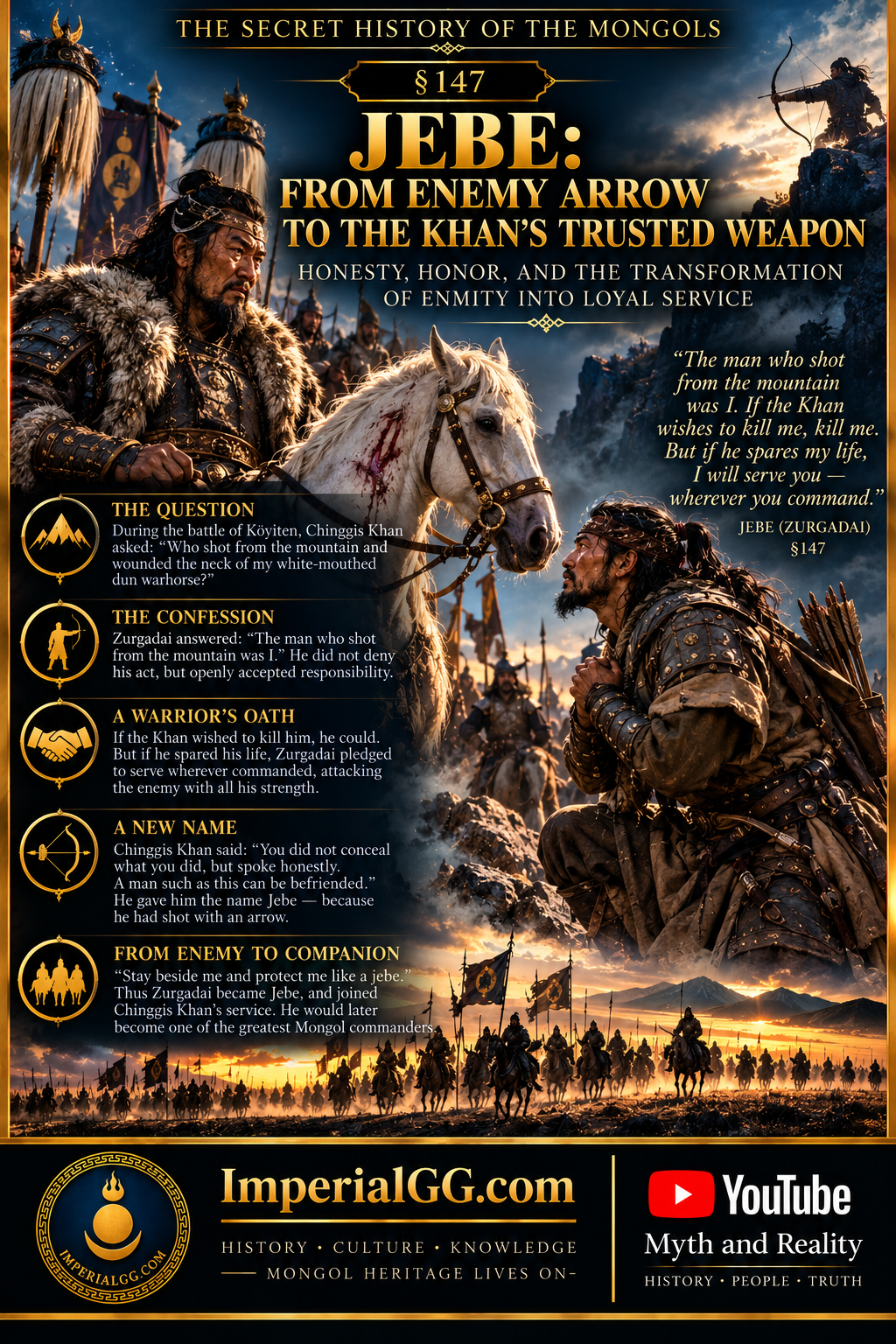
HONESTY, HONOR, AND THE TRANSFORMATION OF ENMITY INTO LOYAL SERVICE
Section 147 of The Secret History of the Mongols presents one of the most revealing encounters in the formation of Chinggis Khan’s early political and military circle. The episode begins with a seemingly simple question concerning the wound inflicted during the battle of Köyiten (Хүйтэн): Chinggis Khan asks who, from the mountain, shot and wounded the neck of his “white-mouthed dun warhorse” (ulaγan ulaγu morin, in the terminology of the Mongolian text). The man who answers is Zurgadai (Зургаадай), a member of the Tayichi’ud (Тайчууд), who openly admits that he was the archer. Chinggis Khan does not execute him. Instead, he recognizes the honesty of his answer, gives him a new name—Jebe (Зэв)—and transforms a man who had moments earlier been an enemy into one of his own trusted military followers. The episode therefore deserves to be read not merely as the anecdotal origin of Jebe’s name, but as a compact narrative about truthfulness, personal honor, reciprocal recognition, and the incorporation of former enemies into the emerging political order of Chinggis Khan.¹
The immediate context is important. Section 143 has described the battle of Köyiten (Хүйтэн), the defeat and fragmentation of the coalition assembled under Jamuqa (Жамуха), and the subsequent pursuit of its constituent forces. Section 144 then describes the dispersal of the defeated commanders and the reorganization of the Tayichi’ud. Section 145 recounts Chinggis Khan’s severe wound and Jelme’s (Зэлмэ) extraordinary effort to save his life, while §146 returns to the theme of personal loyalty through Sorqan Šira (Сорхон-шар) and Qada’an (Хадаан). Section 147 follows naturally from these episodes because it concerns another person whose relationship with Temüjin is transformed through a moment of extreme danger. Yet the direction is different: Jelme demonstrates loyalty from within Temüjin’s circle, whereas Jebe begins as an enemy who had directly caused harm to the future Khan. The narrative therefore places two forms of loyalty beside one another—loyalty demonstrated by service and loyalty created through recognition.²
The wording of Chinggis Khan’s question is particularly significant. According to the Mongolian text supplied in the Secret History, he does not simply say that he himself was wounded. He asks who shot from the mountain and wounded the neck of his white-mouthed dun horse. This formulation has attracted scholarly attention because some interpreters have understood the horse as an indirect or symbolic representation of the Khan himself. A study of Mongol political narratives has specifically argued that the “white-mouthed horse” in this passage functions allegorically because direct reference to the Khan could be avoided through the language of the horse.³ This interpretation is important, but it should remain an interpretation rather than being presented as an explicit explanation supplied by the Secret History itself. The primary text does not say, “I am concealing my own wound by saying that my horse was wounded.” The possibility emerges from the narrative construction and from comparative interpretation of the passage.
There is nevertheless a striking narrative logic in Chinggis Khan’s question. The question creates an opening through which the unknown archer can either conceal his identity or reveal it. Zurgadai chooses the latter. His answer begins without qualification: “The man who shot from the mountain was I.” He does not deny the act, shift responsibility to another man, or attempt to justify himself by claiming that the shooting occurred accidentally. He accepts the consequences of what he has done. He then places his life entirely in Chinggis Khan’s hands, declaring that if the Khan wishes to kill him, he may do so, but if he chooses to spare him, Zurgadai promises to serve wherever he is ordered to go.⁴
The form of Zurgadai’s answer is also significant. His speech is highly rhythmic and constructed through repeated images of water, stone, movement, and attack: wherever the Khan commands him to go, he will leap there; wherever he is ordered to strike, he will strike; he will attack the enemy until the waters churn and the stones are broken. The language is not a bureaucratic declaration of allegiance. It is the language of a warrior placing his physical strength and courage at the disposal of a new lord. The speech therefore performs the transition from enemy to servant in verbal form before the narrative formally confirms that transformation through Chinggis Khan’s response.⁵
The central ethical judgment of the episode is then stated explicitly by Chinggis Khan himself. He observes that an enemy who has attacked and harmed another would ordinarily conceal the deed and lie about it. Zurgadai, however, has not concealed what he did. He has spoken openly about the harm he caused. Chinggis Khan consequently concludes that **“a man such as this can be befriended.”**⁶ This statement is crucial for understanding the political meaning of the episode. The decisive quality is not that Zurgadai had previously been loyal to Temüjin—he had not. Nor is it his lineage, since the episode introduces him as a man from the Tayichi’ud side. What changes his status is his conduct when confronted with responsibility for his action.
This does not mean that the Secret History is presenting a modern principle of universal equality in which lineage has ceased to matter. Such a conclusion would go beyond the evidence. The Mongol political world described throughout the chronicle remained deeply concerned with lineage, kinship, aristocratic status, and inherited political relationships. What §147 demonstrates instead is something more specific: personal conduct could create a new political relationship across an existing line of enmity. Zurgadai’s previous affiliation with the Tayichi’ud does not prevent his incorporation into Chinggis Khan’s circle once his conduct has been judged worthy of trust. This is consistent with a wider pattern in the Secret History, where individuals from different tribal and political backgrounds become important servants of Chinggis Khan through demonstrated loyalty, military ability, or personal service.⁷
The renaming of Zurgadai as Jebe (Зэв) is the narrative culmination of this transformation. Chinggis Khan explains that because Zurgadai had shot the white-mouthed dun horse with an arrow, he would henceforth be called Jebe. The name is associated with the weapon or arrowhead, and Igor de Rachewiltz’s commentary notes that the name can be understood in relation to jebe and jebelegü, with the new name functioning as a permanent reminder of the act through which the warrior entered Chinggis Khan’s service.⁸ Encyclopaedia Iranica likewise identifies Jebe as the new name given to Zurgadai after he joined Chinggis Khan and explains Jebe in relation to the Mongolian term for a weapon.⁹
The naming is therefore more than a simple change of personal designation. It creates a narrative bridge between the act of shooting and the new role of serving. The man who had used the weapon against Chinggis Khan becomes, through the new name, associated with the weapon that Chinggis Khan can now command. De Rachewiltz makes this point especially clearly in his note to the passage: the name Jebe preserves the memory of the deed while simultaneously transforming its meaning, so that the former enemy becomes a weapon in the Khan’s service.¹⁰ The phrase attributed to Chinggis Khan—“Stay beside me and protect me like a jebe”—therefore completes the transformation. The same martial capacity that once threatened the Khan is now incorporated into the Khan’s own power.
There is another important dimension to this exchange. Chinggis Khan does not demand that Zurgadai first pretend innocence before he can be accepted. The narrative instead makes truthfulness the basis for reconsidering the relationship. This is particularly striking because Zurgadai’s honesty does not erase the fact that he had attacked Chinggis Khan. The act remains the very reason he is being questioned. What changes is the Khan’s evaluation of the man who committed it. The Secret History thus distinguishes between an enemy action and the character revealed by the person who performed that action. Zurgadai has been an enemy, but his willingness to acknowledge what he did provides evidence about the kind of man he is.
This distinction helps explain why the passage should not be reduced to a simple story of “forgiveness.” Chinggis Khan does not merely forgive an enemy and send him away. He recruits him. The relationship is transformed from hostility into political and military service. The episode consequently illustrates a form of incorporation that becomes increasingly important in the rise of Chinggis Khan: people who had belonged to competing political communities could be absorbed into a new political order when their abilities and conduct were judged useful and trustworthy. Jebe would subsequently become one of the most prominent commanders of the Mongol Empire. Peter Jackson’s Encyclopaedia Iranica entry records his later rise from a relatively junior command to command of a tümen and his major role in the Mongol campaigns across northern China and, later, westward across Central Asia and the Caucasus.¹¹
The episode also deserves to be placed beside §145, in which Jelme saves Chinggis Khan’s life. In §145, loyalty is demonstrated through extraordinary personal service: Jelme remains beside the wounded Temüjin, absorbs blood from his wound, risks entering the enemy camp, obtains nourishment, and returns without being detected. Chinggis Khan explicitly remembers these acts as three services that he will never forget. In §147, by contrast, Jebe has no prior record of loyalty in the narrative at the moment of his capture. His entry into Chinggis Khan’s service begins with an admission of hostility. The juxtaposition is therefore powerful: Jelme proves loyalty through service; Jebe earns trust through truthfulness and then promises future service. The two episodes together reveal different pathways by which personal loyalty is constructed around the emerging Khan.
The connection with §146 is equally significant. Sorqan Šira’s loyalty is expressed through judgment and timing, while Qada’an’s loyalty is expressed through recognition of the man she had known as Temüjin. Section 147 adds another dimension: the former enemy demonstrates that a relationship can be rebuilt through truthful speech and willingness to accept the consequences of one’s actions. In this sequence, the Secret History repeatedly returns to a world in which political relationships are not determined solely by abstract institutional rules. They are created, tested, remembered, and transformed through individual encounters.
The symbolism of the horse should also be considered carefully. Horses occupy a central place in the narrative world of the Secret History, and recent scholarship has emphasized their broader narrative and metaphorical functions. A 2024 study of the Secret History argues that horses can operate as literary devices through which the narrative represents the circumstances and qualities of historical figures, rather than appearing merely as incidental elements of nomadic life.¹² Another recent study specifically examining the metaphorical use of horses and color in the Secret History similarly argues that horses can participate in the chronicle’s symbolic characterization.¹³ These studies do not by themselves prove that the white-mouthed dun horse in §147 is necessarily a symbolic substitute for Chinggis Khan. They do, however, provide a scholarly basis for taking the horse imagery seriously as part of the narrative construction rather than treating it as an insignificant detail.
There is also evidence that the episode was understood differently in another major Mongolian historical tradition. Rashīd al-Dīn’s Jāmiʿ al-Tawārīkh gives a different account of the horse and associates the wounded white horse with Burji Noyan rather than with Chinggis Khan himself. This divergence is important because it demonstrates that the episode cannot simply be treated as an independently verified description of the physical circumstances of the battle. The Secret History is itself a distinctive Mongolian narrative source whose literary construction, direct speeches, and retrospective shaping require careful interpretation.¹⁴ The safest historical approach is therefore to distinguish the source’s narrative from later reconstructions: in the Secret History, Chinggis Khan asks who wounded the white-mouthed dun horse; Zurgadai admits that he shot from the mountain; Chinggis Khan accepts his honesty, renames him Jebe, and incorporates him into his service. The further interpretation that the horse indirectly represents the Khan is a plausible scholarly reading, not an explicit statement of the source.
The passage is particularly revealing when considered against the broader political transformation occurring around Temüjin at this stage. The destruction and incorporation of rival groups had not yet produced the fully institutionalized empire of 1206 and after. Nevertheless, the narrative increasingly shows the emergence of a political order in which people from different tribal backgrounds could be brought into the Khan’s personal military structure. Jebe’s incorporation is therefore significant precisely because he does not begin inside the innermost circle of Temüjin’s kin or early companions. His value is demonstrated through a combination of martial ability, courage, directness, and willingness to place himself under the Khan’s authority. The later career of Jebe shows how consequential this early act of incorporation became.¹⁵
At the same time, we should not turn §147 into a generalized claim that the Mongol political order simply rejected lineage in favor of merit. The Secret History provides abundant evidence that genealogy, kinship, aristocratic connections, and inherited status continued to structure political life. What this passage demonstrates is narrower and more historically defensible: a person’s conduct in a decisive encounter could alter his political position, even when he came from an opposing group. The capacity to recognize such individuals and incorporate them into a new political coalition was itself an important feature of Temüjin’s rise.
AUTHOR’S THESIS
Section 147 can therefore be read as a compact statement about the political culture emerging around Chinggis Khan. The decisive moment is not simply that Zurgadai shot the Khan’s horse, nor even that Chinggis Khan spared his life. The deeper significance lies in the sequence by which hostility is acknowledged, truthfulness is recognized, punishment is replaced by incorporation, and a new identity is created through the name Jebe. The narrative presents a warrior who does not erase his former hostility by lying about it; instead, he accepts responsibility for his action and offers his strength to the man who now has power over his life. Chinggis Khan, in turn, recognizes that honesty as a quality worthy of trust and converts an enemy’s martial capacity into an instrument of his own political order.
The passage may therefore preserve an important aspect of steppe political ethics: a warrior’s worth could be demonstrated not only by whom he belonged to, but also by how he conducted himself when confronted with danger, responsibility, and authority. The Secret History does not present this as a universal rejection of lineage or inherited political status. Rather, it shows how personal honor, truthful speech, courage, and demonstrated ability could create a new relationship across the boundary between former enemies. In that sense, Jebe’s transformation from Zurgadai, the archer who wounded the Khan’s horse, into Jebe, the “weapon” who would serve beside the Khan, becomes one of the clearest narrative examples of how Chinggis Khan converted the abilities of former enemies into the strength of an expanding political order.
FOOTNOTES
1. The Secret History of the Mongols, §147; Igor de Rachewiltz, trans., The Secret History of the Mongols: A Mongolian Epic Chronicle of the Thirteenth Century, vol. I (Leiden: Brill, 2004), discussion and notes to §147. De Rachewiltz identifies the passage as the episode in which Jirqo’adai/Zurgadai becomes Jebe. Iranica Online
2. On the character of the Secret History as a Mongolian narrative concerning the formation of Chinggis Khan’s political order, see Jun Pin Tay and Andrea Nanetti, “The Secret History of the Mongols. A Digital History Approach,” Journal of Digital History (2024). The study emphasizes the source’s value for understanding Mongolian political organization, social relations, and the relationship between rulers and followers. Journal of Digital History
3. On the interpretation of the white-mouthed/yellow or dun warhorse as a possible indirect representation of the Khan, see the discussion in the modern scholarship on Mongol political narratives summarized in “Mongol Noyans in Greater Armenia (1220–1245),” which notes the possibility that the horse functions allegorically in §147. This is an interpretation rather than an explicit statement in the Secret History. ResearchGate
4. The Secret History of the Mongols, §147. De Rachewiltz’s commentary preserves the warrior’s extended declaration of willingness to serve wherever the Khan commands him to go. AnyFlip
5. On the poetic and metaphorical construction of the Secret History, including the narrative function of horses and other literary devices, see Ahn Hyunjae, “The Narrative Function of Horses in The Secret History of the Mongols: Representatives of Personal Narratives,” Gushan Chinese Journal 11 (2024), pp. 7–33. KCI
6. The Secret History of the Mongols, §147. The source explicitly contrasts an enemy who conceals his hostile action with Zurgadai, who admits what he has done. De Rachewiltz’s translation and notes preserve this contrast. AnyFlip
7. For the broader historical significance of incorporating individuals from different tribal and political backgrounds into Chinggis Khan’s expanding political order, see Peter Jackson, “Jaba,” Encyclopaedia Iranica. Jackson identifies Jebe as originally associated with the Besüt and records his rise within Chinggis Khan’s military hierarchy. Iranica Online
8. Igor de Rachewiltz, commentary to §147. His note explains the relationship between jebe, jebelegü, and the renaming of Jirqo’adai, while also emphasizing the connection between the name and the deed through which he entered Chinggis Khan’s service. AnyFlip
9. Peter Jackson, “Jaba,” Encyclopaedia Iranica. Jackson gives Jebe’s original name as Jirḡoʾadai/Jirqutāy and identifies Jebe as a Mongolian term associated with “weapon.” Iranica Online
10. De Rachewiltz, commentary to §147. The interpretation that the new name preserves the memory of the act while converting its significance into a form of service is particularly important for understanding the narrative structure of the passage. AnyFlip
11. Jackson, “Jaba,” Encyclopaedia Iranica. Jackson describes Jebe’s subsequent rise from a lower command to command of a tümen and his participation in major Mongol campaigns in China, Central Asia, the Caucasus, and the western steppe. Iranica Online
12. Ahn Hyunjae, “The Narrative Function of Horses in The Secret History of the Mongols: Representatives of Personal Narratives,” Gushan Chinese Journal 11 (2024), pp. 7–33. KCI
13. Ahn Hyunjae, “Metaphorical Character Criticism in the Secret History of the Mongols: Black-and-White Contrast and Horses,” Central Asian Studies 29, no. 1 (2024), pp. 81–103. The study argues that color and horse imagery can contribute to the narrative characterization of figures in the Secret History. KCI
14. Peter Jackson, “Jaba,” Encyclopaedia Iranica, and the cited Mongolian/Persian source tradition. Jackson notes the differing etymological explanations and uses of the Jebe episode in the Secret History and Rashīd al-Dīn. Iranica Online
15. For the later historical career of Jebe, including the western campaign with Sübe’etei and the uncertainty surrounding his death, see Stephen Pow, “The Last Campaign and Death of Jebe Noyan,” Journal of the Royal Asiatic Society 27, no. 1 (2017): 31–51. Cambridge University Press
SELECTED BIBLIOGRAPHY
- Ahn, Hyunjae. “Metaphorical Character Criticism in the Secret History of the Mongols: Black-and-White Contrast and Horses.” Central Asian Studies 29, no. 1 (2024): 81–103. KCI
- Ahn, Hyunjae. “The Narrative Function of Horses in The Secret History of the Mongols: Representatives of Personal Narratives.” Gushan Chinese Journal 11 (2024): 7–33. KCI
- de Rachewiltz, Igor, trans. The Secret History of the Mongols: A Mongolian Epic Chronicle of the Thirteenth Century. 2 vols. Leiden: Brill, 2004.
- Jackson, Peter. “Jaba.” Encyclopaedia Iranica. Iranica Online
- Pow, Stephen. “The Last Campaign and Death of Jebe Noyan.” Journal of the Royal Asiatic Society 27, no. 1 (2017): 31–51. Cambridge University Press
- Tay, Jun Pin, and Andrea Nanetti. “The Secret History of the Mongols. A Digital History Approach.” Journal of Digital History (2024).