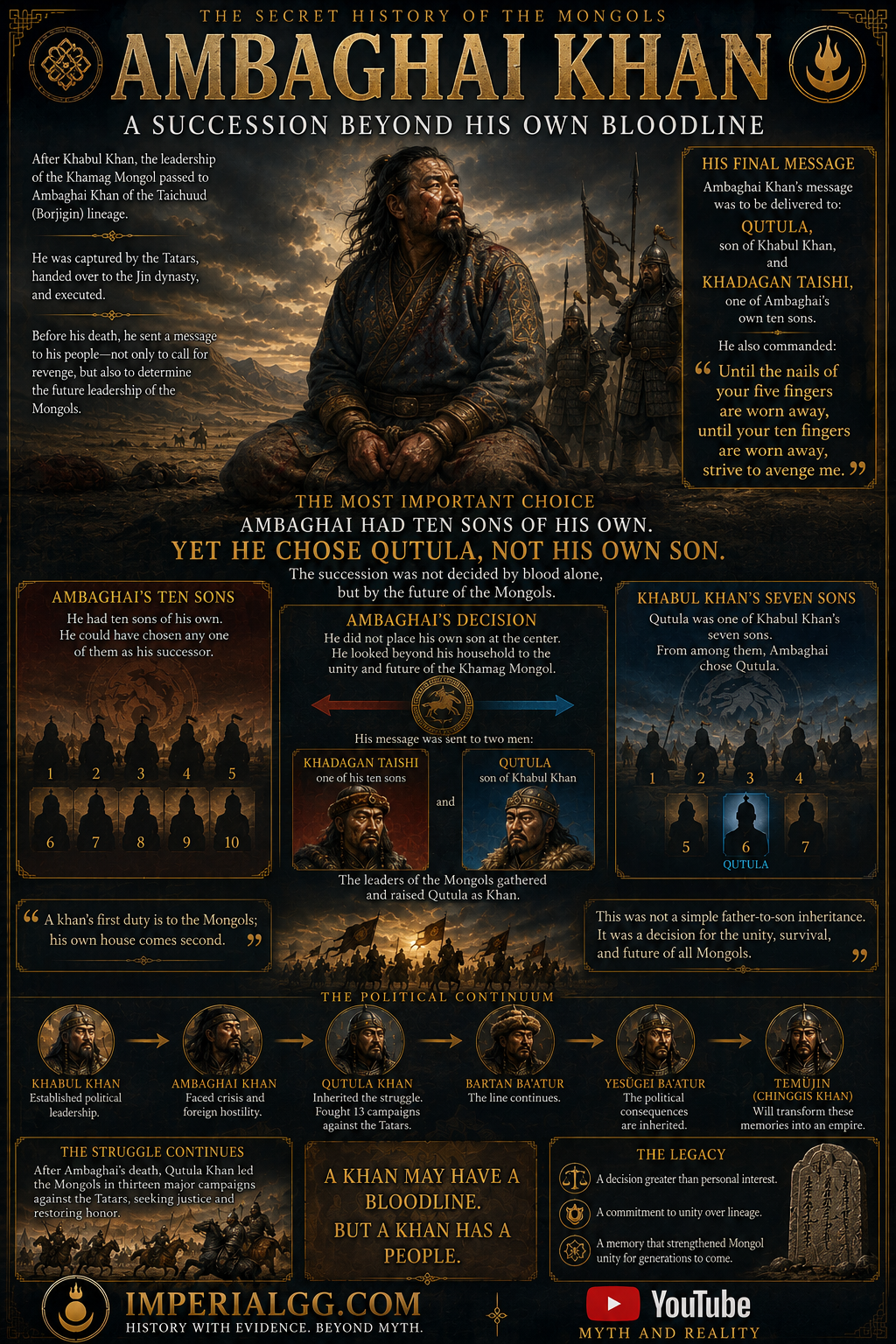
AMBAQAI QAHAN: THE SECOND SOVEREIGN OF THE MONGOLS
By Altanbagana Baatar
DBA Candidate| Independent Historian
ImperialGG Historical Research Seriers
04 September 2026
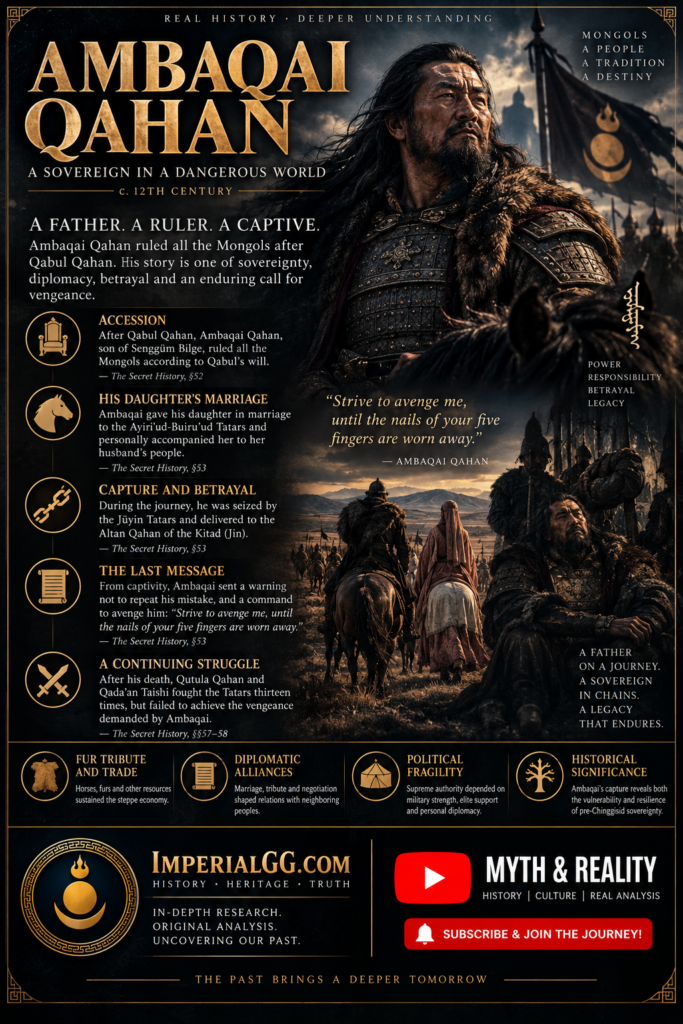
AMBAQAI QAHAN: SOVEREIGNTY, CAPTIVITY, AND POLITICAL CRISIS IN THE PRE-CHINGGISID MONGOL WORLD
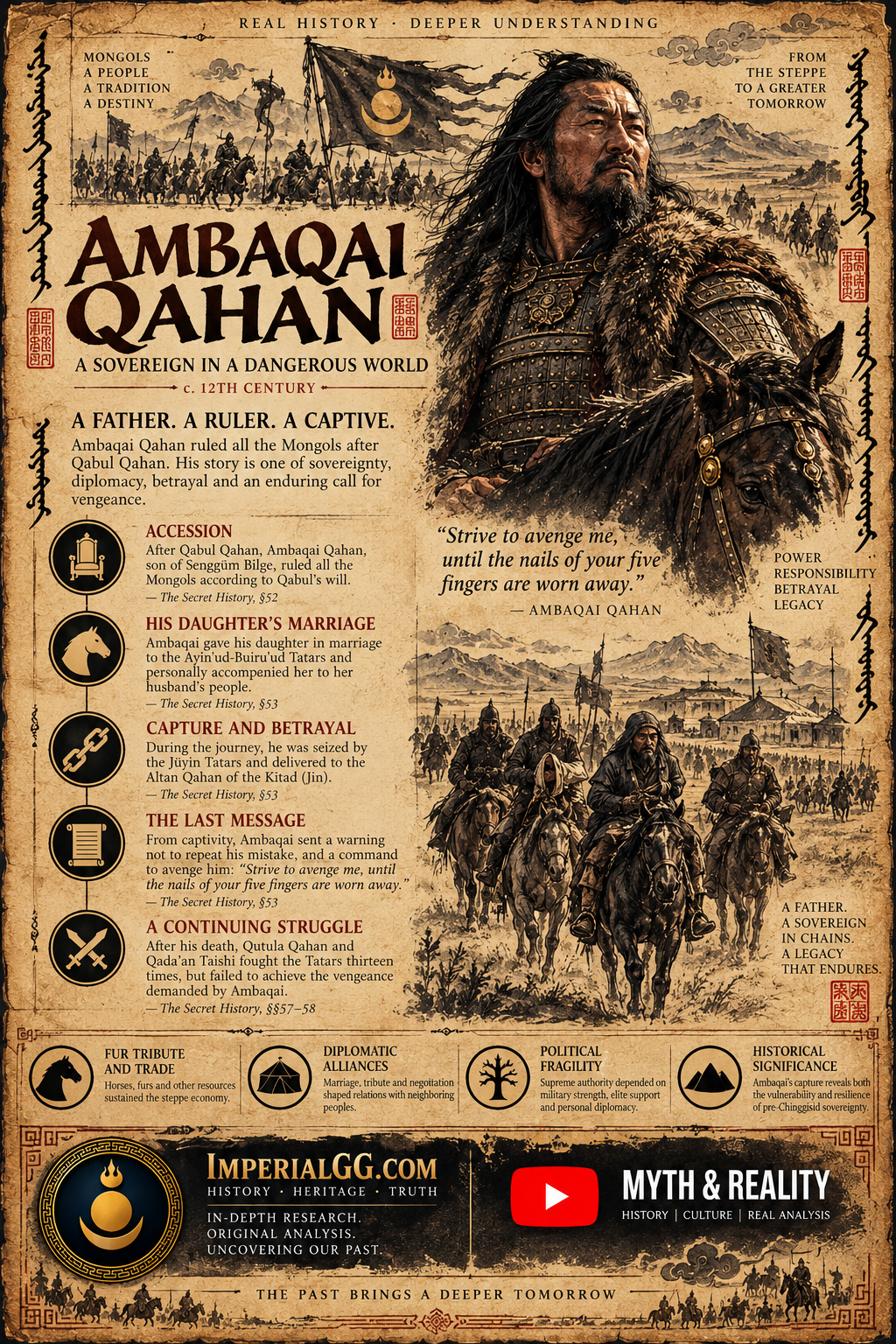
INTRODUCTION
Ambaqai Qahan occupies a relatively brief but exceptionally important place in the Secret History of the Mongols. The source identifies him as the successor of Qabul Qahan and states that he ruled “all the Mongols” according to Qabul’s will.[1] His historical significance therefore lies not simply in his position within the genealogy of the Mongol ruling house, but in the political circumstances surrounding his accession, his relations with neighboring steppe groups, his capture by the Tatars, and the consequences of his execution for the subsequent leadership of the Mongols. His career provides important evidence for understanding the character of pre-Chinggisid Mongol sovereignty at a time when political authority depended upon dynastic legitimacy, inter-group alliances, military power, and collective recognition.
The surviving sources do not provide a continuous biography of Ambaqai, nor do they preserve a detailed description of his physical appearance, personal character, or administrative activities. Consequently, claims that he was exceptionally large in stature, unusually intelligent, or personally heroic must be treated as later characterization unless supported by independent evidence. What can be established from the primary tradition is more specific: Ambaqai occupied the highest political position among the Mongols, participated personally in a marriage-related diplomatic journey, was captured by the Tatars, was transferred toward the Jin court, and, while in captivity, communicated instructions concerning both succession and retaliation.[2] These events make his career particularly valuable for reconstructing the political vulnerabilities of the pre-imperial Mongol polity.
AMBAQAI’S ACCESSION TO SUPREME POWER
The succession from Qabul to Ambaqai is one of the most revealing episodes in the Secret History. Qabul had seven sons, among them Qutula, yet the supreme position did not pass automatically to one of his sons. Instead, Ambaqai, the son of Senggüm Bilge, succeeded him. The Secret History explicitly states that Ambaqai ruled all the Mongols “according to Qabul Qahan’s word.”[1] The formulation is significant because it indicates that political succession within the ruling genealogy could move between different branches of the ruling house rather than following a simple father-to-son principle.
This distinction is important when reconstructing the political institutions of the twelfth-century Mongols. The pre-Chinggisid title qahan/qan should not be equated without qualification with either the modern concept of a hereditary monarch or the later imperial title Qa’an. Igor de Rachewiltz has emphasized the distinction between the earlier use of qan and the later imperial qa’an, identifying Qabul, Ambaqai, and Qutula among the rulers who held the former title before the establishment of Chinggisid imperial succession.[3] A recent study likewise argues that the pre-imperial Mongol khanate should not be understood as a continuously hereditary institution and that the title was associated with rulers capable of securing the allegiance of several political groups or ruling houses.[4]
Ambaqai’s accession consequently illustrates a political system in which genealogy provided legitimacy but did not by itself determine succession. His authority derived from his position within the ruling lineage and from the political recognition that accompanied Qabul’s designation. This distinction becomes even more apparent after Ambaqai’s death, when the Mongol political community again had to determine who would occupy the supreme position.
THE MARRIAGE OF AMBAQAI’S DAUGHTER
The most detailed episode concerning Ambaqai’s personal life concerns the marriage of his daughter. According to the Secret History, Ambaqai gave his daughter in marriage to the Ayiri’ud-Buiru’ud Tatars, who were associated with the region around the Urši’un River between Lake Buyur and Lake Kölen.[2] The marriage must be understood within the broader political environment of the eastern steppe, where marital relationships could serve to establish or reinforce relations between ruling groups.
The source states that Ambaqai personally accompanied his daughter on the journey. It is important not to romanticize this action beyond what the evidence permits. The Secret History does not explain his motives in psychological terms and does not explicitly state that he accompanied her because of paternal anxiety. Nevertheless, the fact itself is significant: the ruler who held supreme authority over the Mongols personally participated in the movement of his daughter to her husband’s community. The journey placed him within territory where political relationships were unstable and where the distinction between diplomatic interaction and military hostility could rapidly disappear.
During this journey Ambaqai was seized by members of the Jüyin Tatars.[2] His capture transformed what had begun as a dynastic and diplomatic undertaking into a major political crisis. The source subsequently states that he was delivered to the ruler of the Jin, described in the Secret History as the Altan Qahan of the Kitad.[2] The precise political coordination between the Tatars and the Jin authorities remains a matter requiring source-critical treatment. The Secret History records the sequence of capture and transfer but does not itself provide sufficient evidence to reconstruct the entire decision-making process behind the episode.
CAPTURE AND THE LOSS OF A SOVEREIGN
Ambaqai’s capture was politically consequential because he was not merely an aristocratic member of the Mongol ruling house. He was the individual whom the source identifies as ruler of all the Mongols.[1] His removal therefore created a problem of political continuity. The Mongol political community had to function without its recognized Qahan while simultaneously confronting the external power responsible for his execution.
The circumstances of his capture also reveal the vulnerability of pre-Chinggisid sovereignty. Political authority on the steppe depended heavily upon the mobility of the ruler, personal diplomacy, kinship networks, and military protection. The same mobility that enabled a ruler to maintain relations with neighboring groups could expose him directly to danger. Ambaqai’s journey demonstrates that supreme political status did not remove the ruler from the risks experienced by other members of the ruling elite.
The episode is consequently important not because it proves that Ambaqai was careless or politically incompetent, but because it illustrates the structural risks of a political system in which rulers personally participated in diplomatic and dynastic affairs.
AMBAQAI’S FINAL MESSAGE
The most significant evidence for Ambaqai’s political thought comes from the message he sent after his capture. The Secret History states that he communicated through Balayači of the Besü’üd to Qutula, one of Qabul’s sons, and Qada’an Taishi, one of Ambaqai’s own sons.[2] His message contained both a warning and an instruction. He warned the future rulers of the Mongols not to repeat his action of personally accompanying a daughter on such a journey, and he urged them to avenge his capture and execution.
The language used in the source is highly formulaic and rhetorically powerful. Ambaqai calls upon those who follow him to continue the struggle until their fingers and nails are worn down.[2] This should not be interpreted merely as a personal expression of anger. Within the political culture represented by the Secret History, the killing of a ruler could create an obligation extending beyond the individual victim to his successors and political community. Ambaqai’s final message therefore connected his personal fate with the continuity and honor of Mongol political authority.
At the same time, the episode demonstrates that Ambaqai remained concerned with succession while facing his own death. His message was directed not simply toward revenge but toward the individuals who could assume responsibility for the Mongol political community. This is one reason why his final words are historically more significant than a conventional account of martyrdom: they reveal the political problem created by his captivity and the mechanisms through which the Mongols attempted to preserve continuity.
SUCCESSION AFTER AMBAQAI
The question of succession after Ambaqai requires particular attention because later summaries sometimes describe him as having simply appointed Qutula as his successor. The evidence is more complicated. J. Gerelbadrakh’s study of the relevant sources argues that Ambaqai’s final designation involved both Qutula and Qada’an and that the ultimate selection occurred through a political gathering rather than through an unconditional unilateral appointment.[5]
The Secret History states that the Mongols and the Tayichi’ut subsequently assembled at Qorqonaq by the Onon and made Qutula their Qahan.[6] This event demonstrates that Ambaqai’s death did not terminate the political institution he represented. Instead, the Mongol political community assembled and recognized a successor. The episode therefore provides evidence for a form of collective political legitimation operating alongside dynastic principles.
The relevant political sequence is therefore Qabul Qahan → Ambaqai Qahan → Qutula Qahan, while the genealogical relationship must be represented separately. Ambaqai was not the father of Qutula, and Qutula’s later position should not be interpreted as the automatic continuation of a father-to-son succession. The distinction between political succession and genealogy is essential for an accurate reconstruction of the period.
THE UNFINISHED REVENGE
Ambaqai’s final command produced an immediate military consequence. After Qutula’s elevation, he and Qada’an Taishi conducted campaigns against the Tatars. The Secret History records thirteen encounters with the Tatar leaders Kötön Baraqa and Jali Buqa, but states that they failed to achieve the desired vengeance for Ambaqai.[6]
This failure is historically significant. The narrative does not depict the death of Ambaqai as the beginning of an immediate Mongol victory. Instead, his execution became part of a prolonged conflict in which the Mongols attempted, unsuccessfully, to impose a political and military response upon the Tatars. The episode illustrates both the strength of the obligation created by Ambaqai’s final command and the limitations of the political and military resources available to his successors.
His death therefore belongs to a broader period of instability preceding the rise of Temüjin. The Mongols possessed a recognized supreme leadership institution, but that institution had not yet produced the durable political consolidation that would characterize the Chinggisid transformation.
AMBAQAI AS A HISTORICAL FIGURE
The historical Ambaqai must therefore be distinguished from the heroic image that can easily emerge from later retellings. The surviving primary account does not allow us to reconstruct his personality in detail. It does, however, allow us to establish several important characteristics of his political career.
He was recognized as Qahan of all the Mongols; he succeeded Qabul through a political decision associated with Qabul’s will; he participated personally in a marriage-related diplomatic journey; he was captured by the Tatars; he was transferred toward the Jin court; and while facing execution he communicated instructions concerning both political succession and retaliation.[1][2]
The combination of these facts makes Ambaqai an important figure in the history of Mongol political development. His significance lies not in a long list of conquests, for the sources do not provide such a list, but in the evidence his career provides for the functioning and vulnerability of pre-Chinggisid sovereignty.
CONCLUSION
Ambaqai Qahan’s historical importance rests on the intersection of personal experience and political structure. He was a sovereign who personally accompanied his daughter during a marriage journey, was captured by the Tatars, transferred toward the Jin court, and ultimately executed. His captivity removed the recognized ruler of the Mongols and created an immediate problem of political succession. His final message transformed his individual fate into a political obligation for those who survived him, while the subsequent elevation of Qutula demonstrated that the Mongol political community possessed mechanisms for restoring supreme leadership.
The episode also illustrates the limitations of hereditary succession as an explanatory model for the pre-Chinggisid Mongols. Qabul’s successor was Ambaqai rather than one of his seven sons, while Qutula’s elevation after Ambaqai required collective recognition. Political authority was therefore rooted in genealogy but mediated through political choice, elite consensus, and the capacity of a ruler to represent a wider Mongol community.
Ambaqai’s story should consequently be understood neither as a simple tale of martyrdom nor as a minor episode preceding the career of Chinggis Qahan. It provides direct evidence for the political order that existed before the Chinggisid transformation. His capture exposed the vulnerability of that order; his final message articulated the responsibilities of its successors; and the political response to his death demonstrates that the institution of supreme Mongol rulership survived the loss of its incumbent.
In this sense, Ambaqai Qahan represents a critical stage in the development of Mongol sovereignty: a ruler whose personal tragedy became a political crisis, and whose final instructions became part of the political memory inherited by the generations that followed.
FOOTNOTES
1. The Secret History of the Mongols, §52. The text identifies Ambaqai, son of Senggüm Bilge, as the ruler of all the Mongols after Qabul Qahan and states that he ruled according to Qabul’s will. The Secret History of the Mongols — scholarly text
2. The Secret History of the Mongols, §53. The account describes Ambaqai’s daughter’s marriage to the Ayiri’ud-Buiru’ud Tatars, his personal accompaniment of her, his capture by the Jüyin Tatars, his transfer toward the Jin ruler, and his final message to Qutula and Qada’an. The Secret History of the Mongols — Rachewiltz translation
3. Igor de Rachewiltz, “Qan, Qa’an and the Seal of Güyüg,” East Asian History 43. The article discusses the distinction between qan and the later imperial qa’an and the pre-Chinggisid rulers associated with the title. East Asian History — de Rachewiltz
4. “The Objects of Loyalty in the Early Mongol Empire (Twelfth and Thirteenth Centuries),” 2021. The study examines the political basis of loyalty and rulership in the pre-imperial Mongol period and discusses Qabul, Ambaqai, and Qutula. Journal article DOI
5. J. Gerelbadrakh, “Did Ambaqai qahan order that Qutula be king?” Acta Mongolica 4 (236), 2005, pp. 187–190. Acta Mongolica — National University of Mongolia
6. The Secret History of the Mongols, §§57–58. The Mongols and Tayichi’ut assembled at Qorqonaq by the Onon and made Qutula Qahan; Qutula and Qada’an subsequently fought the Tatars thirteen times. The Secret History of the Mongols — scholarly text