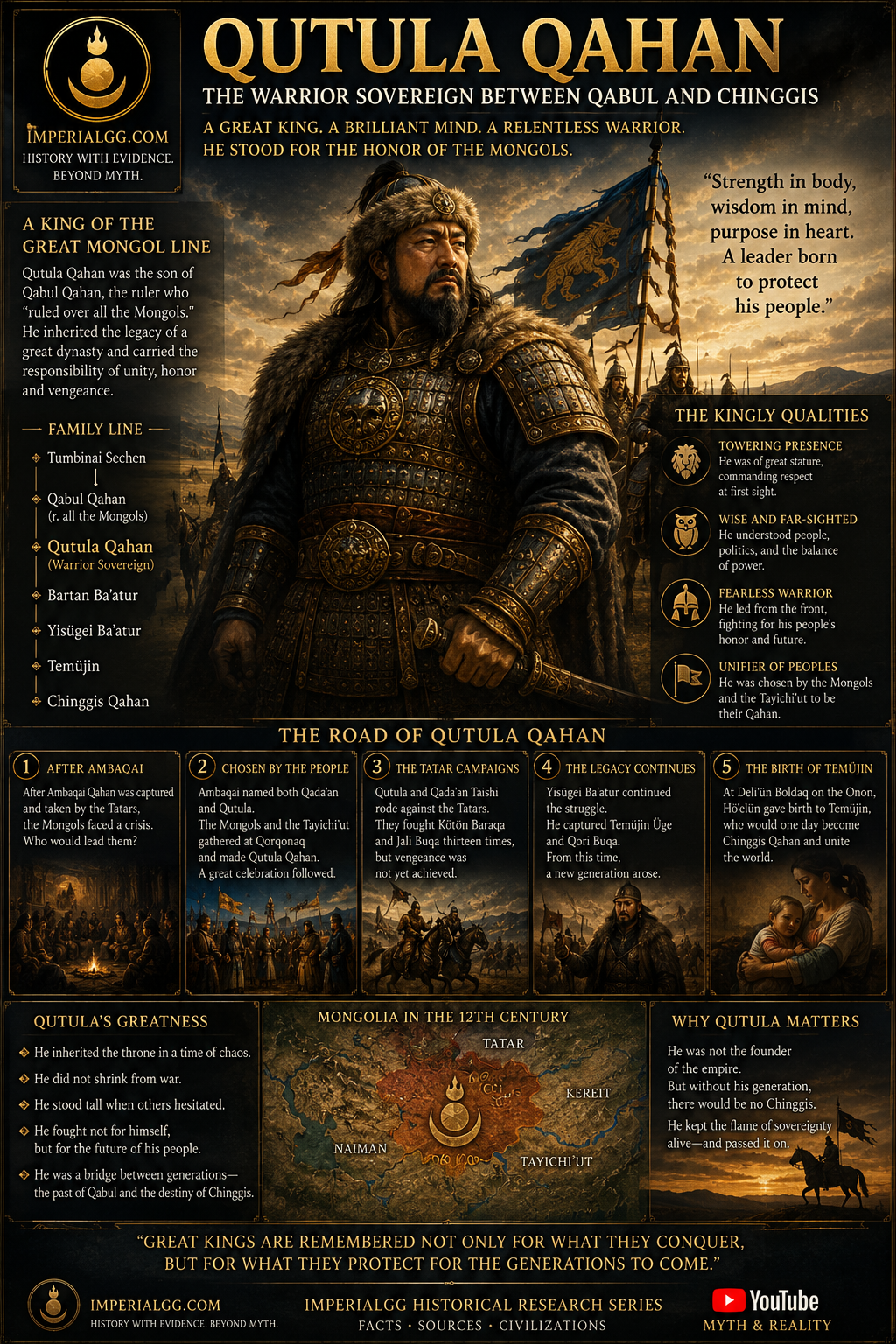
QUTULA QAHAN: THE WARRIOR KING BETWEEN QABUL AND CHINGGIS
By Altanbagana Baatar
DBA Candidate| Independent Historian
ImperialGG Historical Research Seriers
05 September 2026
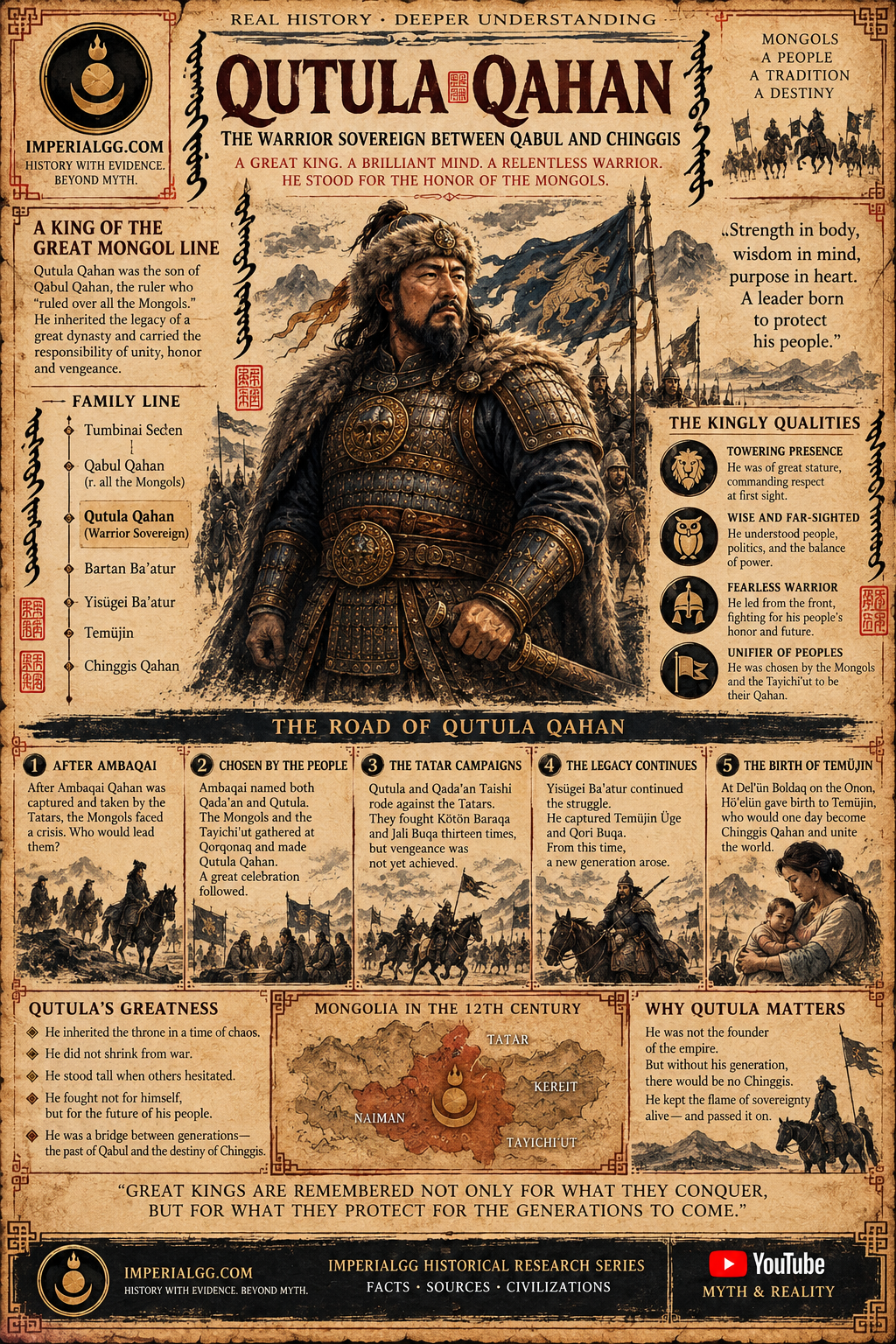
THE STRUGGLE FOR MONGOL SOVEREIGNTY IN THE TWELFTH CENTURY
Before Chinggis Khan united the Mongols in 1206, the Mongolian Plateau had already produced a succession of rulers who carried the title qahan/qan and exercised authority over substantial Mongol political groupings. Among them, Qutula Qahan, known in modern Mongolian as Хотул хаан, occupies a particularly important position.
He was a son of Qabul Qahan, the ruler whom the Secret History of the Mongols says “ruled over all the Mongols.” Qutula therefore belonged directly to the ruling house from which the later Chinggisid imperial dynasty emerged. Yet Qutula’s importance is not merely genealogical. His short and turbulent career reveals something fundamental about Mongol politics before 1206:
Mongol sovereignty was already organized around recognized khans, competing aristocratic houses, assemblies, military mobilization, dynastic legitimacy, and the necessity of securing the allegiance of major political groups. The rise of Chinggis Khan therefore did not occur in a political vacuum. It was the culmination of a much longer history.
QABUL QAHAN AND THE HOUSE OF QUTULA
The Secret History of the Mongols places Qutula within the direct line of the ruling house.
Its genealogy states: Tumbinai-sechen → Qabul Qahan → Qutula Qahan → the generation of Yisügei → Chinggis Khan
More precisely, Qabul had seven sons, among them Ökin-barqaq, Bartan-ba’atur, Qutuqtu Mönggür, Qutula, Qulan, Qada’an, and Tödö’en-otchigin. Qutula is explicitly identified as Qabul’s son. This genealogy is significant because it places Qutula within the same ruling lineage that eventually produced Temüjin. The political significance becomes clearer when the succession is considered.
The Secret History states: “Qabul Qa’an ruled over all the Mongols.”
After Qabul, however, succession did not automatically pass to one of his seven sons. Instead, Ambaqai Qahan, a descendant of Senggüm Bilge, became ruler. This is already an important indication that pre-imperial Mongol sovereignty was not simply hereditary primogeniture.
THE SUCCESSION OF AMBAQAI
The succession from Qabul to Ambaqai is especially important. The Secret History says that Ambaqai became ruler of all the Mongols “by Qabul Qahan’s will.” This suggests that dynastic legitimacy could extend beyond direct father-to-son succession. A ruler could designate or support another member of the ruling aristocracy. That political principle becomes even more important after Ambaqai’s capture by the Tatars.
According to the Secret History, Ambaqai was captured while taking his daughter to the Ayiri’ut-Buiru’ut Tatars living around the Urshi’un River between Lakes Buyur and Kölen. He was subsequently delivered to the Jin court. His death created a political crisis. The Mongols now required another ruler. And the choice was not simply automatic.
QUTULA WAS CHOSEN
This is one of the most important passages in the Secret History. The text explains that Ambaqai had named both Qada’an and Qutula.
Then: the Mongols and the Tayichi’uts gathered together in the Qorqonaq forest by the Onon and made Qutula their qahan.
This is an extraordinarily important political description. Qutula was not simply announced as king by private family inheritance.
Political groups gathered. A ruler was selected. The Mongols and Tayichi’uts participated. And Qutula was ceremonially elevated as qahan.
The Secret History then describes the extraordinary celebration surrounding his elevation: dancing and feasting around the Many-Leaved Tree of Qorqonaq until the ground was deeply worn. This was not merely a private succession ceremony. It was a public act of political recognition.
ELECTION, LEGITIMACY, AND THE PRE-IMPERIAL MONGOL STATE
Modern historians sometimes describe pre-1206 Mongol politics primarily through the language of “tribal confederations.” That terminology can obscure what the sources actually describe. The case of Qutula demonstrates several recognizable political mechanisms: dynastic legitimacy → selection of a ruler → assembly of political constituencies → ceremonial elevation → military command
The title qahan was attached to a ruler whose authority extended beyond his immediate household. A recent study of loyalty and political authority in the early Mongol world likewise notes that the title khan was not consistently held by every local leader; it tended to be associated with rulers who united important groups or political houses under their leadership. The study specifically identifies Qabul, Ambaqai, and Qutula among the pre-imperial Mongol rulers carrying the title.
This is crucial for understanding the political world into which Chinggis Khan was born.
QUTULA AND THE TATAR WAR
Once elevated, Qutula immediately confronted the central problem inherited from Ambaqai: revenge against the Tatars.
The Secret History states that Qutula and Qada’an Taishi rode against the Tatars. They fought the Tatar leaders Kötön Baraqa and Jali Buqa thirteen times. But they failed to avenge Ambaqai. The repeated campaigns are important.
They show that Qutula’s authority was not merely ceremonial. The newly elevated qahan immediately exercised military leadership. The political legitimacy of the ruler was tied directly to the ability to defend the interests of the Mongol political community.
THIRTEEN BATTLES — AND NO DECISIVE REVENGE
The number thirteen is explicitly preserved in the Secret History. But the source does not provide a detailed narrative of every battle. Therefore an academic reconstruction should resist the temptation to invent tactical details.
What can be said with confidence is that: Qutula and Qada’an repeatedly campaigned against the Tatars but failed to achieve the revenge demanded for Ambaqai’s death.
This failure is politically significant. A ruler’s legitimacy could be strengthened by military success. Repeated failure, by contrast, could weaken the authority of a ruling house. The subsequent history of the Mongols suggests precisely such political fragmentation.
THE RISE OF YISÜGEI
While Qutula remained the recognized qahan in the dynastic narrative, another member of the same broader ruling family began to emerge: Yisügei Ba’atur. Yisügei was Qutula’s nephew, the son of Qabul’s son Bartan-ba’atur. He was therefore part of the same ruling lineage. The Secret History places Yisügei immediately after the account of Qutula’s unsuccessful campaigns. Yisügei subsequently captured the Tatars Temüjin Üge and Qori Buqa, among others.
This episode is extraordinarily important for the history of Chinggis Khan. Hö’elün was pregnant when Yisügei returned from this campaign. At Deli’ün Boldaq on the Onon River, she gave birth to the child who would become Temüjin. The Secret History explicitly connects the child’s name with the captured Tatar Temüjin Üge. Thus, within the narrative structure of the source, Qutula’s war against the Tatars forms the immediate political background to the birth of Chinggis Khan.
THE END OF QUTULA’S LINE OF SOVEREIGNTY
Qutula did not establish a stable hereditary succession. The political authority associated with his generation weakened. A modern scholarly treatment of the pre-imperial Mongols notes that after Qutula there was no consistently recognized Mongol khan until the rise of Chinggis Khan, although Yisügei remained an important political leader. This is a critical distinction.
Yisügei was undoubtedly influential. But the Secret History does not present him as having been formally elevated through the same qahan ceremony that had made Qutula ruler. Indeed, this difference becomes part of the ideological architecture of the Secret History.
The text carefully distinguishes between: being a powerful ba’atur and being formally raised as qahan. That distinction would later make Temüjin’s own elevation politically significant.
THE SECRET HISTORY AND THE POLITICS OF MEMORY
We must also recognize the nature of our principal source. The Secret History of the Mongols was produced after the rise of Chinggis Khan and is therefore not a neutral contemporary administrative record. Modern scholarship emphasizes that the work is both a historical narrative and a politically meaningful construction of the Mongol past. T. H. Barrett, for example, notes the continuing scholarly debate over its date, purpose, and historical value. This does not make the text useless.
Quite the opposite. It means that it must be read at two levels: as evidence for remembered historical events and evidence for how the Mongol ruling tradition wanted its own political past to be remembered. Qutula is particularly valuable on both levels.
WHY QUTULA MATTERS FOR THE HISTORY OF MONGOL SOVEREIGNTY
Qutula’s career reveals that the political institution of the Mongol ruler existed before Chinggis Khan.
There was already: a ruling dynasty, a qahan, a political assembly, military mobilization, succession politics, inter-polity warfare, and ceremonial recognition of supreme authority.
The Mongol Empire of 1206 therefore did not appear from an institutional void. Temüjin inherited a political tradition. But he transformed it. That transformation is precisely what makes his achievement extraordinary.
AND THE ROAD TO 1206
The historical sequence can therefore be represented as: Qabul Qahan → Ambaqai Qahan → Qutula Qahan → Yisügei Ba’atur → Temüjin → Chinggis Qahan
This should not be interpreted as a simple uninterrupted hereditary monarchy. The sources themselves show interruptions, alternative candidates, political assemblies, and changes in the distribution of power. But the sequence reveals a long pre-imperial history of Mongol rulership.
Qutula stands at its center. He inherited the political legacy of Qabul. He was selected after Ambaqai. He commanded campaigns against the Tatars. His generation witnessed the emergence of Yisügei. And during that same period, Temüjin was born.
QUTULA IN THE BROADER HISTORY OF THE MONGOL STATE
There is therefore a strong case for treating Qutula as more than a transitional figure. He was one of the recognized rulers of the Mongol political community before 1206. The Secret History explicitly describes Qabul as ruling all the Mongols, and it describes Qutula being made qahan by the Mongols and Tayichi’uts. The political terminology used for this period remains debated. Modern scholars may prefer terms such as Mongol polity, political community, confederation, or pre-imperial Mongol political order.
The evidence does not justify simply projecting the modern nation-state backward into the twelfth century. But neither should the existence of organized political authority be minimized. Qutula’s elevation, military command, and relationship with other Mongol political groups demonstrate a political structure considerably more sophisticated than the image of disconnected nomadic clans acting without central institutions.
THE UNFINISHED MISSION
There is also a deeply symbolic dimension to Qutula’s story. Ambaqai died demanding vengeance. Qutula attempted to fulfill it. Thirteen battles failed to produce the desired result. Yisügei later captured Tatar leaders.
And Temüjin was born in the immediate narrative context of that conflict. Decades later, Chinggis Khan would build an empire that fundamentally altered the balance of power between the Mongols, the Tatars, the Jin dynasty, the Kereit, the Naiman, and other political powers of Inner Asia. Seen from this perspective, Qutula’s career becomes part of a much longer historical process.
The struggle had not ended. It had merely passed to another generation.
CONCLUSION
Qutula Qahan was not Chinggis Khan. He did not create the Mongol Empire. He did not achieve the decisive victory over the Tatars that his generation sought. But his historical importance lies precisely in what his career reveals.
He was a recognized Mongol qahan. He was the son of Qabul Qahan. He was chosen after the death of Ambaqai through a gathering of Mongols and Tayichi’uts. He exercised military command. He fought the Tatars repeatedly. And his generation formed the political world immediately preceding the rise of Yisügei and Temüjin.
Most importantly, Qutula demonstrates that Mongol political sovereignty had a history before 1206.
Chinggis Khan’s achievement was therefore not the invention of Mongol political authority. It was its radical transformation and expansion. The road to the Mongol Empire was already being built by earlier generations.
Qabul established the dynasty’s political authority. Ambaqai inherited and defended it. Qutula fought to preserve it. Yisügei carried its legacy into the next generation. And Temüjin transformed that inheritance into the Mongol Empire.
That is where Qutula belongs in history: not at the beginning of the Mongol story, but at the critical point where the pre-imperial Mongol political tradition was struggling to survive.
REFERENCES
- The Secret History of the Mongols, §§48, 52–59. The genealogy of Qabul and Qutula, the succession of Ambaqai, Qutula’s elevation, and the thirteen campaigns against the Tatars.
- de Rachewiltz, Igor, trans. The Secret History of the Mongols: A Mongolian Epic Chronicle of the Thirteenth Century. The translation preserves the political terminology qahan/qa’an, the genealogy, and the account of Qutula’s elevation.
- Gerelbadrakh, J. “Did Ambaqai qahan order that Qutula be king?” Acta Mongolica 4 (236), 2005, pp. 187–190. Gerelbadrakh argues that the succession tradition should be reconsidered and that Ambaqai’s statement named both Qutula and Qada’an as possible successors through selection by an assembly of nobles.
- Barrett, T. H. “The Secret History of the Mongols: Some Fresh Revelations.” Bulletin of the School of Oriental and African Studies (2009). On the source-critical problems surrounding the Secret History.
- “The Objects of Loyalty in the Early Mongol Empire (Twelfth and Thirteenth Centuries).” The study discusses the political significance of the pre-imperial Mongol khan, including Qabul, Ambaqai, and Qutula, and the relationship between political allegiance and the title khan.
- Atwood, Christopher P. Research on the pre-Chinggisid Mongol political world and the development of the Mongol tribe and ruling house in the twelfth century.
IMPERIALGG HISTORICAL RESEARCH SERIES
QUTULA QAHAN
THE WARRIOR KING BETWEEN QABUL AND CHINGGIS
THE PRE-IMPERIAL HISTORY OF MONGOL SOVEREIGNTY
🌐 ImperialGG.com
▶️ MYTH & REALITY — YouTube
HISTORY WITH EVIDENCE. BEYOND MYTH.