
THE KHITAN’S NORTHERN SUBJECTS
By Altanbagana Baatar
DBA Candidate| Independent Historian
ImperialGG Historical Research Seriers
29 August 2026
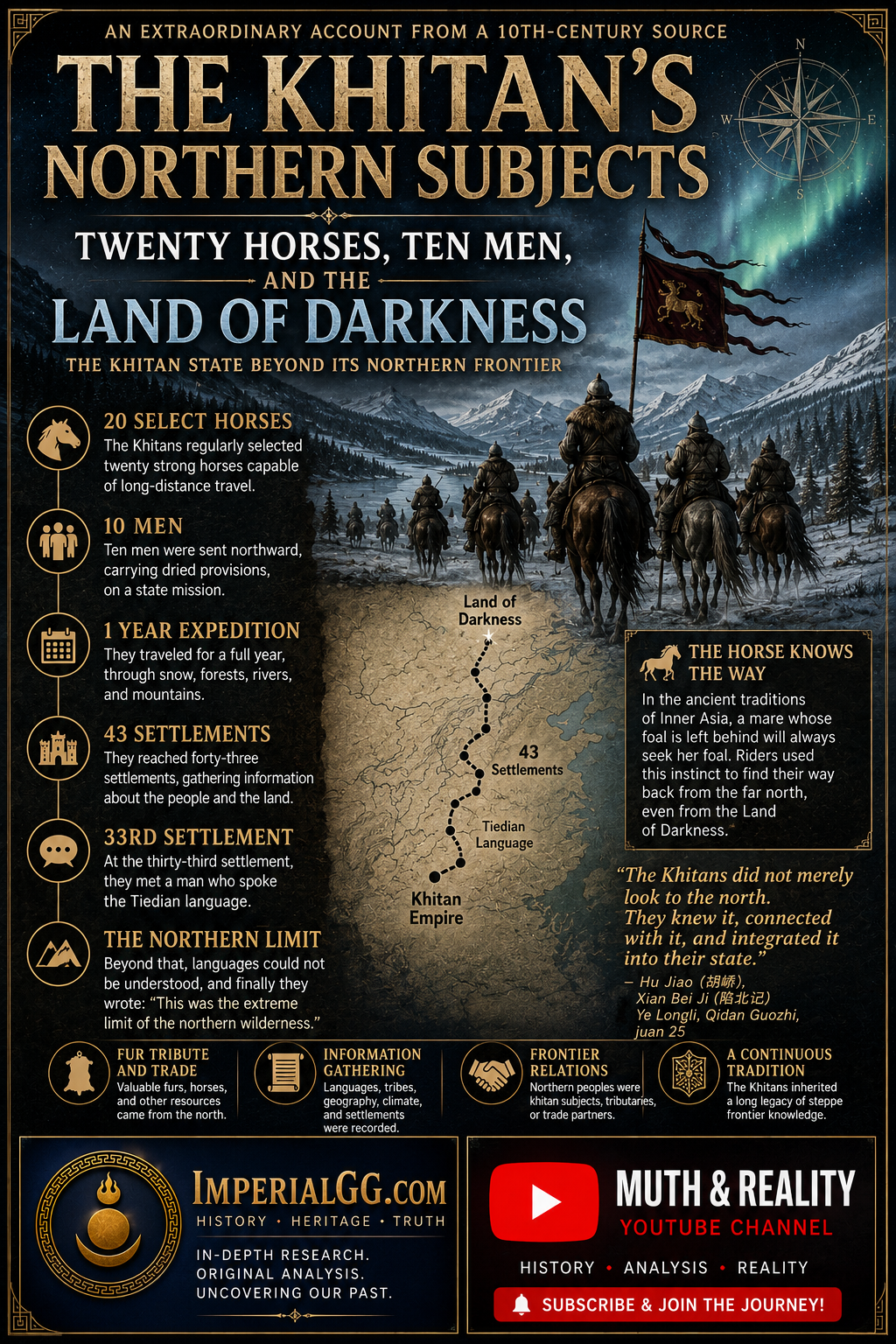
THE KHITAN’S NORTHERN SUBJECTS
KHITAN FRONTIER ADMINISTRATION, FUR TRIBUTE, INFORMATION GATHERING, AND THE LONG ROAD INTO THE NORTH
THE NORTH WAS NOT AN EMPTY SPACE
The northern world of the Khitan was not an empty wilderness beyond the limits of civilization. Beyond the settled core of the Liao realm lived numerous peoples who were connected to the Khitan state through different degrees of political submission, tribute, trade, and frontier relations. From these northern regions came horses, furs, animal skins, fish products, and other resources that were economically valuable to the Khitan state.
The surviving account of Hu Jiao (胡峤), a Chinese official who spent years in Khitan territory, preserves one of the most remarkable descriptions of this northern world. His Xian Bei Ji (陷北记, “Record of Being Captured in the North”) was later incorporated into historical compilations including Ye Longli’s Qidan Guozhi (契丹国志, History of the Khitan State).
According to the account, the Khitans regularly selected twenty strong horses and sent ten men carrying provisions northward. The journey lasted an entire year and reached forty-three settlements.[1]
This was not simply an adventure undertaken by ten volunteers. It was a repeated, organized operation. And the details preserved in the account reveal something much larger: a Khitan state that possessed established knowledge of the northern frontier and maintained systematic relations with the peoples living there.
THE NORTHERN SUBJECTS AND THE ECONOMY OF FURS
The northern frontier was economically important. The Qidan Guozhi distinguishes between different categories of northern peoples. Some were under Khitan authority; some provided annual tribute; others maintained commercial relations with the Khitans without being directly incorporated into Khitan administration.[2]
The products associated with these northern regions included horses, pearls, squirrel and sable furs, fish skins, wax, and other products of the northern environment.[3]
Furs were particularly important. Hu Jiao records that one northern region produced black, white, and yellow diaoshu pi (貂鼠皮), generally understood as sable or related valuable fur, and remarks that the northern states depended upon these products.[4]
This tells us something fundamental about the Khitan frontier. The northern regions were not merely geographical margins. They were economic zones connected to the Khitan political order. Their peoples supplied resources. Their horses mattered. Their furs mattered. Their routes mattered. And therefore their population, settlements, languages, rivers, mountains, and territories mattered.
TWENTY HORSES AND TEN MEN
The most extraordinary passage comes from Hu Jiao’s account: “契丹常选百里马二十匹,遣十人赍干……北行,穷其所见。”[5]
The meaning is essentially that the Khitans regularly selected twenty horses suited for long-distance travel, sent ten men carrying dried provisions northward, and had them travel as far as their knowledge and ability permitted.
The word 常 — “regularly” or “habitually” — is crucial. This was not described as a single expedition. It was a recurring practice. Twenty horses. Ten men. Dried meat and provisions. Northward. One year. Forty-three settlements. That combination is difficult to explain as a spontaneous journey. It points toward an organized frontier operation.
THIS WAS A STATE MISSION
The ten men did not merely travel through empty territory. The account preserves information about the people and environment they encountered. The inhabitants of many of the settlements lived in houses constructed from tree bark. Their language could not be understood, and the travelers were therefore unable to establish the names of the countries, mountains, rivers, tribes, and other geographical features beyond a certain point.[6]
The account also records climatic differences:
“其地气遇平地则温和,山林则寒冽。”[7]
The plains were relatively mild, while the mountains and forests were intensely cold. This is not merely a traveler’s distance report. It is geographical information. It is ethnographic information. It is linguistic information. It is environmental information. For a frontier state, such information had practical value.
Who lives there?
What language do they speak?
Where are their settlements?
What mountains and rivers define their territory?
What resources do they possess?
How does the climate change?
Where can horses travel?
Where does communication become impossible?
These were precisely the kinds of questions that a state operating across an enormous frontier needed to understand.
FORTY-THREE SETTLEMENTS
Hu Jiao records that the travelers passed through forty-three 城 (cheng). The term cheng should not automatically be translated as “forty-three major cities.” In medieval Chinese usage, it could refer more broadly to walled settlements, fortified places, or settlements of varying size. But the number remains striking.
Forty-three settlements in a single year.
And the account did not simply preserve the number. It preserved information about the inhabitants, their houses, their language, their environment, and their geography. This is why the expedition should not be reduced to the phrase “they passed through forty-three cities.” The journey generated knowledge. The state sent people outward. The people returned with information. That is the important historical process.
THE THIRTY-THIRD SETTLEMENT: THE LANGUAGE FRONTIER
At the thirty-third settlement, the travelers encountered a person who spoke the Tiedian (铁甸) language. His speech was sufficiently understandable for communication. But beyond that point, their ability to communicate deteriorated. This is one of the most revealing details in the entire account. The frontier was not simply a line on a map.
It was also a linguistic frontier. Where communication remained possible, information could be gathered. Where communication failed, the political and geographical knowledge of the travelers also began to break down.
The journey therefore reveals a frontier of:
language, information, settlement, and movement.
THE NORTH AS A TRIBUTE FRONTIER
The northern world was also a tributary world. The Qidan Guozhi records that some northern peoples provided annual tribute to the Khitan state, including horses and valuable animal products.[8] Others were not directly controlled by the Khitans but traded with them. This distinction is important. A great steppe empire did not necessarily govern every northern community in exactly the same way.
Political relationships existed on a spectrum:
direct administration → tributary submission → political dependence → regulated exchange → frontier trade.
The Khitan state operated across this spectrum. Thus, when we speak of the Khitan northern subjects, we are referring to a broader northern political and economic sphere rather than claiming that every one of the forty-three settlements was directly administered by the Liao government. The evidence nevertheless shows that the northern frontier was deeply connected to the Khitan state.
FUR, HORSES, AND THE NORTHERN FRONTIER
The importance of furs should not be underestimated. In the northern forests and subarctic zones, animal skins were not simply clothing materials. They were economic commodities. They could function as tribute. They could be exchanged through trade. They could form part of diplomatic relations.
And they represented the economic value of an enormous ecological zone extending beyond the agricultural heartlands. The Khitan state therefore had an obvious reason to maintain knowledge of these northern peoples and their territories. The frontier was producing wealth. And wealth required administration.
THE KHITANS DID NOT INVENT THIS KNOWLEDGE
The Khitans did not suddenly discover how to operate in the northern world. Their political culture emerged from a much older Inner Asian tradition. Long before the rise of the Liao dynasty, steppe empires and confederations had maintained relations with peoples living in the northern forest and forest-steppe zones. The Xiongnu, Xianbei, Rouran, Turkic khaganates, Uyghur Khaganate, and later steppe polities existed within a long continuum of interaction between the steppe and the northern forest world.[9]
These relationships involved: horses, fur, animal products, tribute, trade, warfare, diplomacy and the transmission of geographical knowledge. The Khitans inherited and developed this frontier tradition. They did not have to discover the northern world from nothing. They already possessed a cultural and political system capable of moving through enormous spaces.
THE HORSE WAS PART OF THE MAP
Modern people imagine long-distance travel through maps, coordinates, roads, and GPS. The mounted peoples of Inner Asia operated within a different system. A route could be remembered through: water, grass, mountains, rivers, seasonal conditions, animal movement, local knowledge, and above all, the horse.
For a mounted society, the horse was not merely transportation. The horse was part of the geographical system itself. A rider who knew horses understood distance differently from a sedentary traveler. A horse that could endure hundreds of kilometers was not simply an animal capable of carrying a person. It was an instrument of political reach.
THE HORSE THAT RUNS TOWARD ITS NUTAG
Mongolian pastoral culture preserves an especially powerful concept concerning horses: aduu nutag ruugaa guih — a horse running toward its nutag, its accustomed homeland. This is not simply the human act of “returning home.” The expression places agency in the horse itself. The horse runs. The horse recognizes. The horse is drawn toward its familiar land.
Traditional Mongolian knowledge also speaks of zön, the instinctive or deeply rooted connection of livestock to their accustomed nutag. This concept should not be confused with modern GPS. GPS can tell a person where an object is located. The traditional mounted worldview asks a different question:
Where does the animal itself know it must go?
Modern ethnographic research has documented Mongolian pastoral understandings of zön and the relationship between livestock and nutag, while historical and ethnographic accounts preserve stories of horses finding their way back toward their homeland after being transported far away.[10]
One famous twentieth-century example concerns Mongolian horses sent to Vietnam. A horse reportedly escaped during transportation and eventually appeared back in Mongolia. Scholars have treated this account cautiously because its full factual details cannot be independently verified, but it remains an important ethnographic example of the Mongolian concept of zön.[11]
The significance here is not that a horse possesses a supernatural compass. The significance is that a horse’s relationship to place was itself treated as a form of knowledge.
THE MARE AND THE FOAL: A HORSEMAN’S WAY OF FINDING THE ROAD
An even older and more remarkable tradition survives in Central Asian narratives concerning the Land of Darkness. In versions discussed by J. A. Boyle, travelers entering the Land of Darkness were advised to use mares whose young foals had been left behind.
The logic was simple:
the mare would always seek her foal.
Therefore, when the travelers needed to return, the mare’s attachment to the foal could serve as a means of finding the way back.[12]
This is an extraordinary detail. The horse itself becomes part of the navigation system. The rider does not need to carry a modern instrument capable of calculating coordinates. The rider understands the animal. The animal understands its own attachment to place. And the journey becomes possible because human knowledge and animal behavior work together. This should not be dismissed as merely a fantastic story. The narrative itself belongs to a broader Central Asian tradition in which the behavior of horses is understood as a practical resource for surviving enormous distances.
THE LAND OF DARKNESS
The Land of Darkness occupies a special place in medieval Eurasian geographical imagination. In Central Asian and Islamic versions of the Alexander traditions, it lies in the extreme north and is described as a realm of darkness where ordinary travel becomes extraordinarily difficult.[13] In some traditions, the darkness is connected with a northern region where the sun does not appear for prolonged periods. The concept has obvious parallels with the phenomenon of polar night. But an academic distinction must be maintained.
The Land of Darkness should not simply be declared to be the geographic North Pole. Rather, it represents a historical geographical tradition concerning the far northern world, transmitted through Central Asian, Islamic, and European literary traditions. Its importance lies in the fact that the extreme north was not entirely absent from the geographical imagination of Inner Asian peoples. There was a conceptual geography beyond the ordinary frontier.
THE FRONTIER BEYOND THE FRONTIER
This gives the Khitan expedition a deeper meaning. The forty-three settlements were not necessarily the end of the northern world. They were the end of what these particular travelers could reach and communicate with. Beyond them was another layer of geography. Beyond language was uncertainty. Beyond established settlements was danger. Beyond ordinary routes was the legendary northern world.
And in Hu Jiao’s account, the journey ultimately ends with the words:
“此北荒之极也。”
“This was the extreme limit of the northern wilderness.”[14]
The statement is remarkably powerful. The frontier is defined not only by territory. It is defined by the point at which human knowledge ceases to function.
WHY DID TEN MEN TRAVEL FOR A YEAR?
This is perhaps the most important question. Would ten people voluntarily leave their society and travel for an entire year into an increasingly unfamiliar and dangerous northern environment?
The historical context suggests something different. They were part of an established system. The Khitans regularly selected long-distance horses. They regularly sent men northward. They carried provisions. They followed known routes. They entered territories connected to the Khitan world. They observed settlements and peoples. They gathered information. And they returned.
The surviving text is brief, but behind that brief statement stands an enormous body of practical knowledge accumulated over generations.
The route itself was knowledge. The horse was knowledge. The northern peoples were knowledge. The tribute system was knowledge. The landscape was knowledge. And the ability to return was knowledge.
THE KHITAN STATE AND THE NORTHERN WORLD
The Khitan state therefore should not be understood merely as a power facing a mysterious northern wilderness. It possessed an active northern frontier system.
Its northern subjects and neighboring peoples participated in networks of: tribute, trade, fur production, horse exchange, political dependency, information gathering, and long-distance movement. The twenty horses and ten men were one visible expression of this system.
The fur tribute was another. The forty-three settlements were another. The linguistic encounters were another. Together they reveal a state that was actively engaging with its northern world.
THE NORTH WAS KNOWN BECAUSE PEOPLE MOVED THROUGH IT
This is perhaps the central lesson of the account. The Khitan understanding of the north did not come from drawing an abstract line on a map. It came from movement. People moved. Horses moved. Tribute moved. Furs moved. Information moved. And through this movement, the northern frontier became part of the political geography of the Khitan world. The empire did not need modern technology to operate across enormous distances. It had something older: horses, memory, routes, local knowledge, political networks, and generations of experience.
CONCLUSION: TWENTY HORSES AT THE EDGE OF THE KNOWN WORLD
The account of twenty horses and ten men traveling north for an entire year is easy to read as a curious medieval anecdote. It is much more than that. It provides a glimpse into the machinery of a northern frontier. It shows a Khitan state connected to northern peoples through tribute and trade. It reveals the economic importance of furs and horses. It records settlements, languages, geography, rivers, mountains, tribes, and climate. It demonstrates that the Khitans repeatedly organized long-distance journeys into the north. And it preserves a memory of the point where the known world ended.
Beyond that frontier lay the Land of Darkness. Yet even there, according to the older mounted traditions of Inner Asia, the horse remained part of the answer. A mare could seek her foal. A horse could seek its nutag. And the mounted traveler understood that the road was not written only on a map.
It was carried in the landscape, in memory, in the horse, and in the people who had traveled it before. The Khitans did not merely look north.
They maintained a political, economic, and informational relationship with the north. And when twenty horses carried ten men toward the edge of that world, they were not entering an entirely unknown wilderness. They were traveling through a frontier their civilization had learned, over generations, how to reach.
NOTES AND REFERENCES
[1] Ye Longli (叶隆礼), Qidan Guozhi (契丹国志, History of the Khitan State), juan 25, Hu Jiao Xian Bei Ji (胡峤陷北记). The passage describes the Khitans regularly selecting twenty long-distance horses and sending ten men carrying dried provisions northward for approximately one year, reaching forty-three cheng settlements. See the transmitted text of Qidan Guozhi, juan 25. Chinese Text Project — 契丹国志
[2] Qidan Guozhi, geographical materials concerning the northern polities and peoples associated with the Liao state. The source distinguishes between groups under Khitan control, tributary groups, and groups maintaining commercial relations with the Khitans. Chinese Text Project — 契丹国志
[3] Ibid. The tribute and trade goods listed in the northern geographical materials include horses, pearls, furs, fish skins, wax, and related products.
[4] Hu Jiao, Xian Bei Ji, as transmitted in Qidan Guozhi, juan 25: “又多黑、白、黄貂鼠皮,北方诸国皆仰足.” The passage describes abundant black, white, and yellow diaoshu fur and its importance to northern polities. Chinese Text Project — 胡峤陷北记
[5] Hu Jiao, Xian Bei Ji: “契丹常选百里马二十匹,遣十人赍干……北行,穷其所见.” The critical word chang (常) indicates a regular or customary practice rather than a unique expedition. Wikisource — 陷北记
[6] Hu Jiao, Xian Bei Ji, in Qidan Guozhi, juan 25. The account describes bark-built dwellings and the travelers’ inability to understand the local language sufficiently to establish the names of territories, mountains, rivers, and tribes. Chinese Text Project — 契丹国志
[7] Ibid.: “其地气遇平地则温和,山林则寒冽” — describing relatively mild conditions on the plains and severe cold in mountains and forests.
[8] Qidan Guozhi, geographical accounts of northern polities. These passages distinguish tributary relations from commercial exchange and record horses and fur products among the resources supplied from the north. Chinese Text Project — 契丹国志
[9] For the wider history of Inner Asian steppe–forest relations, see the Shiji, “Xiongnu liezhuan,” and related early Chinese historical materials concerning the Xiongnu and northern peoples. Chinese Text Project — Shiji, Xiongnu Biography
[10] On Mongolian pastoral understandings of zön and the relationship between livestock and nutag, see ethnographic discussions of herd agency and pastoral knowledge in Mongolia and Inner Asia.
[11] See the discussion of the reported Mongolian horse that escaped while being transported to Vietnam and later returned toward Mongolia in research concerning Mongolian concepts of zön. The account is treated as an ethnographic testimony rather than independently verified historical fact. Brill — Inner Asia research article
[12] J. A. Boyle, “The Alexander Romance in Central Asia,” discussing the Land of Darkness tradition and the use of mares whose foals had been left behind as a means of ensuring the travelers’ return. The article compares traditions preserved by Pseudo-Callisthenes, Rashid al-Din, and Marco Polo. National University of Mongolia — Translation Studies article PDF
[13] Boyle’s discussion of the Land of Darkness situates the tradition within the wider Alexander Romance and Central Asian geographical imagination and examines its relationship to northern regions beyond ordinary travel. National University of Mongolia — Translation Studies article PDF
[14] Hu Jiao, Xian Bei Ji: “此北荒之极也” — “This was the extreme limit of the northern wilderness.” Wikisource — 陷北记
SOURCE CRITICISM
The Xian Bei Ji survives through later historical compilations rather than as a securely preserved independent manuscript. Some of its descriptions contain legendary or extraordinary elements. Accordingly, this article distinguishes between the account’s concrete geographical and administrative observations and its legendary imagery. The twenty-horse/ten-man expedition, the forty-three settlements, linguistic observations, and environmental descriptions are treated as textual evidence; the Land of Darkness tradition is treated as a separate layer of Central Asian historical geography and literary tradition.
The argument of this article is therefore not that every detail of the northern narrative should be accepted literally. Rather, the surviving evidence demonstrates that the Khitan political world had sustained and organized relationships with northern peoples and that long-distance movement, tribute, trade, geographical knowledge, and horse-based mobility formed part of that frontier system.