LAOZI, THE HU, AND THE BUDDHIST–DAOIST CONTEST FOR THE PAST
By Altanbagana Baatar
DBA Candidate| Independent Historian
ImperialGG Historical Research Seriers
21 August 2026
INTRODUCTION
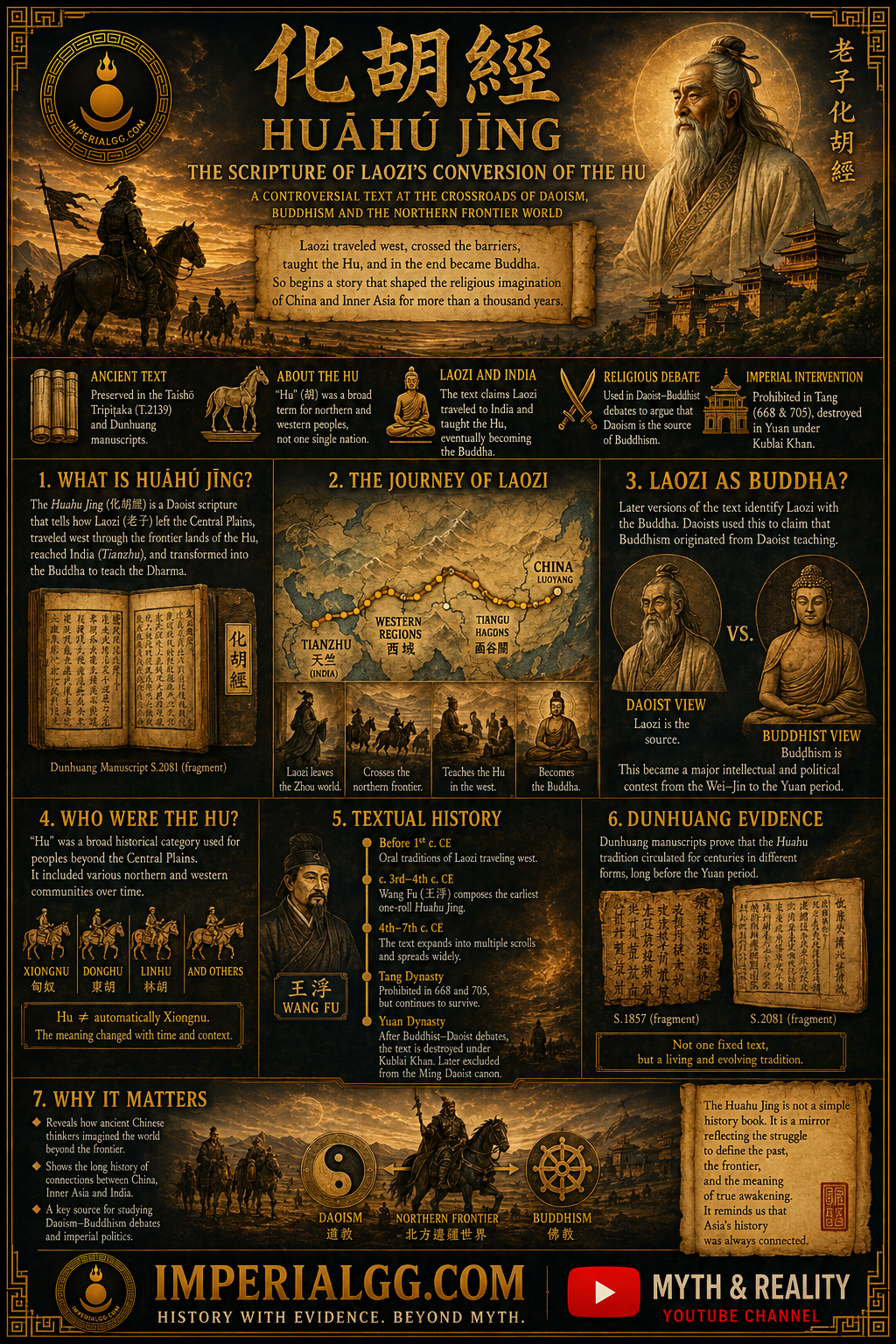
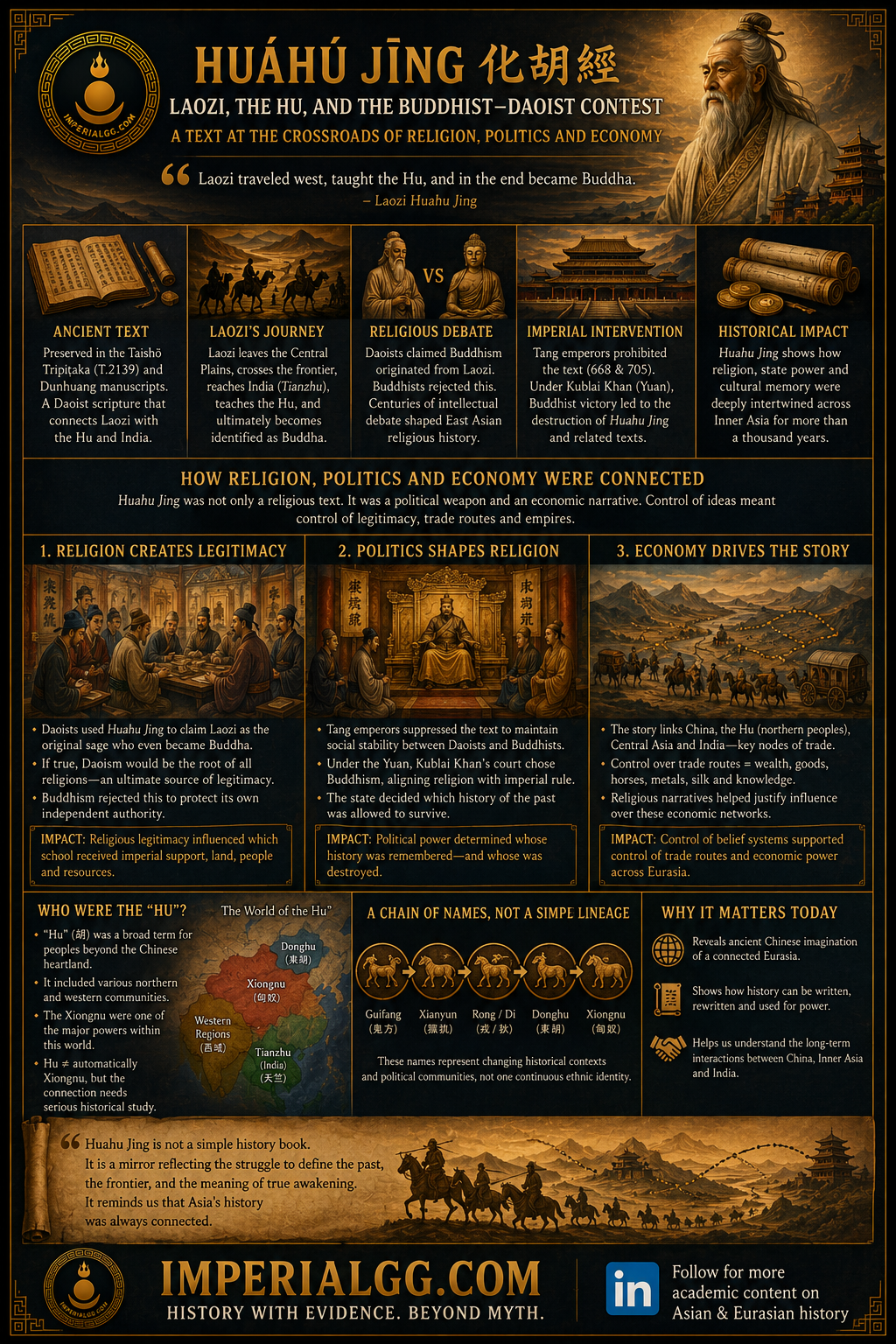
Among the most controversial religious texts in the history of medieval China is the Laozi Huahu Jing (老子化胡經), commonly translated as the Scripture of Laozi’s Conversion of the Hu. The title itself is provocative. It presents Laozi, the foundational sage of Daoist tradition, as a figure who traveled westward and brought religious teaching to the peoples designated as Hu (胡). In its developed form, the tradition went further: Laozi became identified with, or was portrayed as the source of, the Buddha and Buddhism.[1]
The text is therefore important not because it proves a particular ethnic genealogy, but because it preserves a remarkable Chinese religious memory of the western and northern peoples of Inner Asia and demonstrates how the identities of Laozi, Buddha and the “Hu” were debated over many centuries.
The surviving evidence also makes one point clear: the Huahu Jing was not written by Laozi himself. Modern scholarship generally attributes the earliest written version to the Daoist Wang Fu (王浮), around the beginning of the fourth century CE, although the story of Laozi traveling west and converting the Hu appears to have developed through earlier oral and literary traditions.[2]
THE MEANING OF “HU” (胡)
The first question is linguistic.
What did Hu (胡) mean?
The answer is more complicated than simply translating it as “Xiongnu.”
In early Chinese historical writing, Hu could function as a broad designation for peoples beyond the political and cultural center. Its application changed according to historical period and context. By the late first millennium BCE, the term could encompass different northern and western populations, and compounds such as Donghu (東胡) and Linhu (林胡) demonstrate that Hu could function as a category applied to different groups.[3] This is crucial for understanding the title Huahu Jing.
胡 does not automatically equal 匈奴.
At the same time, Xiongnu populations were among the peoples whom Chinese writers could describe within the broader conceptual world of Hu. Modern scholarship has therefore treated Hu as a historical category whose meaning could expand beyond a single ethnic community.[4]
Consequently, translating Huahu Jing as “The Scripture That Converted the Xiongnu” would go beyond the evidence.
A more accurate translation is:
THE SCRIPTURE OF LAOZI’S CONVERSION OF THE HU
The historical question of whether particular Hu communities referred to in the tradition included Xiongnu populations remains a separate question.
BEFORE THE HUĀHÚ JĪNG
The Huahu tradition did not suddenly appear as a fully developed scripture.Its background can be traced through several stages.
The Shiji biography of Laozi already describes Laozi leaving the Zhou world and traveling west through the Hangu Pass. The text does not say that Laozi became Buddha, but this westward journey later provided an important narrative foundation for the development of the Huahu tradition.[5] During the Eastern Han and Three Kingdoms periods, traditions began circulating that connected Laozi with the Buddha and with peoples of the western regions.
A later tradition preserved the statement:
“Laozi entered the land of the Yidi and became Buddha.”
Another early tradition described Laozi as traveling through the Western Regions to Tianzhu (天竺), India, where he taught the Hu.[6]
These traditions are historically significant because they demonstrate that the conceptual connection between:
LAOZI → WEST → HU → INDIA → BUDDHA
developed before the surviving expanded versions of the Huahu Jing. The scripture therefore represents the crystallization of a much longer religious and intellectual process rather than an isolated literary invention.[7]
WANG FU AND THE EARLY SCRIPTURE
The earliest written Huahu Jing is generally associated with Wang Fu, a Daoist active around the beginning of the fourth century CE. The Gaoseng zhuan tradition presents Wang Fu as a Daoist who engaged in debates with the Buddhist monk Bo Yuan (帛遠) and subsequently produced the Huahu Jing. Later scholarship has treated this account cautiously, but the association of Wang Fu with an early version of the text is widely accepted.[8] The original work was probably much shorter than the expanded versions that circulated later.
According to Charles Benn’s Encyclopedia of Taoism, Wang Fu’s original version consisted of one scroll and is now lost except for quotations preserved in later sources. By the seventh century, however, the text had developed into a much larger work.[9] This development is extremely important. It means that when we speak of “the Huahu Jing,” we are not necessarily referring to one fixed text written at one moment.Rather, we are dealing with a textual tradition that expanded, changed and accumulated new episodes over centuries.
LAOZI BECOMES THE BUDDHA
The central claim of the developed Huahu tradition was extraordinary. Laozi traveled west. He encountered foreign peoples. He adapted his teaching to them. And in some versions, he ultimately became the Buddha. The implication was equally significant:
BUDDHISM WAS NOT AN INDEPENDENT RELIGIOUS REVELATION.
It was presented as a transformed or adapted manifestation of Daoist teaching. This was not merely mythology. It was a religious argument about cultural authority. If Laozi was the original teacher of Buddhism, then Daoism could claim chronological and philosophical superiority over Buddhism. The dispute therefore concerned more than theology.
It concerned the question:
WHO HAD THE RIGHT TO DEFINE THE RELIGIOUS HISTORY OF CHINA AND INNER ASIA?
The Buddhist response was equally striking. Buddhist polemical literature developed counter-narratives in which Laozi and other Chinese sages were repositioned within Buddhist cosmology. The two traditions therefore constructed competing histories of one another.[10]
THE BUDDHA AND THE “HU”
The expanded Huahu Jing contains material that deliberately parallels Buddhist sacred biography. In later versions, Laozi’s western journey becomes increasingly connected with India, and his transformation into the Buddha is presented through motifs recognizable from Buddhist accounts of the Buddha’s birth and enlightenment.[11] This creates an important historical paradox. The text is sometimes treated as evidence that Laozi historically met the Buddha. But the surviving textual evidence indicates something different.
It demonstrates that Daoist authors constructed a theological narrative in which Laozi and Buddha became connected. That is evidence for the history of religious ideas.It is not direct evidence for a historical meeting between two sixth- or fifth-century BCE individuals. This distinction is essential.
THE “HU” AND THE XIONGNU QUESTION
The most interesting question for Inner Asian history is whether the Hu of the Huahu Jing can be connected specifically with the Xiongnu.
Here the evidence becomes much more complicated. The term Hu had a wide semantic range. Chinese sources used it for different northern and western peoples over different periods. One study of Xiongnu political history describes Hu as having developed from a possible ethnonym into a broader category for mobile peoples of the northern frontier, including groups such as the Donghu and Linhu.[12]
Therefore:
HU ≠ AUTOMATICALLY XIONGNU
But this does not make the relationship historically irrelevant. The Xiongnu emerged as the dominant imperial power of the eastern Eurasian steppe during the late third and second centuries BCE. Their political world interacted with the Chinese states, Central Asia and populations across the northern frontier.
Consequently, when later Chinese religious texts spoke about Hu, their conceptual universe was shaped by centuries of interaction with northern and western peoples, including populations associated with the Xiongnu world.
The appropriate academic question is therefore not:
“Does Huahu Jing prove that the Xiongnu were the relatives of Buddha?”
There is no basis for that conclusion.
The more productive question is:
How did the changing Chinese category of “Hu” interact with historical memories of the Xiongnu and other Inner Asian peoples, and how did those memories become incorporated into religious narratives about Laozi and Buddha?
That is a genuine historical research problem.
FROM NORTHERN EURASIA TO INDIA
The Huahu tradition also deserves attention because it reflects an ancient Chinese conception of religious transmission across Inner Asia. The narrative is geographically ambitious.Laozi leaves the Chinese political center.He travels west. He crosses the frontier. He encounters foreign populations. He reaches India. And religious transformation occurs across this enormous cultural zone.
Whether or not the story is historically factual, its geographical imagination is significant. It assumes that China, the northern frontier, Central Asia and India belonged to a connected world of movement and religious exchange. This is especially important when studying the early history of the Silk Roads.
Long before the medieval Silk Road became a recognizable system, ideas, technologies, religious practices and political traditions were moving across Inner Asia. The Huahu tradition is therefore also a document of how Chinese intellectuals imagined those transcontinental connections.
THE HUĀHÚ JĪNG AND DUNHUANG
The survival of the text itself provides important archaeological evidence. Several Dunhuang manuscripts preserve portions of Huahu-related texts. Among them are manuscripts such as S.1857 and S.2081, while portions of the ten-scroll tradition were also preserved in manuscript witnesses associated with the Dunhuang corpus.[13] This discovery is particularly important because the original textual tradition was repeatedly attacked and suppressed.
The Dunhuang manuscripts demonstrate that the Huahu tradition was not merely a late Yuan fabrication. It had circulated for centuries. They also reveal that the text did not exist in one completely fixed canonical form. Different textual layers and versions developed over time.[14]
TANG DYNASTY: THE STATE ENTERS THE CONTROVERSY
The controversy became sufficiently serious that Tang emperors intervened. During the Tang period, imperial authorities prohibited the Huahu Jing on more than one occasion. Charles Benn notes prohibitions in 668 and 705, although the text survived and continued to circulate.[15] This demonstrates that the controversy was not simply between individual Buddhist monks and Daoist priests. It had become a question of state-supported religious authority. The Tang imperial court itself was deeply involved in defining the relative status of Buddhism and Daoism.
Thus the Huahu Jing became part of a much larger struggle over:
RELIGIOUS AUTHORITY
IMPERIAL PATRONAGE
CULTURAL PRESTIGE
and THE INTERPRETATION OF CHINESE HISTORY.
THE YUAN DYNASTY AND KUBLAI KHAN
The story reaches another extraordinary stage under the Yuan dynasty. During the reign of Kublai Khan, Buddhist and Daoist institutions became involved in highly consequential court debates. The Huahu doctrine was particularly dangerous to the Buddhist establishment because it claimed that Buddhism was ultimately derived from Laozi. If accepted as historical truth, this would give Daoism a powerful argument for religious precedence. The Yuan court therefore became an arbiter in the dispute.
After the Buddhist victory in the major debates, imperial authorities ordered the destruction of the Huahu Jing and related polemical texts. Surviving evidence indicates that versions of the text were destroyed and that the work was subsequently excluded from the Ming Daoist canon.[16]
The irony is striking. A text that claimed Laozi had conquered the religious world of the Hu ultimately became one of the most contested texts in the struggle between Daoism and Buddhism under a Mongol emperor.
WHAT DOES THE TEXT ACTUALLY PROVE?
This is where historical discipline becomes essential.
The Huahu Jing proves that:
1. A Daoist textual tradition connected Laozi with the western and northern peoples designated as Hu.
2. This tradition developed into a claim that Laozi traveled to India and became or transformed into the Buddha.
3. The tradition was already established by the early centuries CE and was subsequently expanded.
4. The text became a major weapon in Buddhist–Daoist polemics.
5. The tradition survived in Dunhuang manuscripts and other quotations despite repeated suppression.
6. The Yuan state eventually intervened decisively in the controversy.
But it does not by itself prove:
- that Laozi historically traveled to India;
- that Laozi was ethnically Khitan;
- that Laozi was Xiongnu;
- that the Xiongnu were literally a branch of the Buddha’s Śākya family;
- or that Hu always meant Xiongnu.
Those propositions require independent evidence.
A DIFFERENT HISTORICAL VALUE
Yet rejecting those claims does not make the Huahu Jing unimportant. Quite the opposite. The text becomes even more interesting when treated as a historical document of memory.
It preserves the way medieval Chinese religious thinkers imagined the relationship between:
CHINA
THE NORTHERN FRONTIER
INNER ASIA
INDIA
and BUDDHISM.
It also demonstrates that the category of “foreign peoples” was never static. The meaning of Hu changed across time, while historical memories of northern peoples were repeatedly reinterpreted. This gives us an important methodological lesson. We should not ask ancient texts to answer modern questions in the language of modern ethnicity.
Instead, we should ask:
What did these names mean to the people who wrote them, when did their meanings change, and how were earlier identities remembered by later societies?
CONCLUSION: A TEXT AT THE CROSSROADS OF MEMORY
The Huahu Jing is not a straightforward historical biography of Laozi. It is something more complex. It is a religious polemic, a political text, a cultural memory, and a record of changing ideas about the peoples beyond China’s political frontier. Its most provocative word is perhaps not Laozi or Buddha, but Hu.
Who were the Hu?
When did the term become associated with northern steppe peoples?
How did memories of the Xiongnu enter later Chinese historical consciousness?
And why did Daoist authors place Laozi at the center of a journey from China through the frontier and ultimately to India? These questions remain open to interdisciplinary research. The evidence does not presently justify saying that the Huahu Jing proves a Xiongnu–Śākya blood relationship. But it does establish something historically remarkable:
More than a millennium before the Mongol Empire, Chinese religious traditions were already imagining a vast intellectual and spiritual geography linking the Chinese heartland, the northern frontier, Inner Asia and India.
And centuries later, under the Mongol Yuan dynasty, this ancient story became important enough to provoke imperial intervention. That makes the Huahu Jing more than a religious legend. It is a window into the struggle over who owned the memory of Asia’s ancient past.
FOOTNOTES
[1] Charles D. Benn, “Huahu jing,” in The Encyclopedia of Taoism, ed. Fabrizio Pregadio (London/New York: Routledge, 2008), pp. 492–494. Benn describes the text as the Scripture of Laozi’s Conversion of the Barbarians and explains its central claim concerning Laozi, India and Buddhism.
[2] The surviving scholarly consensus generally associates the earliest written version with Wang Fu (王浮), c. 300 CE. See also Internet Encyclopedia of Philosophy, “Laozi,” which summarizes the scholarly position that Wang Fu compiled an early one-scroll Huahu Jing.
[3] On the changing use of Hu (胡) as a broad designation for northern and western peoples, see discussions of the Xiongnu political world and early Chinese frontier terminology.
[4] The distinction between Hu as a broad category and specific political peoples is particularly important when interpreting references to the Xiongnu, Donghu and other northern populations.
[5] The Shiji tradition describes Laozi leaving the Zhou world, passing through the Hangu Pass and traveling west. This narrative became an important foundation for later Huahu traditions. The historical development is discussed in the modern study of the origin of Laozi huahu shuo.
[6] Early traditions connecting Laozi with the western regions, India and the Hu appear in sources discussed by the modern historiographical study of the Huahu tradition.
[7] The origin of the Huahu tradition appears to have involved a long process of development, including an earlier period of oral transmission before the production of a substantial written scripture.
[8] The Gaoseng zhuan tradition connects Wang Fu with the composition of the Huahu Jing following disputes with Buddhist representatives. Modern scholarship treats this as part of the polemical history surrounding the text.
[9] Benn notes that Wang Fu’s original version consisted of one scroll and was subsequently expanded; by the Tang period the tradition had developed substantially.
[10] Buddhist and Daoist traditions developed competing “conversion” narratives, with each side attempting to place the other tradition within its own religious genealogy. The history of these polemics is discussed in modern scholarship on Chinese Buddhist–Daoist debates.
[11] Later versions of the Huahu Jing incorporated motifs closely resembling Buddhist accounts of the Buddha’s birth, including the extraordinary conception and birth narrative.
[12] On the development of Hu from a possible ethnonym into a broader category for northern mobile peoples, including references such as Donghu and Linhu, see the study of Xiongnu political terminology.
[13] Dunhuang manuscript evidence includes fragments associated with the Huahu Jing, including S.1857 and S.2081. The survival of these manuscripts is particularly important because later versions of the text were destroyed or suppressed.
[14] The Dunhuang materials demonstrate that the Huahu Jing existed in multiple textual forms rather than as one immutable canonical work.
[15] Charles D. Benn records imperial prohibitions of the Huahu Jing during the Tang in 668 and 705, while noting that the text continued to survive.
[16] During the Yuan period, Buddhist–Daoist debates culminated in imperial measures against the Huahu Jing and related texts. The tradition was subsequently excluded from the Ming Daoist canon because of its earlier prohibition.
[17] For the Yuan-period relationship between the Huahu Jing, Buddhist–Daoist debates and the political regulation of religious institutions, see the discussion of the text’s political fate and the associated debates under Kublai Khan.
[18] For a modern scholarly discussion of the development of the Laozi huahu shuo, including the transition from early traditions to a written scripture, see the detailed historical analysis published in Religions (2023).