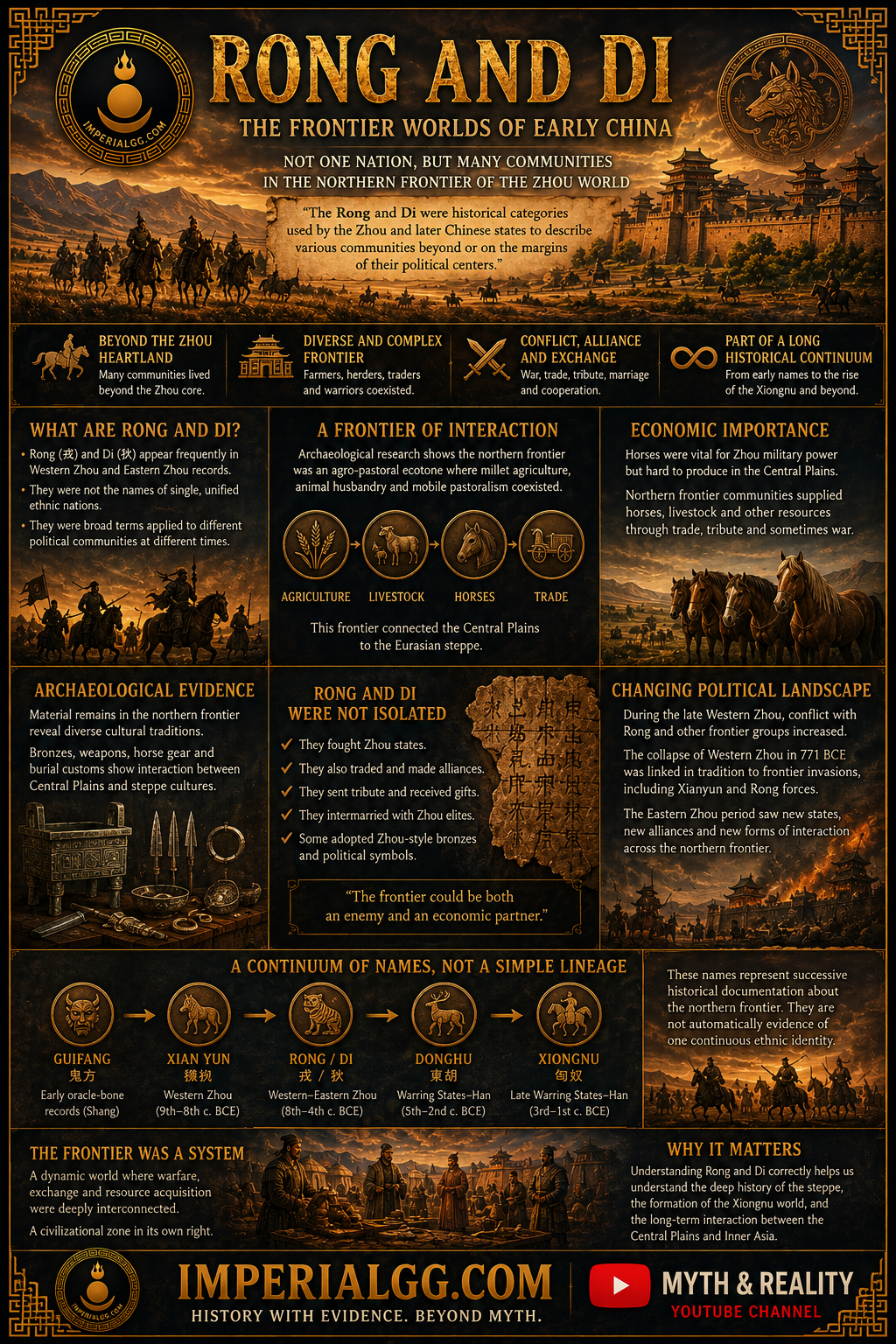
RONG AND DI: THE FRONTIER WORLDS OF EARLY CHINA
By Altanbagana Baatar
DBA Candidate| Independent Historian
ImperialGG Historical Research Seriers
21 August 2026
RONG AND DI AS HISTORICAL CATEGORIES
Introduction
In the historical record of early China, few terms are as important—and as difficult to define—as Rong (戎) and Di (狄).
Appearing prominently in texts concerning the Zhou world and especially the Zuo Zhuan, these names were used for peoples living beyond, around, and sometimes within the political sphere of the Zhou states. They appear as enemies, allies, marriage partners, tributaries, military clients, migrants, and occasionally as political actors capable of defeating or threatening established states.[1]
Modern scholarship has increasingly questioned the assumption that Rong and Di should simply be understood as fixed ethnic groups equivalent to a modern nation or ethnicity. Archaeological evidence instead reveals a frontier characterized by mobility, cultural exchange, political incorporation, warfare, intermarriage, and changing identities.[2]
The historical importance of Rong and Di therefore lies not simply in identifying “who they were,” but in understanding how the northern frontier of early China actually functioned.
1. THE MEANING OF RONG AND DI
The characters 戎 Rong and 狄 Di occur in a variety of early Chinese texts and contexts. The Zuo Zhuan records numerous Rong and Di communities interacting with Zhou states during the Spring and Autumn period. These groups were not confined to one political territory, nor were all communities designated by these terms necessarily identical in language, economy, political organization, or material culture.[3] This creates a fundamental methodological problem. If a historical text says that a particular group was Rong, this does not necessarily mean that every community called Rong belonged to a single ethnic nation.
The same problem applies to Di. The terms could function as political, geographical, cultural, and classificatory labels, depending on context. Modern research therefore increasingly treats Rong and Di as historically situated categories rather than assuming that they describe two biologically or culturally homogeneous peoples.[4] This distinction is essential for reconstructing the history of the northern frontier.
2. THE ZHOU FRONTIER WAS NOT AN EMPTY BORDER
Traditional narratives often present early Chinese civilization as a settled agricultural core surrounded by hostile “barbarians.” The archaeological record presents a much more complicated picture. During the Western and Eastern Zhou periods, the northern and northwestern regions of present-day China contained communities with different economic systems, political structures and material traditions. Some practiced agriculture; others relied more heavily on pastoralism and animal husbandry; many participated in mixed economies.[5]
The frontier was therefore not a simple line. It was a zone of interaction. People moved across it. Animals moved across it. Bronze objects moved across it. Technologies moved across it. Marriage alliances connected communities. And warfare could transform political boundaries within a single generation.
Jessica Rawson’s work on Western Zhou archaeology demonstrates the importance of examining material evidence alongside written records when reconstructing these relationships.[6]
3. RONG AND DI IN THE POLITICAL WORLD OF THE ZHOU
The Zuo Zhuan provides some of the most important evidence. Rong and Di communities repeatedly appear in conflicts involving the Zhou royal house and the major states of the Spring and Autumn period.
But the relationship was not simply:
CHINA VS. BARBARIANS
The historical record contains warfare, but also diplomacy, alliances and political cooperation. The famous Zuo Zhuan passage describing Rong and Di as “jackals and wolves” is one example of hostile rhetoric.[7]
Nicola Di Cosmo has shown how such descriptions formed part of a wider historiographical pattern in which pastoral and frontier peoples were portrayed as aggressive and acquisitive. Yet he also emphasizes that these descriptions should not simply be accepted as objective ethnographic observations.[8]
They were written from the perspective of political societies that were themselves engaged in competition. The frontier was therefore not merely a military problem. It was a political system.
4. WARFARE AND ECONOMIC INTERDEPENDENCE
Why did Rong and Di repeatedly appear in conflict with agricultural states? The answer cannot simply be “because they were nomads.” The economic relationship was much more complicated. Pastoral and agricultural communities occupied different ecological zones and possessed different resources. Livestock, horses and animal products could be exchanged for grain, textiles, metal goods and other agricultural products.
Di Cosmo emphasizes the importance of understanding the economic basis of Inner Asian pastoral societies rather than reducing their interactions with China to simple patterns of plunder.[9] This is especially important because warfare and trade could exist simultaneously. A community could attack a neighboring state in one period, negotiate with it in another, and establish marriage or tribute relationships later. The frontier economy was therefore characterized by both conflict and exchange.
5. HORSES, METAL, AND THE MOVEMENT OF CULTURE
Archaeology provides another important dimension. Northern frontier tombs contain material evidence that cannot be understood solely through the written category of “barbarian.” Horse equipment, bronze objects, weapons, ornaments and other artifacts demonstrate extensive interaction between communities of the Central Plains and those farther north and west.[10]
Jessica Rawson’s archaeological research has emphasized the movement of objects and artistic forms between the Chinese states and Inner Asia during the late second and first millennia BCE.[11] More recent archaeological research has further examined the relationship between Rong, Di and Hu material cultures during the Eastern Zhou period.
Yang Jianhua, for example, argues that northern Chinese archaeological remains can be divided into distinct cultural patterns that correspond to changing economic and social formations, rather than being explained simply through literary ethnic labels.[12] This is important.
Archaeological culture does not automatically equal ethnicity. But archaeology can demonstrate interaction even when textual sources remain ambiguous.
6. THE RONG WERE NOT ONE PEOPLE
One of the most important conclusions from the textual evidence is that there were many Rong communities. The sources refer to different Rong groups, including western and eastern communities and groups associated with particular territories.
Later traditions likewise record communities such as:
Quan Rong 犬戎
Yiqu Rong 義渠戎
Yin Rong 陰戎
Luhun Rong 陸渾戎
These names should not automatically be interpreted as branches of one unified ethnic nation. They often represent local political communities occupying different ecological and political environments.[13] Some were eventually conquered by expanding states. Others were incorporated. Some migrated. Some disappeared from the written record while their populations continued within new political formations. Therefore, the disappearance of the name Rong does not necessarily mean the disappearance of the people who had previously been called Rong.
7. THE DI AND THE NORTHERN FRONTIER
The Di (狄) appear especially prominently in the eastern and northern political landscape of the Spring and Autumn period.
The sources distinguish groups such as the:
Red Di 赤狄
and
White Di 白狄.
The Zuo Zhuan records their conflicts and political relationships with states such as Jin and Qi.[14] Again, however, these categories should not automatically be treated as modern ethnic divisions. The Red Di and White Di were historical political communities whose identities were embedded in changing alliances and territories. Their history demonstrates something fundamental about the Zhou frontier:
political identity could change as rapidly as political power. A group could be incorporated into a state, expelled from one region, establish a new political center, or become absorbed into another population.
8. THE FRONTIER WAS ALSO A ZONE OF MARRIAGE
Military conflict was only one mechanism of integration. Marriage was another. The Zuo Zhuan contains numerous accounts of marriages between ruling houses and frontier communities. Such marriages were not merely personal relationships. They could establish alliances, secure peace, transfer political legitimacy, and create networks connecting communities across cultural boundaries.[15]
This provides another reason why the simple model of:
ZHOU PEOPLE → RONG/DI OUTSIDERS
is inadequate. The political elites of these societies were often connected through precisely the relationships that a rigid ethnic model would obscure. The frontier was therefore a social network, not simply a military boundary.
9. RONG, DI, AND THE EMERGENCE OF NEW POLITICAL ORDERS
The Eastern Zhou period witnessed profound political transformation. The Zhou royal house weakened. Regional states became increasingly independent. Military competition intensified. At the same time, frontier populations became increasingly involved in the political struggles of the Central Plains. The result was not merely the expansion of Chinese states into barbarian territory. It was a process of mutual transformation.
Frontier peoples adopted agricultural practices and technologies. Central Plains states adopted military techniques, horse equipment and other cultural forms associated with Inner Asia. Political institutions changed in response to military competition. By the Warring States period, the northern frontier had become one of the principal arenas in which these transformations occurred.[16]
10. FROM RONG AND DI TO HU
This brings us to one of the most important questions for the larger Before the Mongols research sequence. What happened to the names Rong and Di? Later Chinese sources increasingly used other categories, especially Hu (胡), to describe northern and western peoples. Archaeological research has demonstrated that the transition was not simply a matter of one ethnic group disappearing and another replacing it. Yang Jianhua’s study of Eastern Zhou material culture specifically examines the relationship between Rong, Di and Hu, arguing that changing archaeological patterns correspond to changes in material culture, economic life and social organization.[17]
The historical sequence therefore should not be represented as:
RONG → DI → HU → XIONGNU as though each name represented the same people under a new name.
A more cautious model is:
RONG / DI / HU
overlapping historical categories
used in different periods and contexts
for communities participating in a changing northern frontier world. This distinction is essential.
11. THE XIONGNU QUESTION
The emergence of the Xiongnu Empire in the late third century BCE transformed the political landscape of Inner Asia. Later Chinese historians sometimes connected earlier northern peoples with the Xiongnu. The Shiji, for example, incorporated earlier traditions into its account of the Xiongnu and their relationship with the peoples of the northern frontier.[18] But retrospective identification must be treated cautiously. The existence of Rong and Di centuries before the Xiongnu Empire does not by itself prove that the Rong and Di were simply early Xiongnu. At the same time, it would also be incorrect to imagine the Xiongnu appearing from nowhere.
The Xiongnu political formation emerged within a northern Eurasian world that had already experienced centuries of:
mobility
pastoralism
warfare
trade
political aggregation
and interaction with agricultural states.[19] The most productive research question is therefore not whether Rong “equals” Xiongnu.
It is:
To what extent did the political, economic and cultural systems represented by the Rong and Di contribute to the northern Inner Asian environment from which later large-scale steppe polities emerged?
That question remains open.
12. RONG AND DI AS A FRONTIER SYSTEM
The historical significance of Rong and Di therefore extends far beyond their individual names. They reveal an early form of a phenomenon that would become central to Eurasian history:
the interaction of agricultural states with mobile and semi-mobile societies across an ecological frontier. This frontier produced both instability and innovation. States sought horses. Pastoral communities sought grain, metal and manufactured goods. Political elites sought alliances. Merchants crossed boundaries. Warriors moved between political systems. Marriage connected ruling families. And cultural practices traveled with all of them. The result was not isolation. It was integration through competition.
CONCLUSION
Rong and Di should not be treated as forgotten “barbarian tribes” standing outside the history of civilization. They belonged to the political world that produced early Chinese states. Their conflicts helped shape military institutions. Their alliances affected dynastic politics. Their economic relationships connected agricultural and pastoral zones. Their material culture demonstrates interaction across the northern frontier. And their changing representation in Chinese texts reveals the gradual construction of categories such as Hu and, eventually, the historical memory surrounding the Xiongnu. Most importantly, the evidence does not support a simple ethnic genealogy.
Rong ≠ Di ≠ Hu ≠ Xiongnu. But neither should these categories be studied as completely unrelated phenomena. They belong to a long history of changing political communities and identities across the northern frontier of early Eurasia. The historical task is therefore not to force these names into a single uninterrupted ethnic lineage. It is to reconstruct the networks of people, economies, warfare, migration and cultural exchange through which those names acquired meaning. That is where the history of Rong and Di becomes part of the larger history of Inner Asia.
FOOTNOTES
1. The Zuo Zhuan contains extensive references to Rong and Di communities and their interactions with Zhou states. For a modern discussion of these sources and their political context, see Yuri Pines, “Zuo Zhuan and the Construction of the Chinese Historical Tradition.” The surviving textual evidence should be read as political historiography rather than neutral ethnography.
2. Yang Jianhua, “Differentiation of two types of cultural remains of the Eastern Zhou Period in North China: on the relationships among the Rong, Di and the Hu,” Chinese Archaeology 12, no. 1 (2012): 136–148. Yang explicitly combines archaeological and textual evidence to examine the changing relationship between these categories.
3. For the geographical and political diversity of Rong communities recorded in early texts, see the Zuo Zhuan and later historical compilations. The Book of the Later Han preserves extensive retrospective traditions concerning different Rong communities and their movements.
4. The problem of treating Rong and Di as fixed ethnic groups has been central to modern scholarship on early Chinese frontier history. The terminology should be interpreted within particular political and geographical contexts rather than assumed to designate homogeneous populations.
5. Nicola Di Cosmo, “Ancient Inner Asian Nomads: Their Economic Basis and Its Significance in Chinese History,” The Journal of Asian Studies 53, no. 4 (1994): 1092–1126. Di Cosmo emphasizes the economic basis of Inner Asian pastoral societies and challenges explanations based exclusively on Chinese stereotypes of frontier peoples.
6. Jessica Rawson, “Western Zhou Archaeology,” in Michael Loewe and Edward L. Shaughnessy, eds., The Cambridge History of Ancient China: From the Origins of Civilization to 221 B.C. (Cambridge: Cambridge University Press, 1999), 352–449. The chapter examines the archaeological record of the Western Zhou and the interaction between the Zhou political world and surrounding regions.
7. Zuo Zhuan, especially the passages concerning Guan Zhong and the Rong-Di attacks on the Zhou states. Modern scholarship has emphasized that such descriptions represent political rhetoric and cannot simply be treated as ethnographic observation.
8. Nicola Di Cosmo, “Ancient Inner Asian Nomads,” pp. 1092–1126. The article discusses the stereotypical portrayal of Rong, Di and Hu in Zhou historiography and the connection between those stereotypes and the development of a Chinese ethnocultural identity.
9. Di Cosmo argues that the economic relationship between agricultural China and Inner Asian pastoralists involved more than predation: livestock, horses, animal products and access to agricultural goods formed part of a wider system of economic interaction.
10. Jessica Rawson’s archaeological work and later studies demonstrate the circulation of material forms between the Central Plains and Inner Asia. See Rawson, “Western Zhou Archaeology,” and subsequent archaeological research on northern frontier material culture.
11. Jessica Rawson, “Carnelian Beads, Animal Figures and Exotic Vessels: Traces of Contact between the Chinese States and Inner Asia, c. 1000–650 BC,” Archäologie in China 1 (2010): 1–42. The study examines archaeological evidence for long-distance cultural contact.
12. Yang Jianhua, “Differentiation of two types of cultural remains of the Eastern Zhou Period in North China,” pp. 136–148. The study specifically investigates the relationships among Rong, Di and Hu through archaeological evidence and textual records.
13. Later historical sources preserve records of numerous individual Rong communities, including Luhun Rong and Yiqu Rong. Their separate political histories caution against treating “Rong” as the name of one unified state or nation.
14. The Zuo Zhuan distinguishes Red Di and White Di in its accounts of the Spring and Autumn period. James Legge’s translation and commentary provide an accessible record of these classifications and their geographical contexts.
15. Marriage and alliance formed important mechanisms of political integration between Zhou states and frontier communities. The Zuo Zhuan repeatedly records marriages between rulers and members of neighboring political communities.
16. On the transformation of northern frontier politics and the increasing importance of Inner Asian military practices during the Eastern Zhou and Warring States periods, see Di Cosmo, Ancient China and Its Enemies (Cambridge University Press, 2002), especially the discussion of the northern frontier and the emergence of powerful steppe political formations.
17. Yang, “Differentiation of two types of cultural remains,” is particularly valuable because it explicitly addresses the changing archaeological relationship among Rong, Di and Hu rather than assuming that the literary categories represent one continuous ethnic population.
18. Sima Qian, Shiji, chapter 110, “The Account of the Xiongnu.” Later Chinese historiography incorporated earlier traditions concerning northern peoples into the history of the Xiongnu. Such retrospective connections must be distinguished from contemporary evidence.
19. On the economic and political environment from which later Inner Asian nomadic powers emerged, see Di Cosmo, “Ancient Inner Asian Nomads,” and Ancient China and Its Enemies: The Rise of Nomadic Power in East Asian History (Cambridge: Cambridge University Press, 2002).
AUTHOR’S HISTORICAL NOTE
This article deliberately does not equate Rong, Di, Hu, and Xiongnu as one continuous ethnic group. The evidence instead supports investigating them as changing historical categories within a long-lived northern frontier system. This distinction is especially important for the Before the Mongols series, where continuity should be demonstrated through political structures, archaeological interaction, economic networks, mobility, and historical memory—not simply through similar names.