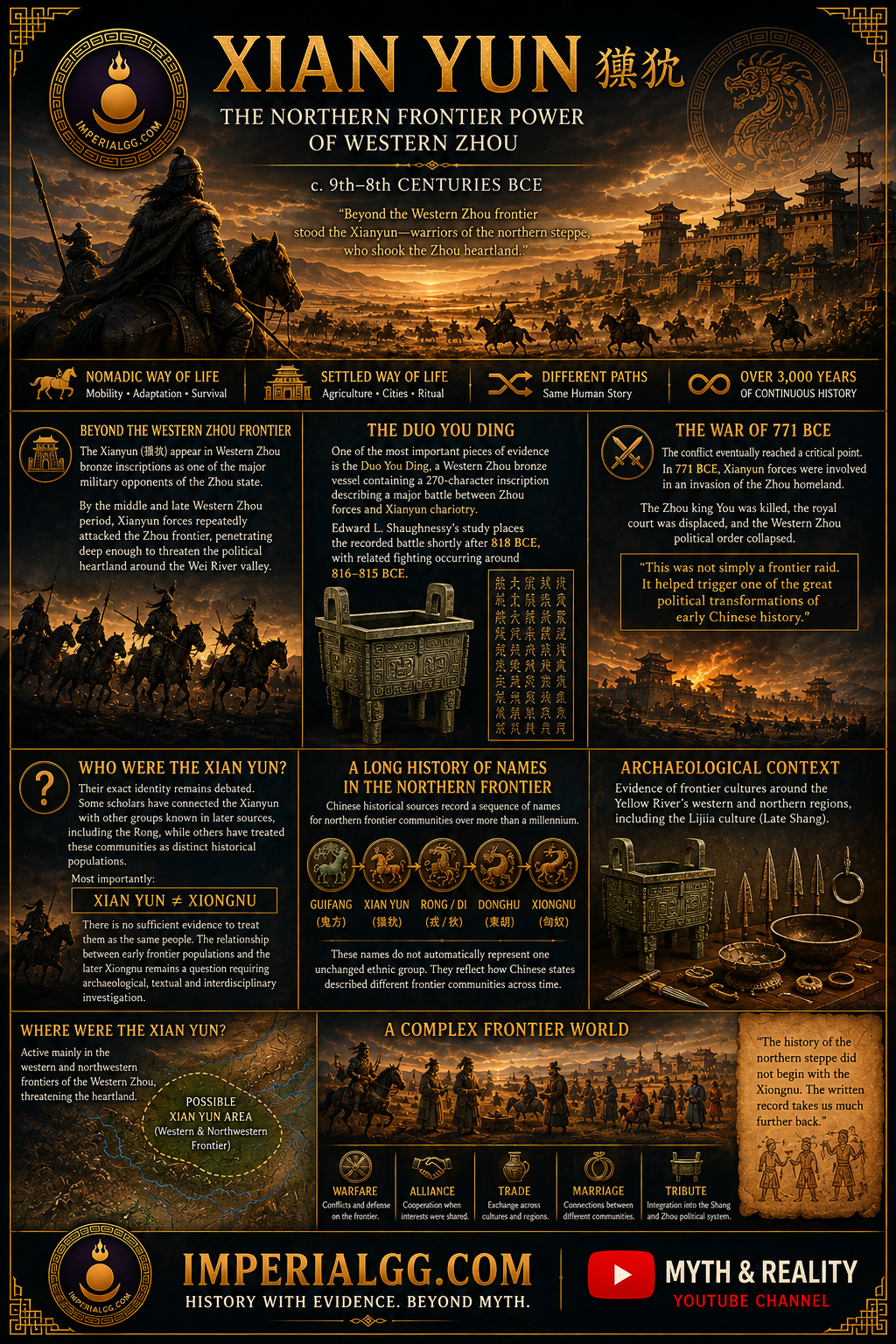
XIAN YUN — THE NORTHERN FRONTIER POWER OF WESTERN ZHOU
By Altanbagana Baatar
DBA Candidate| Independent Historian
ImperialGG Historical Research Seriers
20 August 2026
BEYOND THE WESTERN ZHOU FRONTIER
獫狁 (Xianyun) and the Political Geography of the Northwestern Frontier, c. 9th–8th Centuries BCE
INTRODUCTION
The Xianyun (獫狁) occupy an important but difficult position in the historical record of early China. They appear prominently in Western Zhou bronze inscriptions and later textual traditions as a major opponent of the Zhou state, particularly along the northwestern frontier. Their emergence in the sources marks a period in which warfare between the Zhou royal center and communities beyond its political core became increasingly intense.
Yet the historical significance of the Xianyun cannot be reduced to the conventional image of a “northern nomadic tribe.” The surviving evidence points to a complex frontier society involved in organized warfare, regional interaction and political competition. Their exact ethnic, linguistic and political identity remains uncertain, and the relationship between the Xianyun and other groups such as the Rong (戎) is still debated.
The Xianyun therefore provide an important case study for examining how early Chinese states interacted with societies beyond their political heartland.
THE WESTERN ZHOU FRONTIER
The Western Zhou dynasty conventionally dates from approximately 1045 to 771 BCE. Its political heartland was concentrated around the Wei River valley, particularly in present-day Shaanxi, where the royal centers of Feng and Hao were located. The geography of the Zhou state placed its western capital region relatively close to the frontier, making the security of the northwestern approaches a permanent strategic concern.
The upper Jing River valley became particularly important. It connected the Zhou heartland with the northwestern frontier and served as one of the principal theaters of conflict between the Zhou and the Xianyun. Li Feng’s reconstruction of the Western Zhou geopolitical landscape places this region at the center of the military crisis that developed during the later Zhou period.
This geography is essential for understanding the conflict.
The Xianyun were not simply distant enemies appearing from an undefined “northern steppe.” Their military activity directly affected the frontier zone through which the Zhou royal center communicated with its western and northern territories.
THE BRONZE INSCRIPTIONS AS PRIMARY EVIDENCE
One of the most important sources for Xianyun history is the corpus of Western Zhou bronze inscriptions. Unlike much later historical literature, these inscriptions were produced close to the events they commemorate. They record military campaigns, political appointments, territorial claims, ritual actions and the achievements of Zhou elites.
The technological sophistication of Western Zhou bronze inscription production is itself significant. Research on the production of these texts demonstrates that inscriptions were carefully composed and transmitted through written exemplars before being cast into bronze. This means that bronze inscriptions should be treated not simply as decorative objects but as deliberately constructed historical documents. Among these inscriptions, the Duo You Ding (多友鼎) is particularly important.
THE DUO YOU DING
The Duo You Ding contains a 270-graph inscription describing a major military confrontation between Zhou forces and Xianyun chariotry. It was discovered in Shaanxi in 1980 and has become one of the most important primary sources for reconstructing the military geography of the late Western Zhou.
Edward L. Shaughnessy’s detailed study argues that the events recorded in the inscription occurred shortly after the tenth year of King Xuan’s reign, placing the campaign around 818 BCE, while other bronze inscriptions indicate continued warfare in 816–815 BCE. Shaughnessy therefore interprets the battle recorded by the Duo You Ding as part of a larger period of Zhou–Xianyun warfare. This evidence is particularly valuable because it provides more than the name of an enemy.
It preserves information concerning:
- military commanders,
- geographical locations,
- troop movements,
- chariot warfare,
- captured equipment,
- and the organization of Zhou military response.
The inscription consequently allows historians to reconstruct a frontier conflict as a political and military system, rather than simply as an isolated battle.
WERE THE XIAN YUN MOUNTED NOMADS?
This question requires particular caution. Modern popular representations often portray every ancient northern opponent of a Chinese dynasty as a mounted nomadic people. The Western Zhou evidence does not support such a simple interpretation. Li Feng has emphasized that the Xianyun forces described in the Duo You Ding fought with chariots, rather than representing a later-style mounted nomadic military system. His reconstruction places their principal area of conflict in the upper Jing River region.
This does not mean that the Xianyun had no relationship with pastoral or mobile populations. Rather, it demonstrates that the political and military systems of the ninth century BCE cannot simply be projected backward from the later Xiongnu period.
The distinction is important:
XIAN YUN ≠ LATER XIONGNU MILITARY SYSTEM
The two belong to different historical contexts separated by several centuries.
THE POETIC MEMORY OF THE XIAN YUN
The Xianyun also entered the literary memory of early China. The Classic of Poetry contains references to campaigns against the Xianyun, including the famous poem “Cai Wei” (采薇). The poem describes soldiers serving on the frontier and links their military service with separation from home and family. Later exegetical traditions understood the poem as referring to campaigns against the Xianyun.
This literary evidence is valuable, but it must be handled differently from bronze inscriptions. A bronze inscription may preserve a near-contemporary record commissioned by a participant in the political system. A transmitted poem, by contrast, passed through processes of compilation, interpretation and later transmission. The two sources therefore should not simply be treated as equivalent. Instead, they allow us to observe two different dimensions of the same historical memory:
EPIGRAPHIC MEMORY — WARFARE AND POLITICAL ACHIEVEMENT
LITERARY MEMORY — WARFARE AND HUMAN EXPERIENCE
THE CRISIS OF 771 BCE
The Xianyun question becomes even more significant in the final decades of the Western Zhou. By the late eighth century BCE, the Zhou state was experiencing serious internal and external pressures. The northwestern frontier had become increasingly unstable, while the political authority of the Zhou king was weakening.
In 771 BCE, forces identified in Western Zhou evidence with the Xianyun, and in later traditions associated with the Rong, participated in an invasion of the Zhou homeland. The Zhou king You was killed, the royal political order collapsed, and the dynasty’s center was subsequently relocated eastward. However, the event should not be interpreted as a simple story in which an external “barbarian invasion” alone destroyed the Zhou dynasty.
Modern scholarship emphasizes the interaction between internal political conflict and external military pressure. Recent research using the excavated Xinian manuscript has also demonstrated that the traditional narrative of the events following 771 BCE is more complicated than the later Shiji account suggests. Thus, 771 BCE should be understood as the culmination of a broader political crisis rather than a single-cause collapse.
XIAN YUN AND THE RONG
The relationship between the Xianyun and the Rong remains one of the most important questions. Some scholarship identifies the Xianyun with the Western Rong traditions found in later sources. This interpretation has become influential, particularly because later texts frequently use variant terminology when describing the enemies of the Zhou. But this identification is not universally accepted.
Nicola Di Cosmo, for example, has treated the Xianyun and Rong as potentially distinct populations, demonstrating that the equation should not be regarded as unquestioned historical fact. The methodological lesson is important:
A change in historical terminology does not automatically prove a change—or continuity—in ethnic identity. Names in ancient sources were political and textual categories as much as they were ethnic labels.
XIAN YUN AND THE XIONGNU QUESTION
The temptation to connect the Xianyun directly with the later Xiongnu (匈奴) is understandable. The names appear in broadly related northern frontier contexts, and later Chinese historical traditions constructed genealogical relationships among several northern peoples. But the chronological gap is substantial.
The Xiongnu imperial confederation emerged more than two centuries after the fall of the Western Zhou, and its political structure belongs to a substantially different historical environment. Modern interdisciplinary research describes the origins of the Xiongnu themselves as complex and mixed, rather than the straightforward continuation of a single earlier population.
Consequently, the statement
“Xianyun were the Xiongnu”
A more defensible question is whether there were long-term demographic, technological, ecological or political continuities among northern frontier societies across the intervening centuries. That is a much broader—and more productive—research question.
A CHANGING NORTHERN FRONTIER
The historical sequence can therefore be represented cautiously:
GUIFANG
↓
XIAN YUN
↓
RONG / DI
↓
DONGHU
↓
XIONGNU
This sequence should not be interpreted as a single uninterrupted ethnic genealogy. Rather, it represents a succession of names appearing in Chinese historical records as political communities beyond or around the northern and northwestern frontiers changed over time.
It is:
What forms of political organization, mobility, warfare, exchange and cultural interaction persisted across the northern frontier despite changes in political identity?
CONCLUSION
The Xianyun occupy a critical position in the history of the early Eurasian frontier. They were not merely a vague “barbarian tribe” described by Chinese chroniclers. The Western Zhou bronze inscriptions provide direct evidence of organized warfare involving Xianyun forces, while the Duo You Ding offers an unusually detailed record of a major campaign around the early eighth century BCE.
Their conflict with the Zhou developed within a larger geopolitical struggle over the upper Jing River and the security of the Wei River heartland. By 771 BCE, the accumulated pressure of frontier warfare and internal Zhou political conflict contributed to the collapse of the Western Zhou political order.
Yet the Xianyun remain historically elusive. Their exact identity, their relationship to the Rong, and their possible connections with later northern populations cannot be resolved by textual names alone. The evidence instead points toward a much larger historical problem:
The northern frontier of early China was not a fixed border.
It was a changing political zone in which communities fought, traded, negotiated, migrated, intermarried and competed for access to land and resources. The Xianyun were one of the most important powers within that changing world. And they remind us that the history of the Eurasian steppe does not begin with the Xiongnu.
The written record reaches further back.
FOOTNOTES
1. Li Feng, Landscape and Power in Early China: The Crisis and Fall of the Western Zhou, 1045–771 BC (Cambridge: Cambridge University Press, 2006), especially pp. 141–192. Li examines the upper Jing River valley as a principal theater of Zhou–Xianyun conflict.
2. Edward L. Shaughnessy, “The Date of the ‘Duo You Ding’ and its Significance,” Early China 9–10 (1983–1985): 55–69. Shaughnessy dates the inscription’s campaign to the period shortly after 818 BCE and identifies related fighting in 816–815 BCE.
3. Ondřej Škrabal, “Writing Before Inscribing: On the Use of Manuscripts in the Production of Western Zhou Bronze Inscriptions,” Early China 42 (2019): 273–332. The study demonstrates the sophisticated processes involved in composing and casting Western Zhou inscriptions.
4. Li Feng, Landscape and Power in Early China, pp. 141–192. Li reconstructs the northwestern frontier and discusses the military geography of the Zhou–Xianyun wars.
5. Li Feng, discussion of Xianyun military organization and the Duo You Ding in Landscape and Power in Early China. The study emphasizes that the Xianyun forces described in the inscription employed chariot warfare rather than representing a later mounted-nomad military model.
6. Chen Qingmao, “Analysis of Selected Poems from the Shi Jing, Xiao Ya, and Cai Wei,” Journal of Humanities Research 2 (2007): 185–204. The study discusses the Cai Wei poem and its traditional association with campaigns against the Xianyun.
7. Chen Minzhen and Yuri Pines, “Where is King Ping? The History and Historiography of the Zhou Dynasty’s Eastward Relocation,” Asia Major 31.1 (2018): 1–27. The authors compare the traditional narrative of the 771 BCE crisis with the newly excavated Xinian manuscript.
8. Li Feng, “The Fall of the Western Zhou: Partisan Struggle and Spatial Collapse,” in Landscape and Power in Early China. The study emphasizes both the external military threat and internal political factors in the collapse of Western Zhou.
9. “Colonialism and Diaspora in Early China,” Early China (2026). The study notes that Xianyun appear more frequently in Western Zhou sources, while later sources often employ the term Rong, and explicitly notes scholarly disagreement over whether the two designations refer to the same population.
10. Nicola Di Cosmo, Ancient China and Its Enemies: The Rise of Nomadic Power in East Asian History (Cambridge: Cambridge University Press, 2002), cited in the recent discussion of Xianyun–Rong identification. The work represents a more cautious position concerning their identification as the same population.
11. J. J. Kim et al., “Early nomads of the Eastern Steppe and their tentative connections in the West,” Evolutionary Human Sciences 2 (2020). The study emphasizes the complex, mixed origins of the Xiongnu and the need for interdisciplinary approaches to continuity questions.
12. Bryan K. Miller, Xiongnu: The World’s First Nomadic Empire (Oxford University Press, 2024), especially the discussion of the later Xiongnu legacy. The work demonstrates the distinct political importance of the Xiongnu imperial formation and its later historical memory.
AUTHOR’S THESIS
The Xianyun should neither be dismissed as an undefined “barbarian” population nor prematurely equated with the later Xiongnu. The strongest interpretation is to treat them as a historically specific political formation of the Western Zhou frontier whose wars with Zhou reveal a much older pattern of interaction between the agrarian state centers of East Asia and the mobile and semi-mobile societies of the northern frontier. The central research problem is therefore continuity of political and cultural systems—not assumed continuity of ethnic names.