GUIFANG: THE NORTHERN POWER IN SHANG HISTORICAL MEMORY
By Altanbagana Baatar
DBA Candidate| Independent Historian
ImperialGG Historical Research Seriers
19 August 2026
GUIFANG: THE NORTHERN POWER
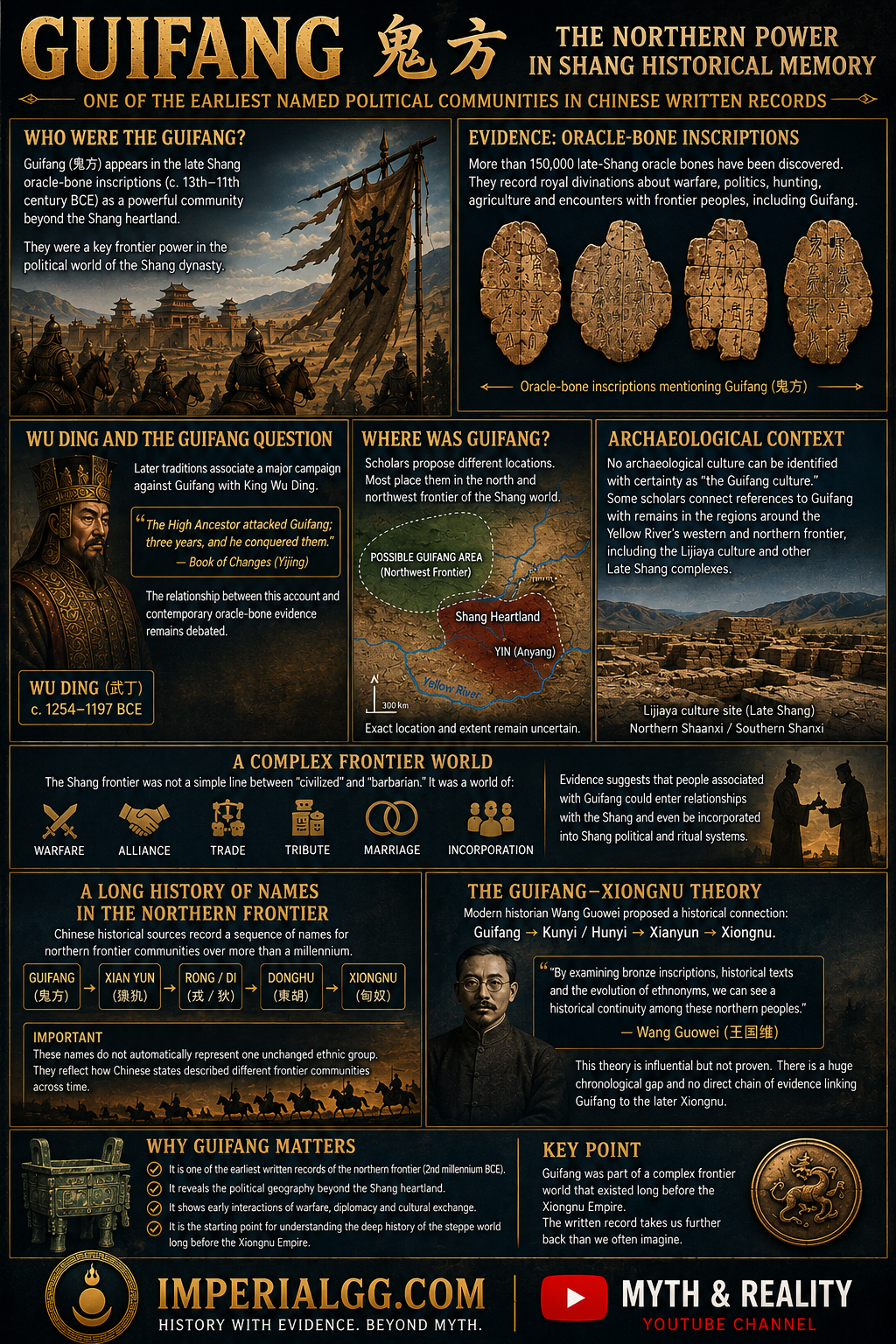
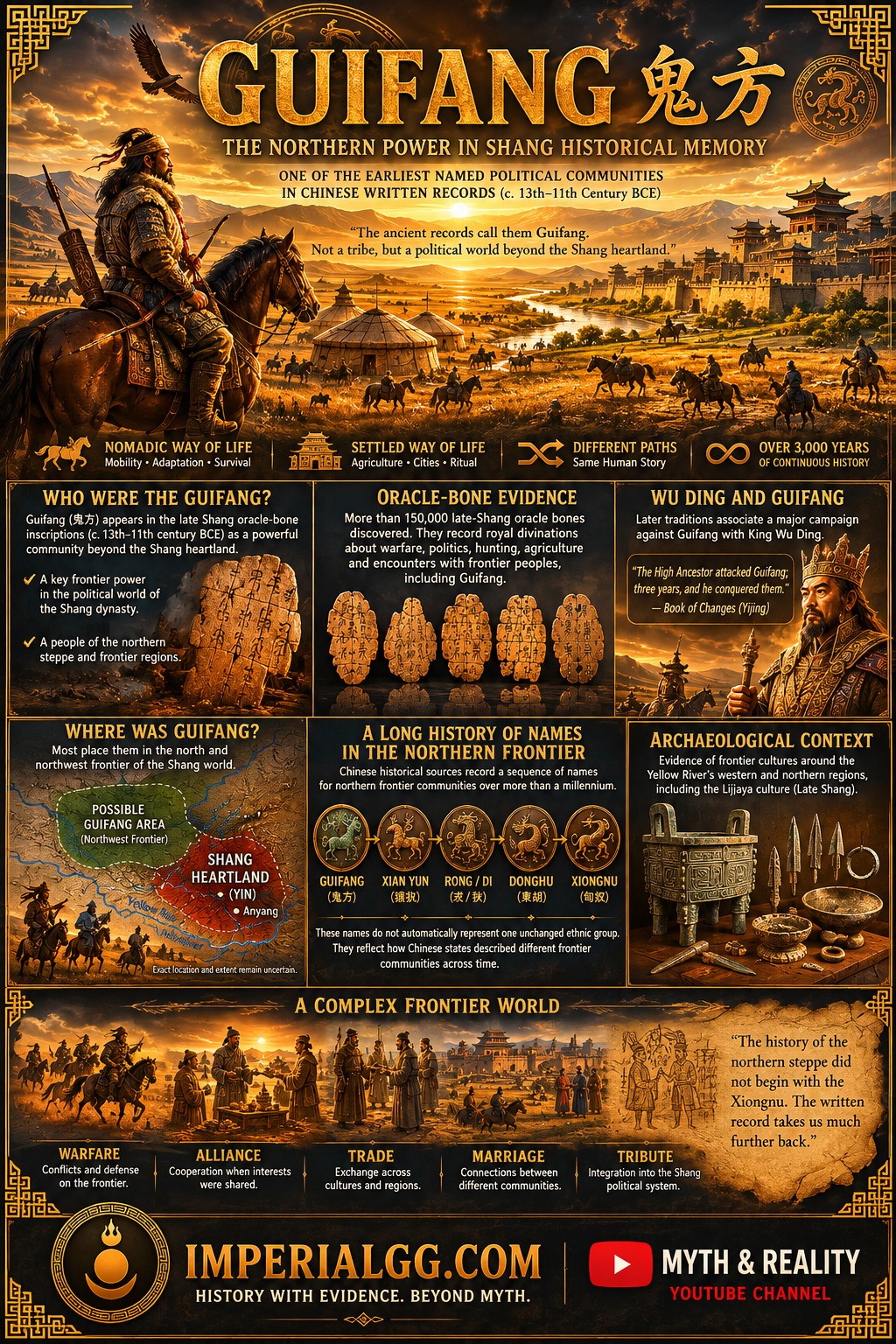
Guifang (鬼方) is one of the earliest named political communities appearing in the written record of ancient China. Its history reaches back to the late Shang period, more than three thousand years ago, when the Shang royal court recorded military, political and ritual information through oracle-bone inscriptions. Yet Guifang remains one of the most debated names in early East Asian history.
The central problem is simple: Who were the Guifang, and where did they live?
The surviving evidence does not provide a simple answer. What it does provide is more valuable: a glimpse into the political geography of the late Shang world and the complex relationship between the Shang royal center and communities beyond its immediate control.
THE NAME GUIFANG
The name Guifang (鬼方) appears in several different bodies of early Chinese evidence, including oracle-bone inscriptions, bronze inscriptions and later transmitted texts. The character fang (方) is particularly important. During the Shang period, fang was frequently used in names of political communities or territorial groups outside the immediate royal domain, such as Tufang (土方), Qiangfang (羌方) and others.
This means that Guifang should not automatically be understood as the name of an ethnic group in the modern sense. It may have referred to a political community, regional polity, coalition, or population identified by the Shang court under a particular external name.
This distinction is essential. The Shang inscriptions were produced by the royal court, and therefore they describe the world primarily from the perspective of the Shang political center.
THE ORACLE-BONE EVIDENCE
The most important evidence comes from the oracle-bone inscriptions of the late Shang period. Oracle-bone inscriptions represent the earliest known systematic form of Chinese writing. More than 150,000 late-Shang oracle bones have been discovered, containing thousands of identifiable characters. They record royal divinations concerning warfare, hunting, agriculture, weather, sacrifices and political affairs.
Guifang appears within this wider political and ritual system. However, the evidence requires caution. The surviving oracle-bone corpus does not provide a straightforward narrative history of a Shang–Guifang war. Some inscriptions mention Guifang in divinatory contexts, but the exact meaning and historical circumstances of individual inscriptions remain debated. One modern reassessment, for example, has emphasized that the oracle-bone evidence does not simply reproduce the later literary narrative of a three-year Shang conquest of Guifang.
This is an important methodological point:
Later historical texts cannot automatically be read back into the contemporary oracle-bone evidence.
WU DING AND THE GUIFANG QUESTION
The traditional narrative associates Guifang with King Wu Ding, one of the most important rulers of the late Shang period.
The Book of Changes (Yijing) contains the famous statement:
“The High Ancestor attacked Guifang; three years, and he conquered them.” Later tradition identified the “High Ancestor” with Wu Ding. The Bamboo Annals likewise preserves a tradition that Wu Ding campaigned against Guifang. This produced the traditional image of Guifang as a powerful enemy of the Shang. But modern scholarship has questioned whether the Yijing passage can be used as direct evidence for a specific Wu Ding campaign. Some scholars argue that the transmitted text reflects later historical memory rather than a contemporary record of Wu Ding’s military operations.
Therefore, the strongest academic position is not simply:
“Wu Ding fought Guifang for three years.”
It is:
“Later transmitted traditions associate a major campaign against Guifang with the Shang High Ancestor, conventionally identified as Wu Ding, but the relationship between this account and contemporary oracle-bone evidence remains disputed.”
That distinction matters.
WHERE WAS GUIFANG?
The geographical location of Guifang is perhaps the most controversial question.
Older scholarship proposed several possibilities, including areas north, northwest and west of the Shang heartland. Traditional interpretations of later texts placed Guifang in various regions, demonstrating that its geographical identity was already uncertain in premodern scholarship.
One influential twentieth-century interpretation was developed by Wang Guowei (王国维). Examining ancient bronze inscriptions, historical texts and the evolution of ethnonyms, Wang argued that Guifang, Kunyi, Xianyun and later Xiongnu represented successive historical names for related northern populations. He placed an important Guifang presence in the region around the Qianlong–Longshan area west of the Zhou heartland, while recognizing that the wider population could have occupied a much larger frontier zone. Other scholars have proposed locations further east or southeast.
More recent geographical studies have even challenged the traditional western/northwestern placement and argued that some references traditionally read as Guifang may instead relate to communities in the eastern Shang sphere. This demonstrates that the location cannot currently be treated as settled.
The safest conclusion is therefore:
Guifang belonged to the wider frontier world beyond the Shang royal center, but its precise geographical extent remains unresolved.
GUIFANG AND THE ARCHAEOLOGICAL RECORD
Archaeology creates another difficulty. We do not possess an archaeological culture that can be identified with certainty as “the Guifang culture.” Researchers have nevertheless attempted to connect the Guifang mentioned in inscriptions with archaeological remains in the regions around the Yellow River’s western and northern frontier, including material associated with the Lijiaya culture and other Late Shang archaeological complexes.
Scholars working in southern Shanxi and northern Shaanxi have noted similarities between Late Shang bronze assemblages and archaeological communities outside the Shang heartland, while some have proposed that the Lijiaya cultural sphere may represent populations mentioned in Shang and Zhou sources under names such as Guifang or related ethnonyms.
But these identifications remain hypotheses. Archaeology can demonstrate interaction, cultural contact, technological exchange and political incorporation. It cannot automatically transform an archaeological culture into a named ethnic group from a textual source.
GUIFANG WAS NOT SIMPLY “A BARBARIAN TRIBE”
The traditional Chinese historical vocabulary often classified communities beyond the central political zone through categories such as Rong, Di, Yi and Man. Modern historians must be careful not to treat these labels as fixed ethnic classifications. The Shang political world was composed of multiple interacting communities. Some fought the Shang. Some traded with it. Some supplied military assistance. Some entered the Shang political system.
Evidence cited by modern scholars indicates that people associated with Guifang could participate in relationships with the Shang rather than existing permanently outside it. One study notes evidence suggesting that Guifang-related figures could have been incorporated into Shang political and ritual structures. This suggests a more complex frontier than a simple division between:
“civilized Shang” vs. “barbarian Guifang.”
The historical reality was likely a constantly changing frontier of warfare, alliance, tribute, marriage, migration and political incorporation.
THE GUIFANG–XIONGNU THEORY
This is where the subject becomes especially important for the long-term history of the northern steppe. The great historian Wang Guowei proposed a historical sequence connecting:
GUIFANG → KUNYI / HUNYI → XIAN YUN → XIONGNU
His argument was based principally on comparative philology, ancient bronze inscriptions and transmitted historical sources. This interpretation became highly influential in Chinese and later East Asian historical scholarship. But it should not be presented today as established fact.
The problem is the enormous chronological gap. Guifang belongs to the second millennium BCE. The Xiongnu Empire emerges in securely documented form more than a millennium later. Between them lie major changes in political organization, population movements, material culture and language. There is currently no single chain of evidence proving that the people called Guifang were genetically, ethnically or politically identical to the later Xiongnu.
Therefore, the academically responsible formulation is:
Some historians have proposed a long-term historical relationship between Guifang and the Xiongnu, but the direct continuity remains unproven.
That distinction allows the hypothesis to be investigated without turning a scholarly argument into a historical certainty.
WHY GUIFANG MATTERS
Guifang is important not because we can already give it a simple ethnic label. It is important because it reveals something fundamental about the formation of early East Asian political geography. By the late Shang period, the Shang court was already interacting with a wide world beyond its central territories. The oracle bones preserve evidence of warfare, diplomacy, divination and political relationships involving numerous neighboring communities. Guifang therefore belongs to the earliest recoverable layer of written evidence for the political world surrounding the Shang. It is a starting point.
From this world, later Chinese sources would record other frontier names and political communities:
GUIFANG
↓
XIAN YUN
↓
RONG / DI
↓
DONGHU
↓
XIONGNU
But these names should not be treated as automatically representing one unchanged ethnic group. Rather, they provide a sequence of historical names through which Chinese states described different northern and western frontier communities over more than a millennium. The question of continuity is precisely what requires further archaeological, linguistic, genetic and historical investigation.
CONCLUSION: BEFORE THE XIONGNU
Guifang stands near the beginning of the written history of the northern frontier. The evidence tells us that a political community known by this name existed within the Shang-era world and interacted with the Shang political center. Its precise location, internal organization and ethnic or linguistic identity remain uncertain. The traditional association with Wu Ding and the later theory connecting Guifang with the Xiongnu are historically important, but both require careful qualification.
What can be stated with confidence is more fundamental:
Guifang was part of a complex political frontier that existed long before the Xiongnu Empire.
Understanding that frontier is essential if we want to study the emergence of later steppe powers without beginning the story too late. The history of the northern Eurasian steppe did not begin with the Xiongnu.
The written record takes us further back.
And one of the earliest names waiting there is: GUIFANG — 鬼方
FOOTNOTES
1. Jonathan Smith and Yuzhou Fan, “The Cultural and Historical Setting of the Shang,” in The Oxford Handbook of Early China, Oxford University Press, 2020, pp. 226–252. The chapter emphasizes the importance of combining archaeology, inscriptions and transmitted texts in reconstructing Shang history.
2. Dongpo Fu et al., “Radiocarbon Dating of Oracle Bones of Late Shang Period in Ancient China,” Radiocarbon. The study dates the reign of Wu Ding to approximately 1254–1197 BCE and the end of the Shang to around 1041 BCE.
3. David N. Keightley, The Ancestral Landscape: Time, Space, and Community in Late Shang China, ca. 1200–1045 B.C., University of California, Berkeley, 2000.
4. Zhao Guangjie, The Guifang and Gongfang in the Yin-Shang Dynasty, master’s thesis, Chinese Culture University. The study surveys transmitted texts, oracle-bone evidence and archaeological approaches to Guifang.
5. Li Fa, “Research on the Oracle-Bone Inscriptions Concerning the Relationship between Shang and [𢀛]fang,” Southwest University. The article reviews hundreds of relevant inscriptions and discusses the chronology and geographical interpretations of the Shang frontier.
6. Wang Guowei, “Research on Guifang, Kunyi and Xianyun,” Guantang Jilin, vol. 13. Wang’s influential argument connected several ancient ethnonyms with the later Xiongnu; this remains a historiographical hypothesis rather than an established identity.
7. David W. Pankenier, discussion of the Gui Rong/Gui Fang in relation to the Shang and the western/northern frontier.
8. Recent geographical research has challenged older assumptions about the location of Guifang and emphasized that some traditional identifications may derive from later interpretation of transmitted texts.
9. Research on the Late Shang archaeological landscape in southern Shanxi has considered possible relationships between Guifang and the Lijiaya cultural sphere, while recognizing the limits of identifying archaeological cultures directly with textual ethnonyms.
10. The Yijing tradition of “Gaozong attacking Guifang for three years” and the Bamboo Annals tradition concerning Wu Ding are important later sources, but their relationship to contemporary Shang oracle-bone evidence remains debated.