
From the Steppe to the Seas — The Empires That Connected Continents
Explore the civilizations and empires that transformed Eurasia through conquest, trade, migration, and cultural exchange. From the ancient steppe confederations to the great imperial states, these histories reveal how peoples, ideas, and institutions shaped the world we know today.
Before Tumen Chanyu
Before the rise of Tumen Chanyu, the tribes later known collectively as the Xiongnu Confederation existed as a loose network of nomadic clans scattered across the eastern steppe of Mongolia and the Ordos region.
Ancient Chinese records referred to various northern peoples by different names over time, including the Guifang, Xianyun, and other frontier tribes. These groups lived through pastoral nomadism, seasonal migration, mounted hunting, and tribal warfare long before the emergence of a unified Xiongnu state.
Prior to Tumen’s reign, no single Chanyu had successfully united all major steppe tribes under centralized authority. Leadership among the nomads was often temporary and dependent upon military prestige, clan alliances, and control of pasturelands and trade routes.
During the late Warring States period and the rise of the Qin dynasty, pressure from expanding Chinese frontier states intensified. Northern campaigns, fortified border systems, and competition over grazing territory forced many tribes to migrate, reorganize, and form larger military alliances.
Tumen Chanyu emerged during this unstable era as one of the earliest rulers capable of exercising broader authority over multiple Xiongnu tribes. Although his confederation remained fragile, his rule represented an important transitional stage between scattered nomadic clans and the centralized imperial system later established by his son, Modu Chanyu.
Thus, the period before Tumen Chanyu may be understood as the formative age of the eastern steppe — a time of migration, tribal consolidation, frontier warfare, and the gradual emergence of the first great nomadic empire of Inner Asia.
Tumen Chanyu
Early Ruler of the Xiongnu Confederation
(d. c. 209 BCE)
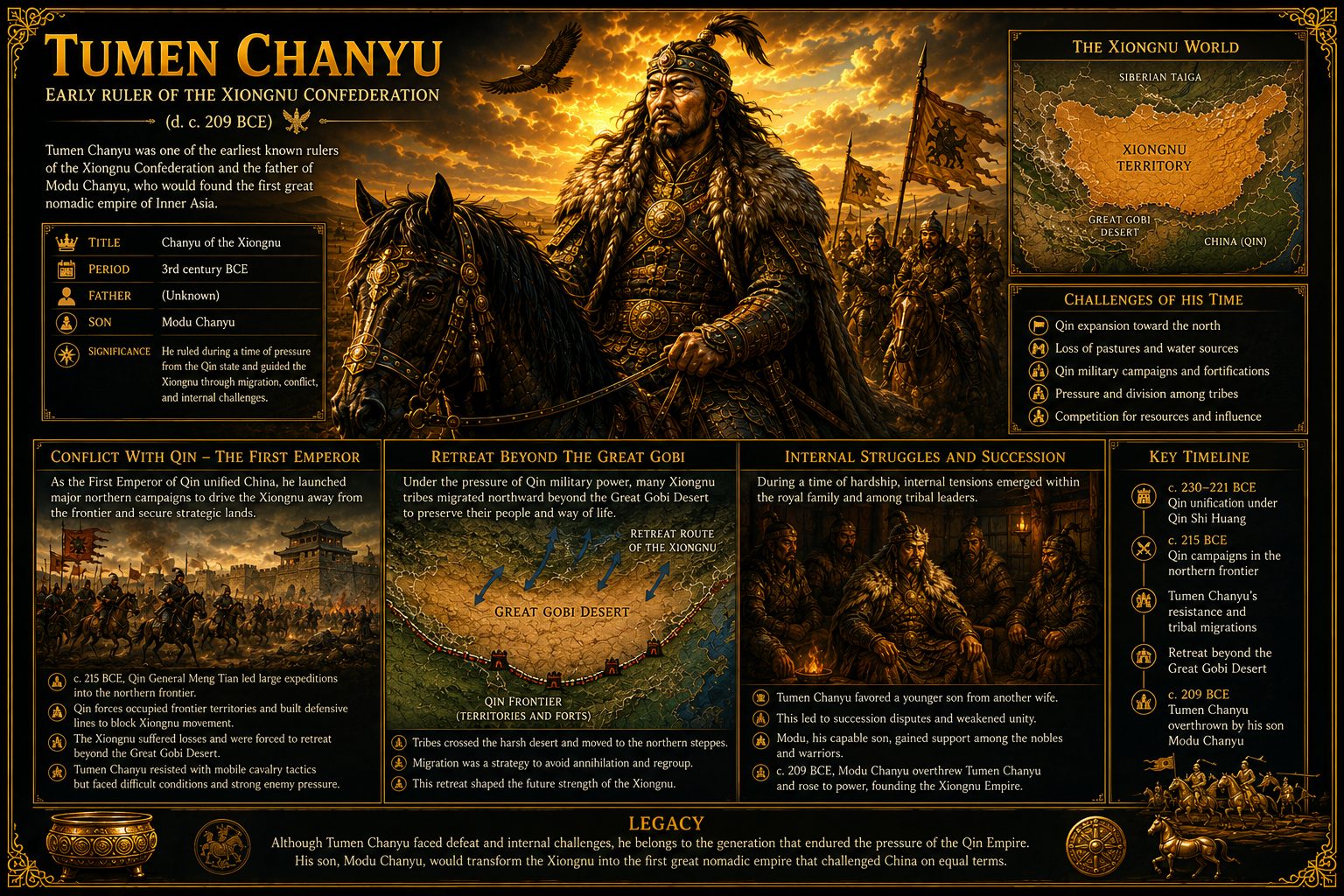
Tumen Chanyu was one of the earliest known rulers of the Xiongnu Confederation and the father of Modu Chanyu. He ruled during a formative period in the history of the eastern steppe, when nomadic tribes faced increasing military pressure from the rising power of the Qin dynasty and later the early Han state.
Chinese frontier expansion and military campaigns forced many steppe peoples to retreat northward beyond the Great Gobi Desert. During this era, the Xiongnu confederation struggled to preserve its political unity, grazing lands, and control over migration routes across Mongolia and Inner Asia.
Historical records describe continuous conflict between the Xiongnu and Chinese frontier forces. Defensive walls, fortified frontier zones, and cavalry expeditions pushed nomadic groups farther into the northern steppe. These pressures contributed to major tribal movements beyond the Gobi and intensified competition among the nomadic clans.
Tumen Chanyu attempted to maintain authority over the confederation during this unstable period, but internal political tensions weakened his rule. According to traditional accounts, succession disputes emerged within the royal family when Tumen favored a younger son from another queen instead of Modu.
These internal conflicts ultimately led to the rise of Modu Chanyu, who overthrew Tumen around 209 BCE and transformed the Xiongnu into the first great nomadic empire of Inner Asia.
Although later overshadowed by his son’s achievements, Tumen Chanyu remains an important figure in steppe history, representing the final generation before the dramatic imperial expansion of the Xiongnu world.
THE EMPIRE THAT UNITED CHINA WAS ONCE CALLED A "BARBARIAN" fROM NORTHERN FRONTIER STATE.
Qin Shi Huang and the Frontier Origins of Qin
Before unifying China in 221 BCE, the state of Qin dynasty was regarded by many eastern Zhou states as a harsh and militarized frontier kingdom. Located on the northwestern borderlands, Qin developed through constant interaction with Rong, Di, and other steppe-related peoples beyond the central plains.
Because of its frontier character, the Qin court was sometimes viewed by the older aristocratic states as culturally rough and less refined than the traditional Zhou elite. Ancient texts frequently associated the western frontier with Rong and Di populations, whom the central states described as semi-nomadic or “barbarian” peoples.
Before becoming the first emperor, Qin itself had once been a relatively small frontier kingdom on the western margins of the Zhou world. Through military reforms, cavalry warfare, and centralized state power, it eventually conquered the rival states and established the first unified imperial dynasty in Chinese history.One of the most controversial events associated with his reign was the policy traditionally known as the “Burning of Books and Burying of Scholars” (Fenshu Kengru). According to later historical records, particularly the writings of the Han historian Sima Qian, the Qin government ordered the destruction of many philosophical and historical texts that were not aligned with official state doctrine.
The campaign primarily targeted Confucian writings and independent scholarly traditions viewed as threats to centralized imperial authority. Historical accounts state that hundreds of scholars — often traditionally described as around 460 to 500 individuals — were executed or buried alive after being accused of criticizing the emperor and the Qin state.

Rise of the Steppe Empires
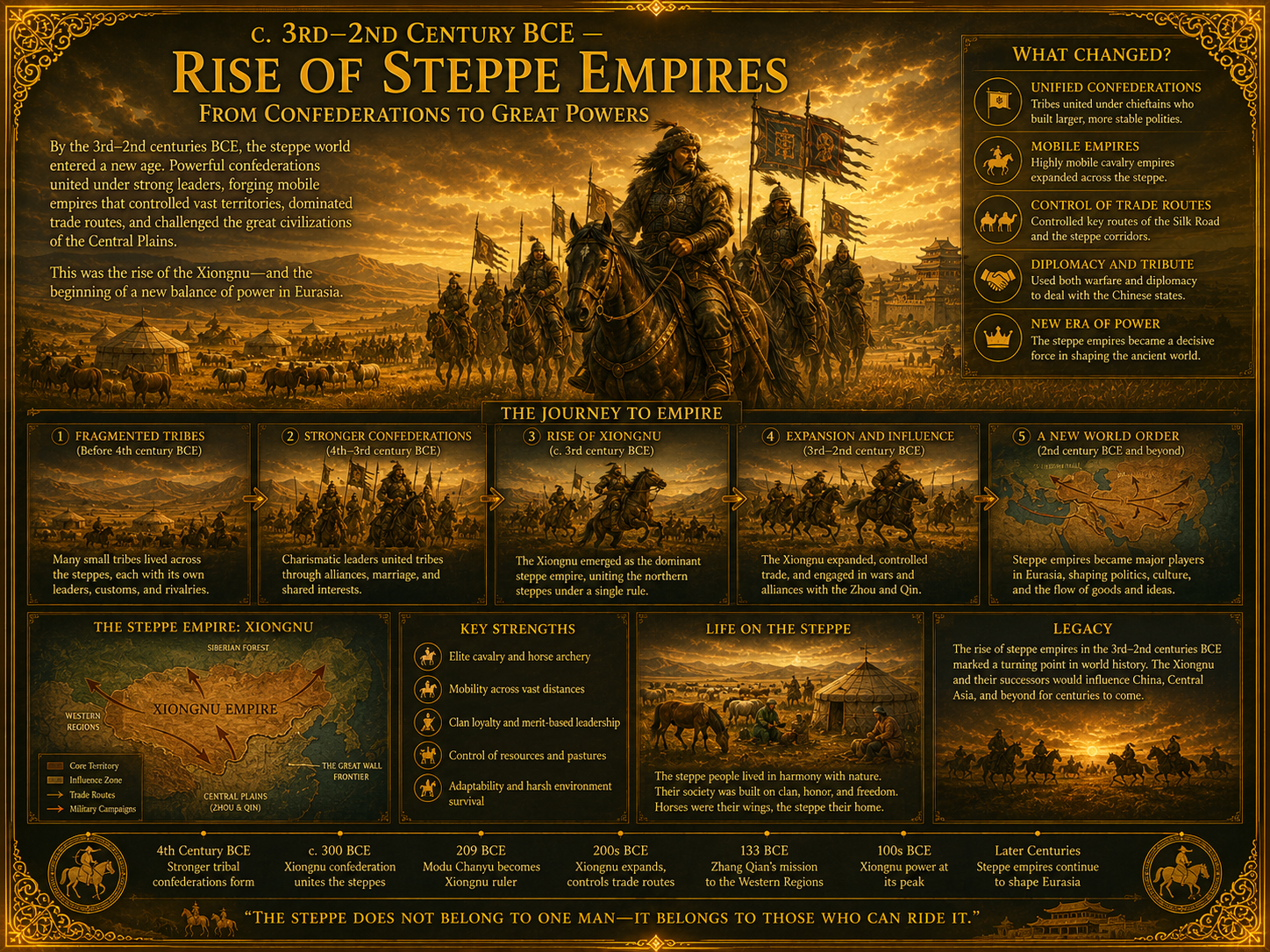
The rise of the steppe empires marked one of the great transformations in Eurasian history. Across the vast grasslands stretching from Mongolia to the Black Sea, nomadic peoples developed highly mobile societies built upon horse culture, pastoral economy, tribal alliances, and military discipline. Unlike settled civilizations centered upon cities and agriculture, the peoples of the steppe relied upon movement, seasonal migration, and mastery of mounted warfare.
The domestication of the horse and the development of composite bows allowed steppe warriors to achieve extraordinary military mobility. Cavalry armies could travel immense distances, strike rapidly, and disappear into the open plains before slower infantry forces could respond. Over time, these advantages enabled nomadic confederations to unite tribes, dominate trade routes, and challenge the great sedentary empires surrounding them.
Hun–Han Wars
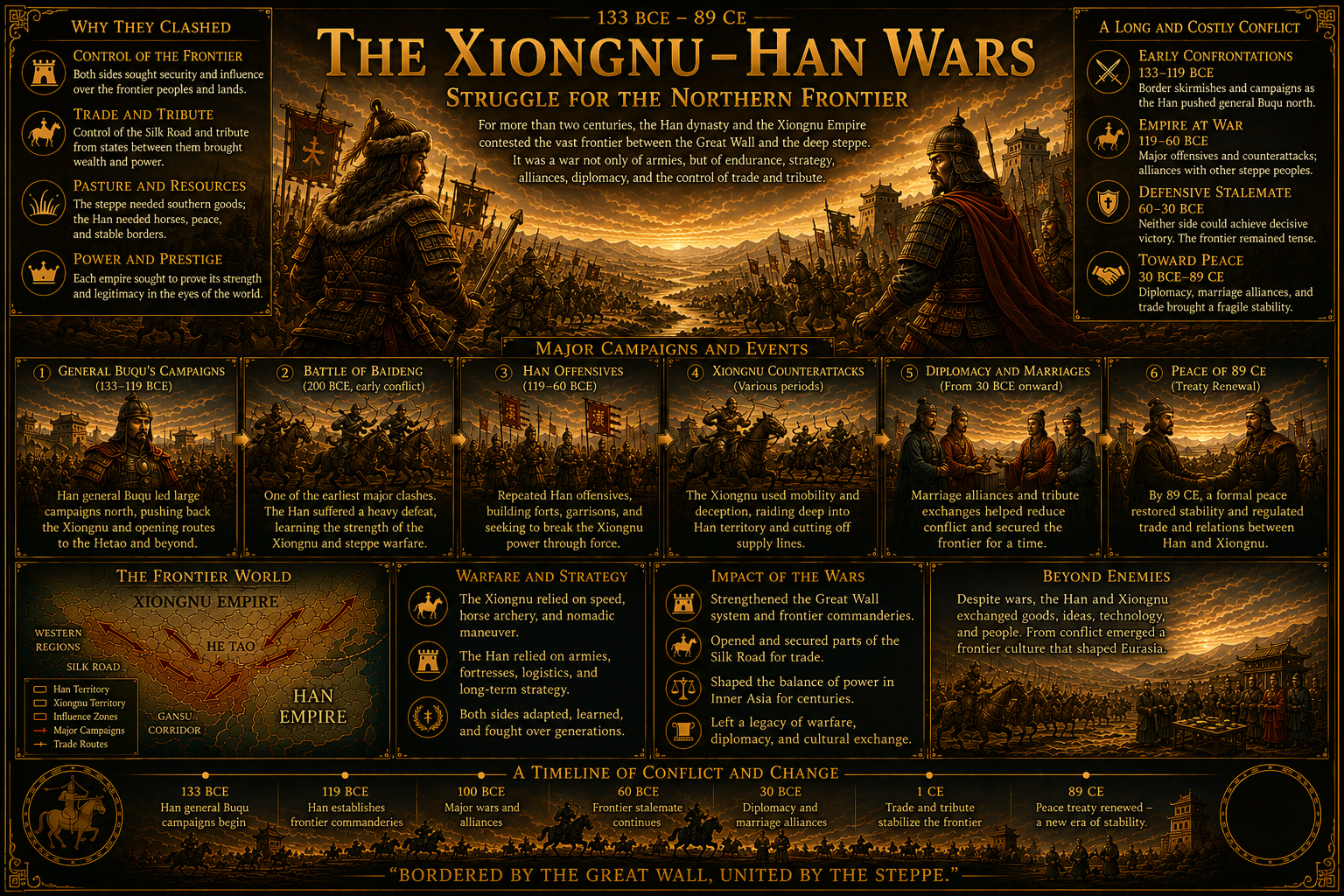
The Hun–Han Wars were a prolonged series of military conflicts fought between the Xiongnu Confederation and the Han dynasty from the 2nd century BCE onward. These wars became one of the defining geopolitical struggles of ancient Eurasia, shaping the balance of power across the eastern steppe, northern China, and the emerging Silk Road corridors.
During the early phase of the conflict, the Xiongnu held strategic superiority. Under rulers such as Modu Chanyu, Laoshang Chanyu, and Junchen Chanyu, the nomadic empire maintained powerful cavalry armies capable of rapid raids deep into Han frontier territories. The mobility of mounted archers, combined with tribal alliances and intimate knowledge of the steppe environment, gave the Xiongnu a major military advantage against slower agricultural armies.
In response to repeated incursions, the Han court initially relied upon diplomacy, tribute payments, marriage alliances, and frontier defense policies. These agreements, known as heqin, attempted to preserve peace through negotiated relations between the two powers. However, tensions remained constant, and border warfare continued across northern China.
The conflict intensified dramatically during the reign of Emperor Wu of Han. Rejecting passive appeasement, the Han state underwent extensive military reforms and launched large-scale offensives against the Xiongnu heartland. Massive cavalry expeditions pushed into the steppe, targeting tribal alliances, supply routes, and strategic regions such as the Hexi Corridor.
The wars became a contest between two fundamentally different imperial systems: the mobile nomadic confederation of the steppe and the centralized bureaucratic empire of agrarian China. While the Han gradually secured important victories and expanded westward influence, the Xiongnu continued to resist through maneuver warfare, rapid mobility, feigned retreats, and decentralized tribal resilience.
One of the most important consequences of the wars was the Han conquest of the Hexi Corridor, which weakened Xiongnu influence over western trade networks and strengthened Han access to Central Asia. The conflict also accelerated the militarization of the Han Empire and transformed frontier policy for centuries afterward.
Although the balance of power eventually shifted, the Hun–Han Wars were not a simple story of conquest. For generations, the Xiongnu remained one of the greatest military powers of Inner Asia and forced one of the world’s strongest ancient empires into continuous adaptation and reform.
The wars ultimately shaped the political, military, and economic foundations of Eurasia during the ancient age, influencing the development of imperial warfare, frontier systems, and transcontinental exchange across the Silk Road world.
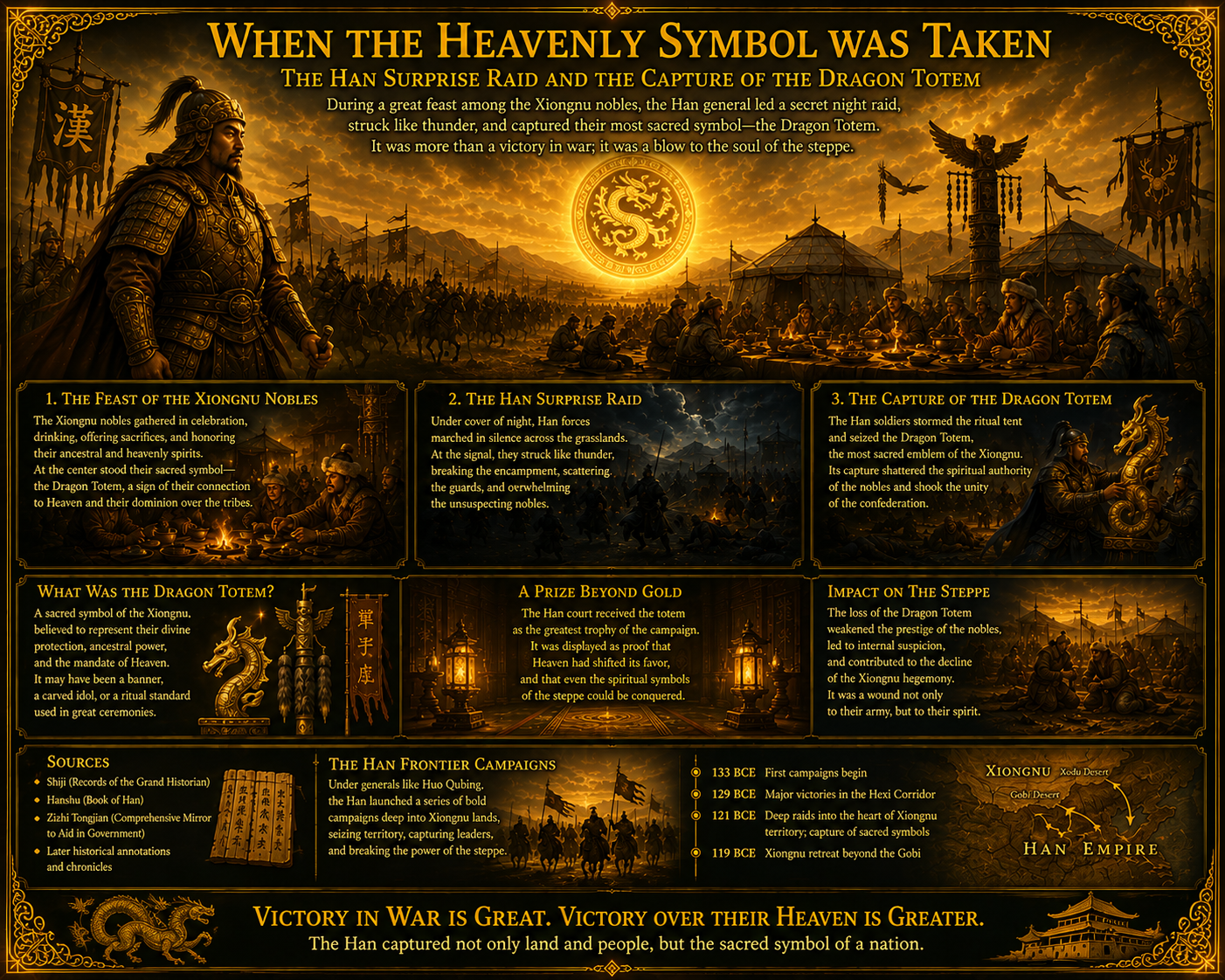
Heavenly Symbols Seized — 133 BCE
In 133 BCE, during the failed Mayi Trap operation, forces of the Han dynasty attempted to ambush the army of Junchen Chanyu after inviting the Xiongnu into what appeared to be a peaceful frontier exchange.
According to historical accounts, Han commanders launched a surprise attack while the Xiongnu leadership and nobles were engaged in diplomatic feasting and negotiations near Mayi. Although the ambush ultimately failed, Han forces seized valuable ceremonial items and military treasures abandoned during the sudden withdrawal.
Among the captured objects were banners, ornaments, and imperial-style dragon symbols associated with Xiongnu authority and heavenly legitimacy. In steppe political culture, such sacred emblems represented divine favor, sovereign power, and the protection of Eternal Heaven.
The incident shattered remaining trust between the two empires and marked the collapse of long-standing heqin diplomacy. After 133 BCE, relations between the Xiongnu and Han transformed into an era of open imperial warfare that would dominate Inner Asian politics for generations.
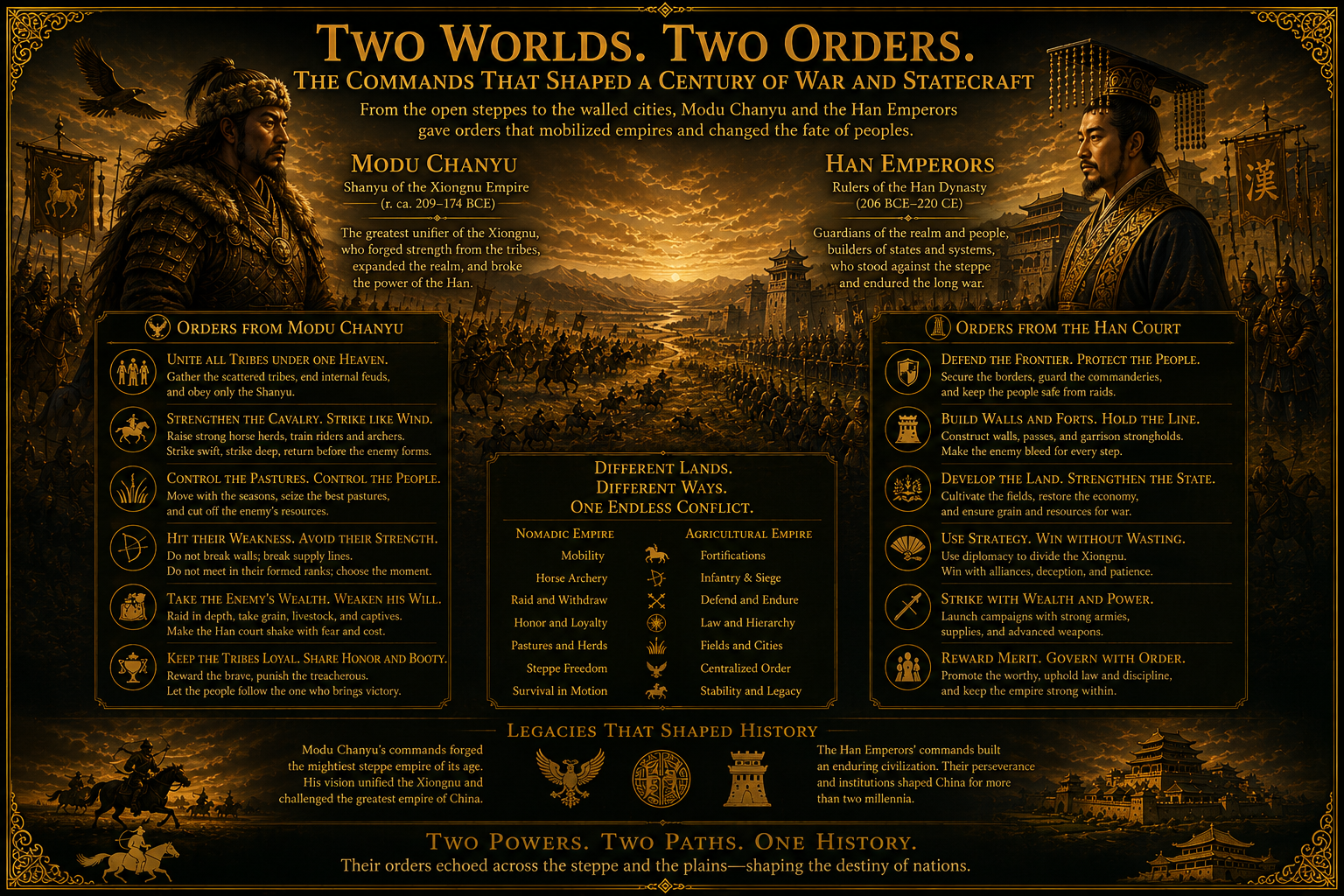
198 BCE: THE HEQIN TREATY THAT FORCED THE HAN TO NEGOTIATE WITH THE XIONGNU AS AN EQUAL
Treaty of Equality — 198 BCE
In 198 BCE, following the defeat of Emperor Gaozu of Han at the Battle of Baideng by the forces of Modu Chanyu, the Han dynasty and the Xiongnu Confederation concluded the first major heqin agreement.
The treaty formally recognized the two realms as equal powers and established peace through diplomatic marriage alliances, frontier agreements, and the regular exchange of silk, grain, wine, and luxury goods from Han to the Xiongnu court.
Although officially described by the Han court as ceremonial gifts, these payments functioned politically as tribute intended to secure stability along the northern frontier and prevent large-scale Xiongnu invasions.
The agreement marked one of the earliest diplomatic recognitions of parity between a major agrarian empire and a nomadic imperial confederation in Inner Asian history.
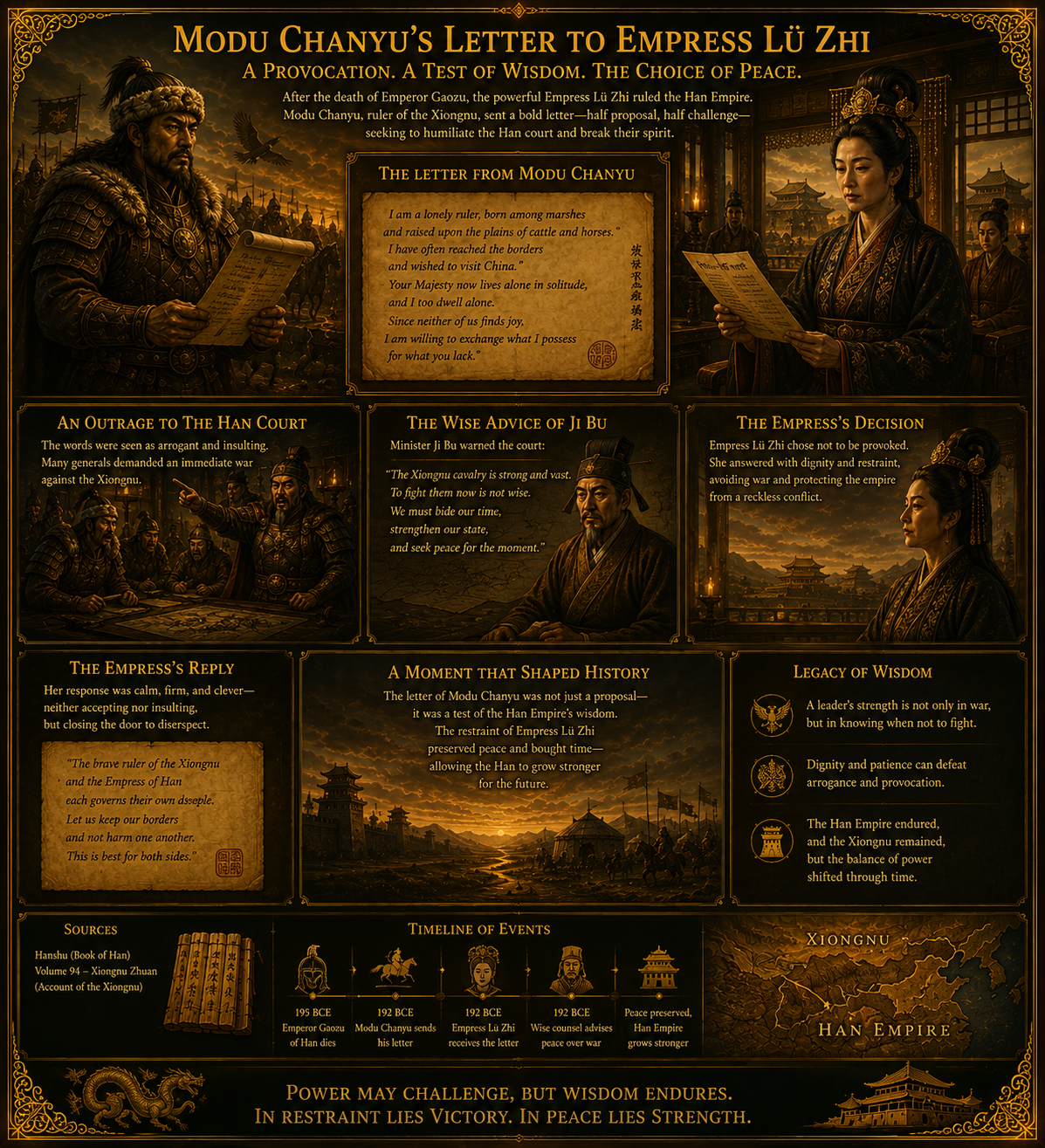
198 BCE: THE HEQIN TREATY THAT FORCED THE HAN TO RECOGNIZE THE XIONGNU AS A POLITICAL EQUAL unusually direct and provocative language for interstate correspondence. The Han court regarded the message as an insult and a challenge to imperial dignity, yet the dynasty was not in a strong military position to confront the Xiongnu directly at that time.
Empress Lü ultimately rejected the proposal diplomatically while attempting to avoid open war. The incident revealed the extraordinary confidence and geopolitical power of the Xiongnu Confederation during the early Han period and demonstrated the ability of the steppe empire to negotiate with Han China on near-equal terms.
From this section onward, the explanatory text will appear in the upper portion, while the infographic panels will be placed below. This adjustment is intended to improve visual clarity and maintain a more focused reading flow. Thank you for your understanding.
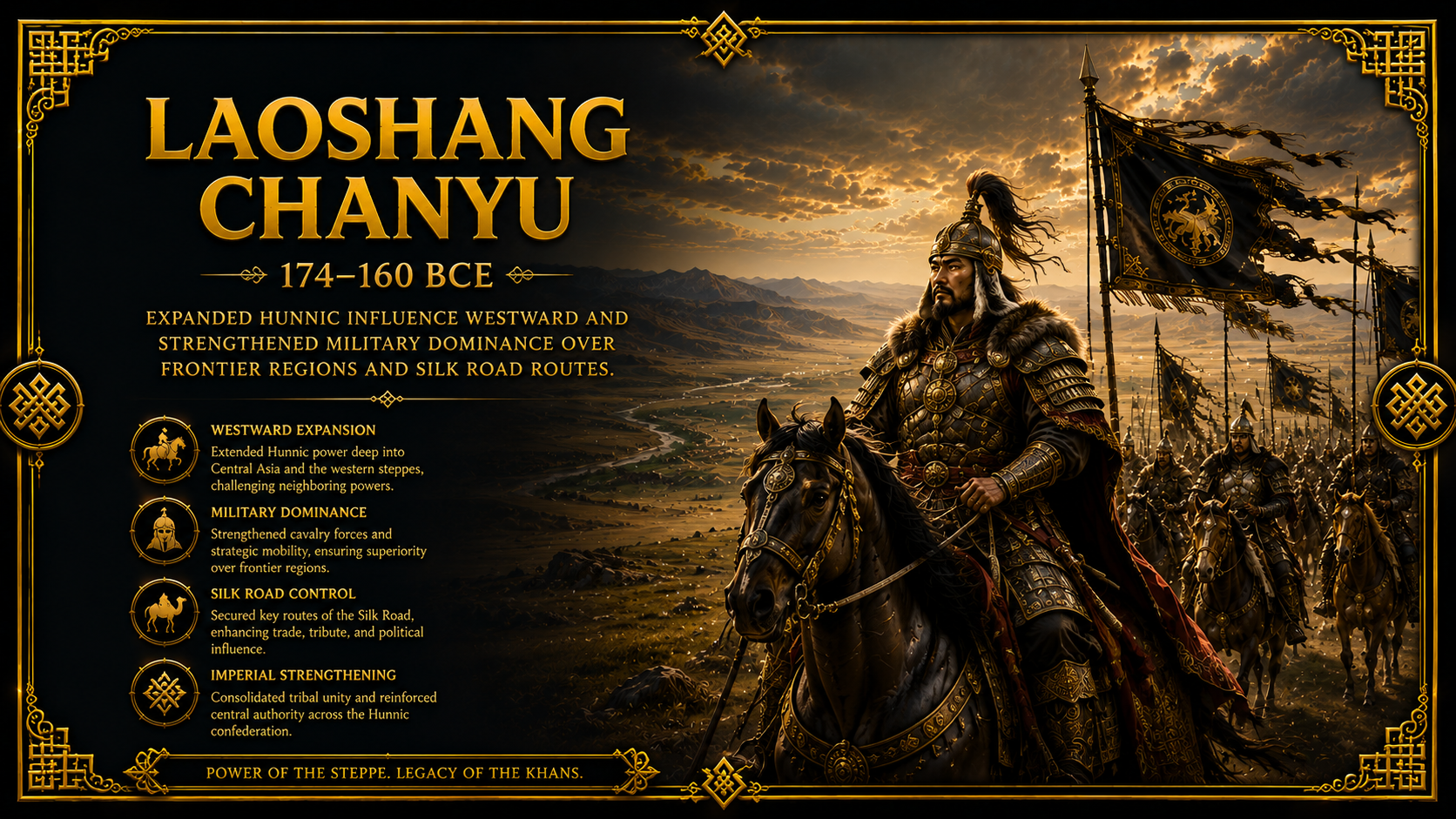
Laoshang Chanyu (老上单于, also rendered Lao-shang Shan-yü) was the second supreme ruler of the Xiongnu Confederation, reigning approximately from 174 BCE to 160 BCE. He succeeded his father, the formidable Modu Chanyu, and inherited a rapidly expanding steppe empire that stretched across much of Inner Asia.
Under Laoshang Chanyu, the Xiongnu state entered a phase of military consolidation and geopolitical dominance. Whereas Modu had forged the empire through conquest, Laoshang strengthened its institutions, extended its western influence, and intensified pressure upon the Han dynasty frontier.
Major Achievements.
Consolidation of the Xiongnu Empire
Laoshang preserved the unity of the tribal confederation created by his father. He maintained centralized authority through the Chanyu court and ensured the loyalty of subordinate tribal princes and military commanders across the steppe.
Expansion toward the Western Regions
During his reign, Xiongnu influence expanded farther west into the regions connected to the early Silk Road corridors. This expansion increased control over trade routes, tribute systems, and pastoral territories.
Defeat of the Yuezhi
One of the most consequential campaigns associated with his reign was the crushing defeat of the Yuezhi. According to historical chronicles, the Yuezhi king was killed, and his skull was allegedly fashioned into a ceremonial drinking cup — a symbolic act demonstrating Xiongnu supremacy in steppe political culture.
The defeated Yuezhi migrated westward into Central Asia, a movement that later contributed indirectly to the emergence of the Kushan Empire centuries afterward.
Pressure upon Han China
Laoshang continued aggressive raids and diplomatic coercion against Han frontier territories. Despite periodic treaties known as heqin (“peace through kinship marriage”), warfare and border incursions remained frequent.
The Han court often sought to avoid catastrophic frontier war through tribute, silk payments, and diplomatic marriages, reflecting the military strength of the Xiongnu during this period.
Historical Significance
Laoshang Chanyu stands as one of the principal architects of early steppe imperial power. His reign demonstrated that the Xiongnu Empire was not merely the creation of a single conqueror, but a durable imperial system capable of surviving succession and projecting power across Eurasia.
In Chinese historical memory, he was portrayed as a dangerous and relentless adversary of the Han Empire. In the broader history of Inner Asia, however, he represents the maturation of the first great nomadic superpower of the eastern steppe world.
Junchen Chanyu
Third Supreme Ruler of the Xiongnu Confederation
(r. c. 160–126 BCE)
Junchen Chanyu was the third supreme ruler of the Xiongnu Confederation and the son of Laoshang Chanyu. He inherited the empire during the height of Xiongnu military power and governed one of the largest nomadic confederations in ancient Eurasia.
Under his leadership, the Xiongnu maintained dominance across the eastern steppe and continued to pressure the northern frontier of the Han dynasty through cavalry raids, frontier warfare, and strategic diplomacy. The mobility and discipline of Xiongnu mounted archers allowed the confederation to preserve its military superiority during much of his reign.
Junchen Chanyu ruled during a critical turning point in Han–Xiongnu relations. Earlier Han emperors had relied largely upon heqin diplomacy, tribute exchanges, and defensive strategies to maintain peace with the steppe empire. However, during Junchen’s reign, Emperor Wu of Han began reorganizing the Han military and preparing for direct imperial confrontation against the Xiongnu.
One of the defining events of his rule was the failed Mayi ambush of 133 BCE, when Han forces attempted to trap the Xiongnu leadership near the frontier city of Mayi. Although the operation failed, it shattered diplomatic trust and marked the beginning of full-scale war between the Han Empire and the Xiongnu Confederation.
Despite increasing pressure from Han military reforms, Junchen Chanyu preserved the authority of the Chanyu throne and maintained Xiongnu supremacy across much of Inner Asia until his death around 126 BCE.
In the broader history of the Eurasian steppe, Junchen Chanyu represents the final great ruler of the era in which the Xiongnu stood at the absolute height of their imperial strength before the long wars with Han China transformed the balance of power in Inner Asia.
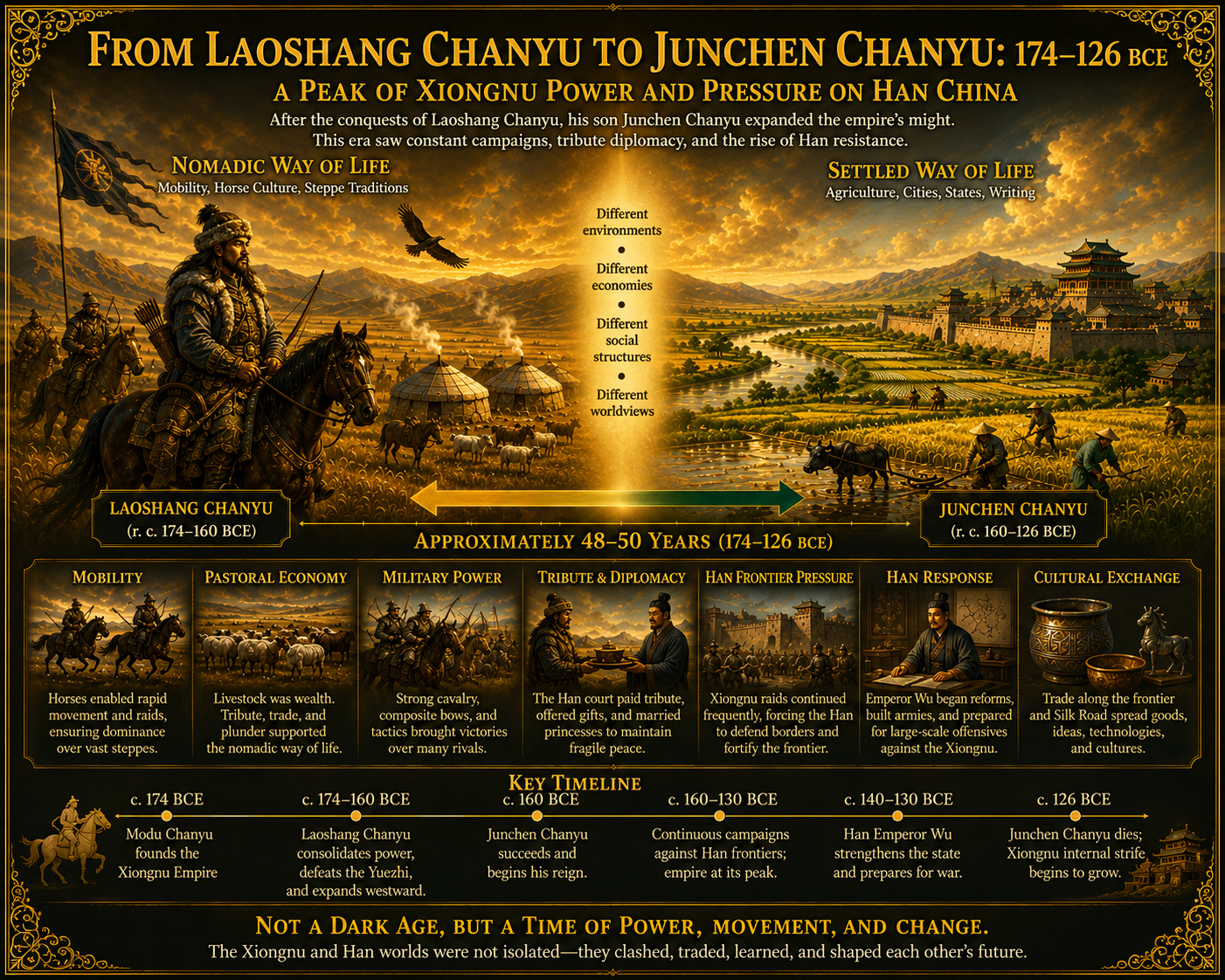
Peak of Xiongnu Power
c. 174–126 BCE
The period between the reigns of Laoshang Chanyu and Junchen Chanyu marked the height of power for the Xiongnu Confederation. During these decades, the Xiongnu dominated the eastern steppe, controlled major frontier trade routes, and maintained military superiority over neighboring states across Inner Asia.
The empire stretched across vast territories from Mongolia toward the western regions of Central Asia, uniting numerous nomadic tribes under the authority of the Chanyu. Xiongnu cavalry armies became feared for their speed, mobility, and highly disciplined mounted archery tactics, allowing them to conduct deep raids across the frontier of the Han dynasty.
At the same time, the Han court remained unable to decisively defeat the steppe empire. Through the heqin system, the Han dynasty agreed to diplomatic marriage alliances and regular transfers of silk, grain, gold, and luxury goods in order to preserve frontier stability and avoid devastating invasions.
This era also witnessed the expansion of Xiongnu influence into the western regions and the defeat of rival nomadic powers such as the Yuezhi. These victories reshaped the political landscape of Inner Asia and strengthened Xiongnu authority over transcontinental trade corridors linked to the early Silk Road world.
The peak period of Xiongnu power represented the emergence of the first great nomadic superpower of Eurasia — an empire capable of confronting powerful sedentary civilizations as an equal and transforming the geopolitical history of the ancient world.

Junchen Chanyu
Third Supreme Ruler of the Xiongnu Confederation(r. c. 160–126 BCE)
Junchen Chanyu succeeded his father, Laoshang Chanyu, during the height of Xiongnu imperial power. Under his reign, the Xiongnu Confederation maintained dominance across the eastern steppe and continued to exert immense military pressure upon the Han dynasty frontier.
Junchen preserved the political unity established by earlier Chanyus and commanded a vast confederation of nomadic tribes stretching from Mongolia toward the western regions of Inner Asia. His authority rested upon cavalry mobility, tribal alliances, military discipline, and control of key frontier trade routes.
Throughout his reign, the Xiongnu launched frequent raids and military campaigns against Han territories. These operations forced the Han court to continue tribute diplomacy, defensive frontier construction, and large-scale military preparations. Although periods of negotiation existed, relations between the two powers remained tense and unstable.
The reign of Junchen Chanyu also marked a turning point in East Asian geopolitical history. During this era, Emperor Wu of Han gradually abandoned passive appeasement policies and began transforming the Han state into a militarized imperial power capable of confronting the steppe empires directly.
Despite growing Han resistance, Junchen Chanyu maintained Xiongnu supremacy for much of his reign and preserved the prestige of the Chanyu throne during one of the strongest phases of nomadic imperial history.
In historical memory, Junchen Chanyu represents the final era in which the Xiongnu Confederation stood at the peak of its territorial strength before the long and exhausting imperial wars with Han China intensified across Inner Asia.

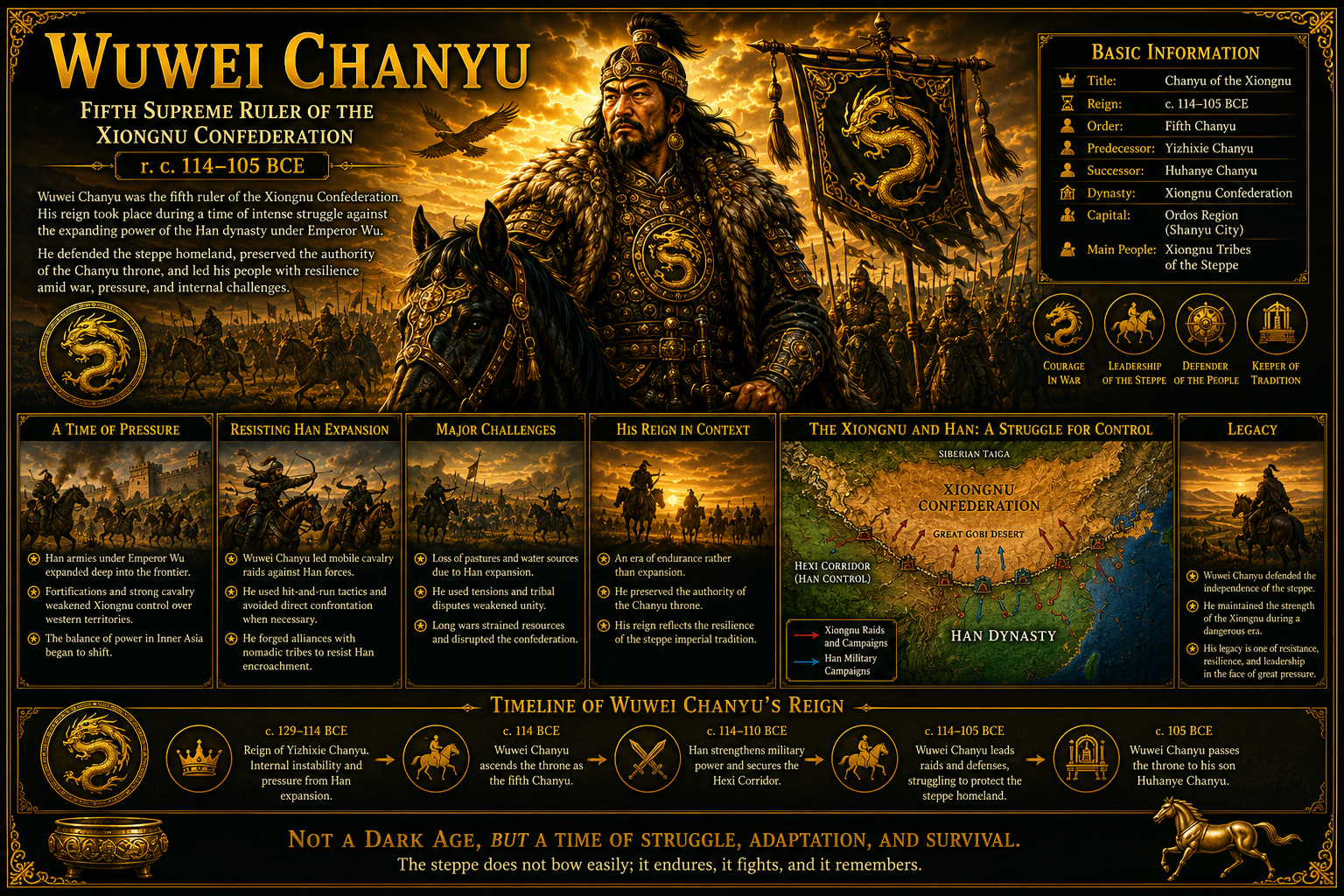
Wuwei Chanyu
Fifth Supreme Ruler of the Xiongnu Confederation
(r. c. 114–105 BCE)
Wuwei Chanyu succeeded Yizhixie Chanyu during a difficult period in the history of the Xiongnu Confederation. His reign took place amid the intensifying imperial wars between the Xiongnu and the expanding military power of the Han dynasty under Emperor Wu of Han.
By the time Wuwei Chanyu ascended the throne, the strategic balance in Inner Asia had begun to shift. Han armies had strengthened their cavalry forces, expanded frontier fortifications, and secured important territories in the Hexi Corridor. These developments weakened Xiongnu influence over western trade routes and increased pressure upon the steppe confederation.
Despite mounting difficulties, Wuwei Chanyu continued to resist Han expansion through mobile cavalry warfare and alliances with nomadic tribes across the northern frontier. Xiongnu forces carried out raids, defensive maneuvers, and long-range campaigns intended to preserve their independence and maintain control over the steppe world.
Historical sources portray his reign as an era of endurance rather than expansion. The Xiongnu remained a formidable military power, but continuous warfare strained resources, disrupted tribal unity, and intensified political tensions within the confederation.
Nevertheless, Wuwei Chanyu preserved the authority of the Chanyu throne during one of the most dangerous periods faced by the early Xiongnu Empire. His reign reflected the resilience of steppe imperial traditions in the face of growing Han military transformation and imperial expansion.
In the broader history of Inner Asia, Wuwei Chanyu stands as a ruler who fought to defend the autonomy of the steppe during the long imperial struggle that reshaped the political order of ancient Eurasia.
After the 6th Chanyu (usually counted as Er Chanyu / Er Shizhi line depending on chronology systems), the Xiongnu entered a long transitional period marked by internal struggles, Han pressure, fragmentation, and eventual decline before the rise of the Xianbei. A concise chronology would be:
Late Xiongnu Era → Rise of Xianbei
Wuwei Chanyu (c. 114–105 BCE) — Continued resistance against expanding Han military campaigns during the intensification of the Han–Xiongnu wars.
Er Chanyu (c. 105–102 BCE) — Faced increasing Han offensives and growing pressure upon Xiongnu frontier control.
Ershihu Chanyu (c. 102–96 BCE) — Ruled during continuing conflict as Han expansion weakened western influence and tribal cohesion.
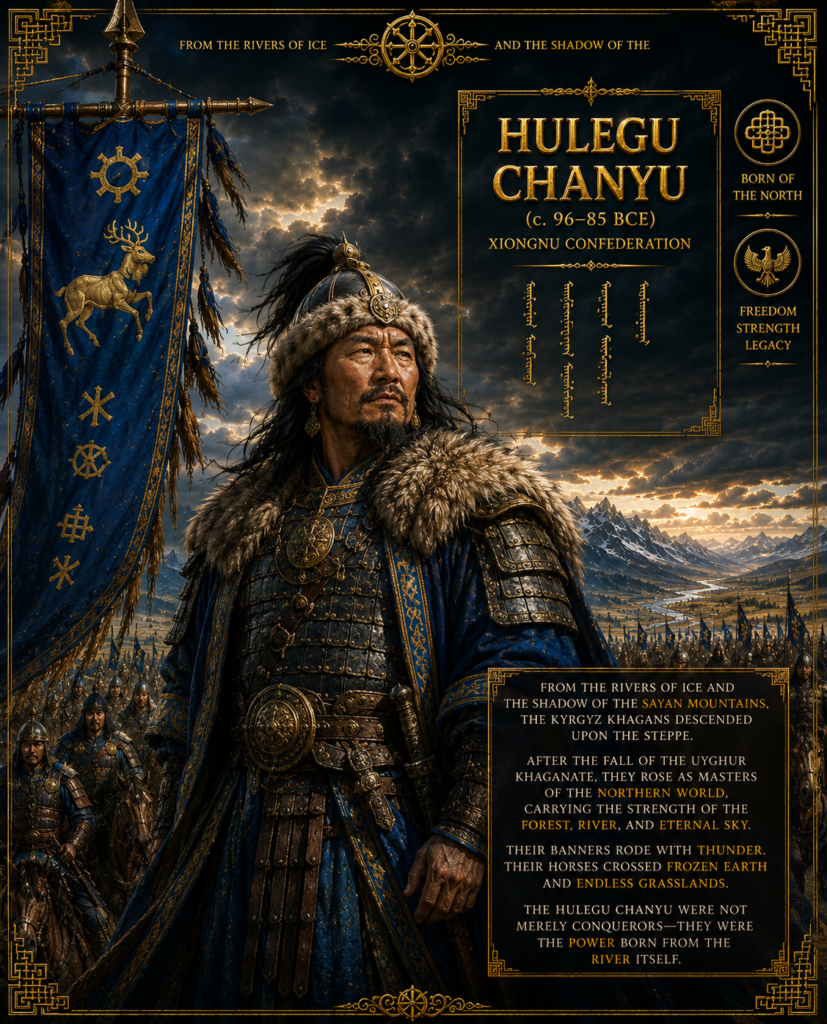
Hulugu Chanyu (c. 96–85 BCE) — Attempted to preserve unity while prolonged warfare strained the confederation.
Huyandi Chanyu (c. 85–68 BCE) — Internal succession disputes and external pressure increased instability within the Xiongnu state.
Zhizhi–Huhanye Era (1st century BCE) — Rival claimants Zhizhi Chanyu and Huhanye Chanyu divided the empire, creating Northern and Southern Xiongnu.
Northern–Southern Division (1st century BCE – 1st century CE) — Southern Xiongnu entered Han influence while Northern Xiongnu continued resistance in the steppe.
Decline of Northern Xiongnu (1st–2nd century CE) — Continuous warfare against Han, Xianbei, Wuhuan, and frontier powers weakened remaining Xiongnu authority.
Rise of Xianbei (2nd century CE onward) — The Xianbei expanded across Mongolia and Inner Asia after the decline of the Xiongnu political order.
Thus the sequence is broadly:
Late Imperial Xiongnu → Division → Northern/Southern Xiongnu → Decline → Xianbei Ascendancy (2nd century CE).
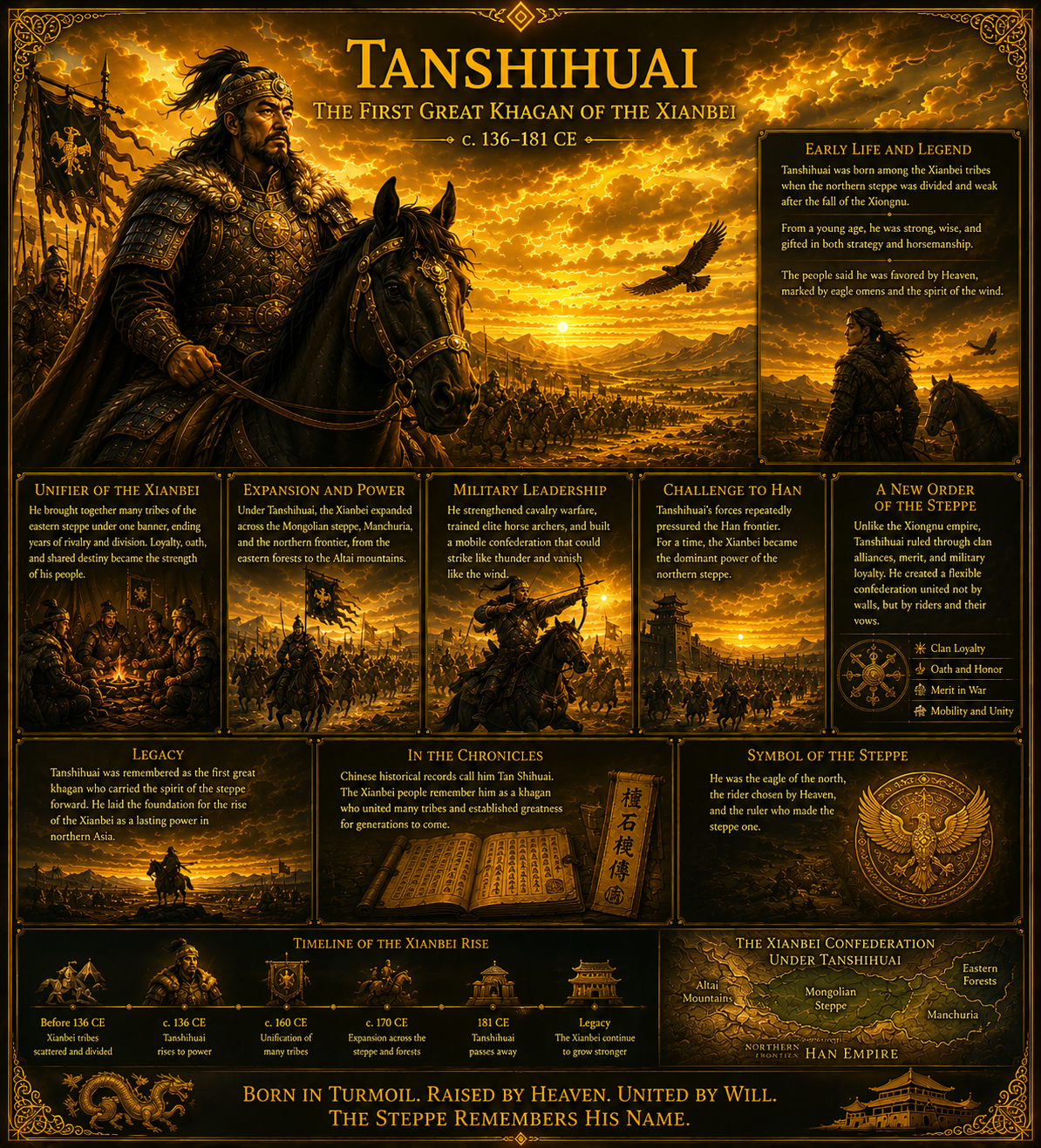
Unifier of the Xianbei and Founder of the Steppe Confederation
Unifier of the Xianbei and Founder of the Steppe Confederation
(c. 136–181 CE)
Tanshihuai was the great leader who transformed the scattered Xianbei tribes into a powerful steppe confederation after the decline of the Xiongnu political order.
Born among the eastern steppe peoples, Tanshihuai rose through military skill, tribal alliances, and personal authority. During the second century CE, he united numerous Xianbei tribes stretching across Mongolia, Manchuria, and parts of Inner Asia.
Under his leadership, the Xianbei Confederation emerged as the dominant nomadic power of the eastern steppe. His state challenged the northern frontier of the Han dynasty and expanded influence across territories once controlled by the Xiongnu.
Historical records describe Tanshihuai as an energetic and capable ruler who reorganized tribal administration and divided the confederation into eastern, central, and western sectors in order to strengthen control over the steppe.
Unlike the imperial structure of the Xiongnu Chanyus, the Xianbei Confederation remained more decentralized, relying upon tribal cooperation and military leadership rather than a rigid central state.
During his reign, the Xianbei launched repeated campaigns along the frontier and became the strongest nomadic force in Inner Asia. Their rise marked the beginning of a new political era after the centuries-long dominance of the Xiongnu.
Following the death of Tanshihuai around 181 CE, internal divisions weakened the confederation. Nevertheless, his achievements laid the foundation for later steppe powers and the historical development of northern Eurasia.
In the history of the eastern steppe, Tanshihuai stands as the founder of Xianbei unity and the architect of the post-Xiongnu order.
Xianbei Confederation and Successor States
Tanshihuai (c. 136–181 CE)
— United the Xianbei tribes and established the strongest post-Xiongnu steppe confederation.
Helian (He Lian) (late 2nd century CE)
— Son of Tanshihuai; inherited leadership but failed to preserve unity.
Qianman (late 2nd century CE)
— Grandson of Tanshihuai; ruled during increasing fragmentation.
Collapse of Unified Xianbei (late 2nd–3rd century CE)
— Confederation fragmented into regional tribal groups and successor states.
Major Xianbei Branches
Murong Xianbei (3rd–4th century CE)
— Founded states such as Former Yan, Later Yan, and Western Yan in northern China.
Tuoba Xianbei (3rd–5th century CE)
— Rose in north of China and eventually founded the Northern Wei in 386 CE.
Yuwen Xianbei (3rd–6th century CE)
— Later influenced Northern Zhou and northern Chinese politics.
Duan Xianbei (3rd–4th century CE)
— Regional steppe power in northeastern frontier zones.
Major Events
220 CE — Fall of Han Dynasty
— End of Han rule; beginning of the Three Kingdoms era.
304–439 CE — Sixteen Kingdoms Period
— Numerous states founded by Xianbei, Xiongnu, Jie, Di, and Qiang peoples in Eurasia.
386 CE — Founding of Northern Wei
— Emperor Daowu of Northern Wei established the Tuoba Xianbei state.
439 CE — Unification of Great Steppe.
— Northern Wei completed conquest of northern rivals.
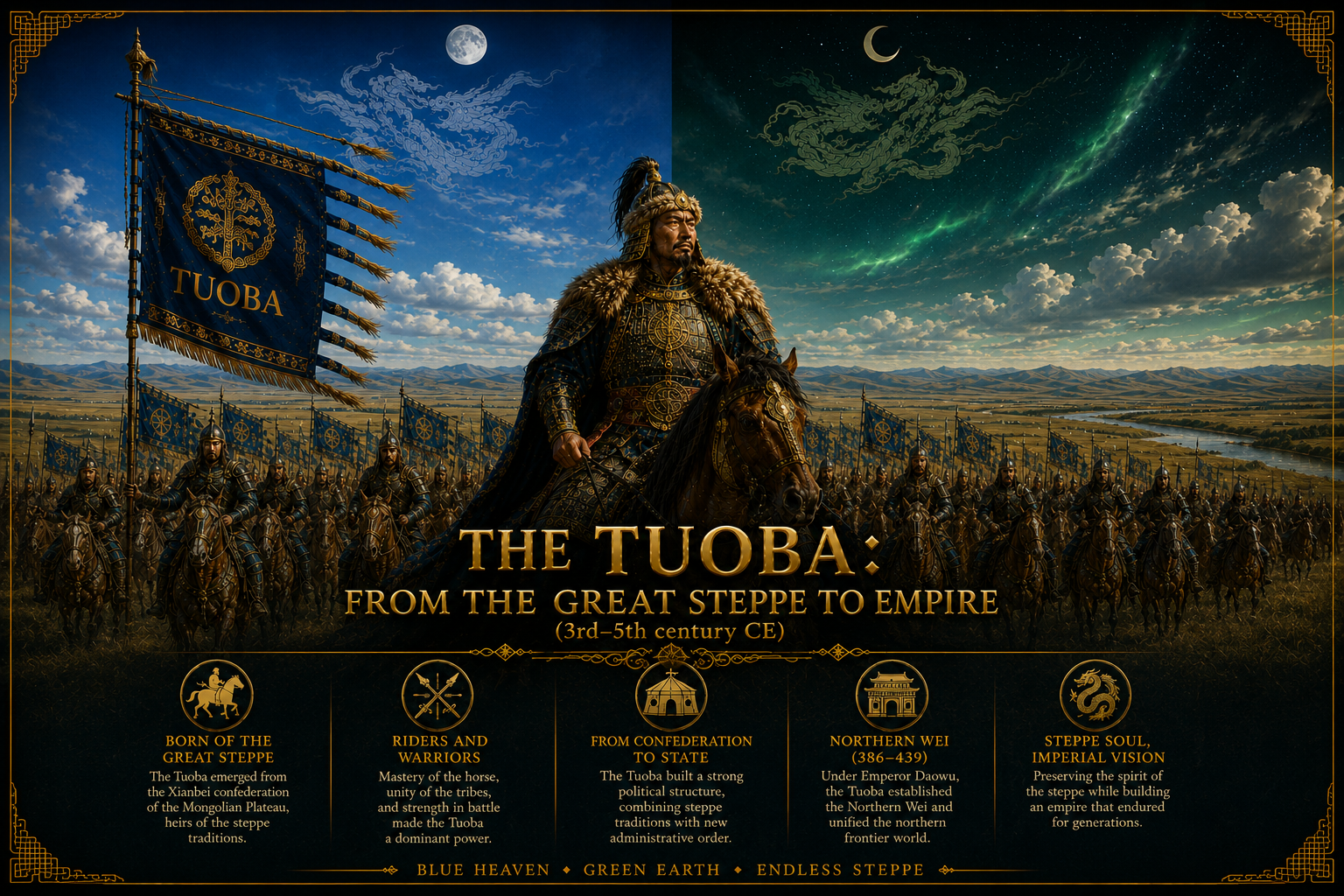
THE TUOBA: FROM THE GREAT STEPPE TO EMPIRE
(3rd–5th century CE)
The Tuoba were one of the most powerful branches of the Xianbei peoples who emerged after the decline of the Xiongnu order. Originating from the Great Steppe and the regions of the Mongolian Plateau, the Tuoba inherited the traditions of mounted warfare, tribal alliances, and mobile steppe governance that had shaped Inner Asia for centuries.
Following the fragmentation of the unified Xianbei Confederation after Tanshihuai, the Tuoba gradually expanded their authority across the eastern steppe and frontier regions.
Unlike earlier nomadic confederations, the Tuoba combined steppe military traditions with increasingly centralized systems of administration. Their cavalry forces remained rooted in the culture of the grasslands, while their political institutions evolved toward imperial state organization.
During the era following the collapse of the Han dynasty, northern East Asia entered a long period of division and conflict. Numerous kingdoms founded by frontier peoples competed for power across the region.
In 386 CE, Emperor Daowu of Northern Wei established the Northern Wei, transforming the Tuoba state into one of the most influential powers of its age.
By 439 CE, Northern Wei had consolidated much of the northern frontier world under a single authority. The Tuoba thus became one of the few steppe peoples to successfully transform a nomadic confederation into an imperial dynasty.
Their armies preserved cavalry warfare traditions inherited from the steppe, while their rulers adopted administrative systems, law, taxation, and urban institutions suited to governing settled populations.
The reign of Emperor Xiaowen of Northern Wei introduced major reforms that reshaped the identity of the ruling elite and accelerated cultural transformation within the empire.
The history of the Tuoba therefore represents more than the rise of a dynasty. It marks the transformation of a Great Steppe people into imperial state builders whose legacy influenced the political evolution of East Asia for centuries.
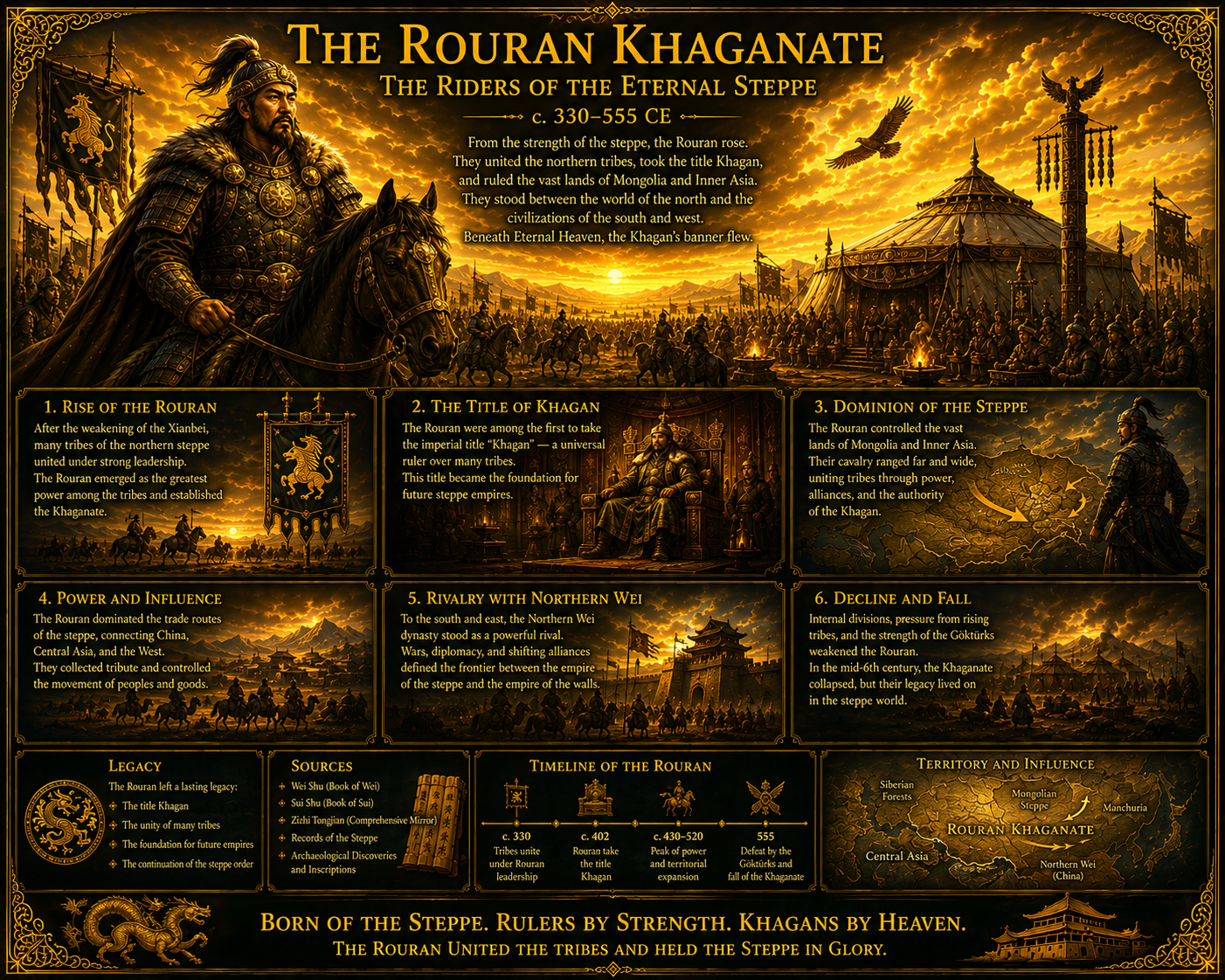
Rouran Khaganate
Lords of the Eternal Steppe
(4th–6th century CE)
The Rouran emerged from the Great Steppe after the age of the Xianbei and became one of the most powerful nomadic empires of Inner Asia.
Formed through alliances of steppe tribes across Mongolia and the eastern grasslands, the Rouran established a mobile imperial order built upon cavalry warfare, tribal loyalty, and control of the vast steppe routes.
They were among the first known steppe powers to widely use the title Khagan, a term later adopted by many Turkic and Mongol empires across Eurasia.
Under rulers such as Yujiulü Shelun, the Rouran unified large territories of the eastern steppe and expanded their influence across Mongolia, the Altai regions, and Inner Asia.
The Rouran maintained political independence from the agrarian dynasties to the south and developed their own imperial structure rooted in steppe traditions rather than sedentary state systems.
Their mounted armies dominated the grasslands for generations and controlled important trade and migration corridors connecting East Asia, Central Asia, and the western steppe.
The rise of the Rouran also shaped the political world of later nomadic empires. Many frontier peoples, tribes, and military groups either served under them or fought against their expanding power.
During the 6th century CE, the rising Göktürk Khaganate rebelled against Rouran rule. In 552 CE, Bumin Qaghan defeated the Rouran leadership and established a new steppe empire.
Although the Rouran state eventually disappeared, their imperial system, military organization, and use of the title Khagan left a lasting legacy across the history of the Great Steppe.
Göktürk Khaganate
Heirs of the Great Steppe
(6th–8th century CE)
The Göktürks emerged from the Great Steppe after the fall of the Rouran and established one of the greatest nomadic empires in the history of Inner Asia.
In 552 CE, Bumin Qaghan defeated the Rouran rulers and proclaimed the new Khaganate, uniting many tribes of the steppe under a single imperial order.
From Mongolia and the Altai to Central Asia and the western grasslands, the Göktürk state became a vast transcontinental power linking the eastern and western worlds.
The Göktürk Khaganate was not an extension of the settled states to the south. It was an independent steppe civilization built upon mounted warfare, tribal alliances, mobility, and the political traditions of Inner Asia.
Their rulers governed through the authority of the Khagan, supported by noble clans, military commanders, and regional leaders across the steppe.
The Orkhon inscriptions later described the ideals of the Göktürk world: Blue Heaven above, the dark earth below, and the people of the steppe between them.
The empire protected trade routes, controlled migration corridors, and shaped the political order of Eurasia.
After periods of division between eastern and western branches, leaders such as Ilterish Qaghan and Bilge Khagan restored steppe power and left enduring monuments in the Orkhon Valley.
The Göktürks stood as heirs to the long tradition of the Great Steppe — preserving the legacy of the nomadic world while building an empire that influenced Inner Asia for centuries.
Bumin Qaghan (r. 552 CE)
Founder of the Gug Tureg Khaganate
│
├── Kara Issik Qaghan (r. 552–553)
│
├── Muqan Qaghan (r. 553–572)
│ Great Expansion of the Empire
│
└── Taspar Qaghan (r. 572–581)
Peak Period and Diplomacy
│
├── Division of the Khaganate (582–603)
│
├── Eastern Gug Tureg
│
└── Western Gug Tureg
│
└── Tardu Qaghan
Expansion into Central Asia
Collapse of the First Khaganate (630 CE)
↓
Ilterish Qaghan (r. 682–692)
Restorer of Steppe Independence
│
├── Kapaghan Qaghan (r. 692–716)
│ Imperial Restoration
│
└── Bilge Khagan (r. 716–734)
Golden Age of the Second Khaganate
│
├── Kul Tigin
│ Great Commander
│
└── Tonyukuk
Statesman and Strategist
Fall of the Gug Tureg Khaganate (744 CE)
552 — Bumin Khagan founded the Khaganate
553–572 — Muqan expansion
582 — Division
682 — Ilterish restoration
716–734 — Bilge golden age
744 — Fall
| Khagan | Reign | Major events |
|---|
| Bumin | 552 | Founded empire |
| Muqan | 553–572 | Expansion |
| Taspar | 572–581 | Peak phase |
| Ilterish | 682–692 | Restoration |
| Bilge | 716–734 | Golden age |
Uyghur Khaganate Masters of the Silk Road Steppe
(744–840 CE)
The Uyghur Khaganate emerged after the fall of the Gug Tureg Khaganate and became one of the dominant powers of Inner Asia during the 8th and 9th centuries CE.
In 744 CE, an alliance of Uyghur, Karluk, and Basmyl tribes defeated the last Gug Tureg rulers and established a new imperial order upon the Great Steppe. Centered in Mongolia and the Orkhon Valley, the Uyghur Khaganate inherited many political traditions of earlier steppe empires while developing a more urbanized and commercially connected state. Unlike many previous nomadic powers, the Uyghurs maintained strong relationships with Silk Road trade networks and major neighboring civilizations.Their empire became an important bridge between East Asia, Central Asia, and the western regions of Eurasia.
The Uyghur rulers controlled caravan routes, protected merchants, and accumulated wealth through trade, diplomacy, and military alliances. The Khaganate also played a major role in the politics of the Tang dynasty. Uyghur cavalry forces assisted the Tang court during major internal rebellions, including the An Lushan Rebellion. In return, the Uyghurs received large quantities of silk, treasure, and commercial privileges.
The Uyghur world became known for cultural diversity and religious exchange. Buddhism, Manichaeism, and other traditions spread across the empire through trade and diplomatic contact. Their capital, Ordu-Baliq, became one of the great cities of the steppe world. Despite its wealth and influence, the Khaganate weakened during the 9th century because of internal struggles, famine, and external attacks.
In 840 CE, the Kyrgyz Khaganate invaded the Uyghur capital and destroyed the Khaganate. After the collapse, many Uyghur groups migrated toward the western regions of Inner Asia, where they continued to influence the cultural and political history of Central Asia for centuries. The Uyghur Khaganate remains remembered as one of the great Silk Road empires of the Great Steppe — a state where nomadic power, trade, diplomacy, and urban civilization merged together.
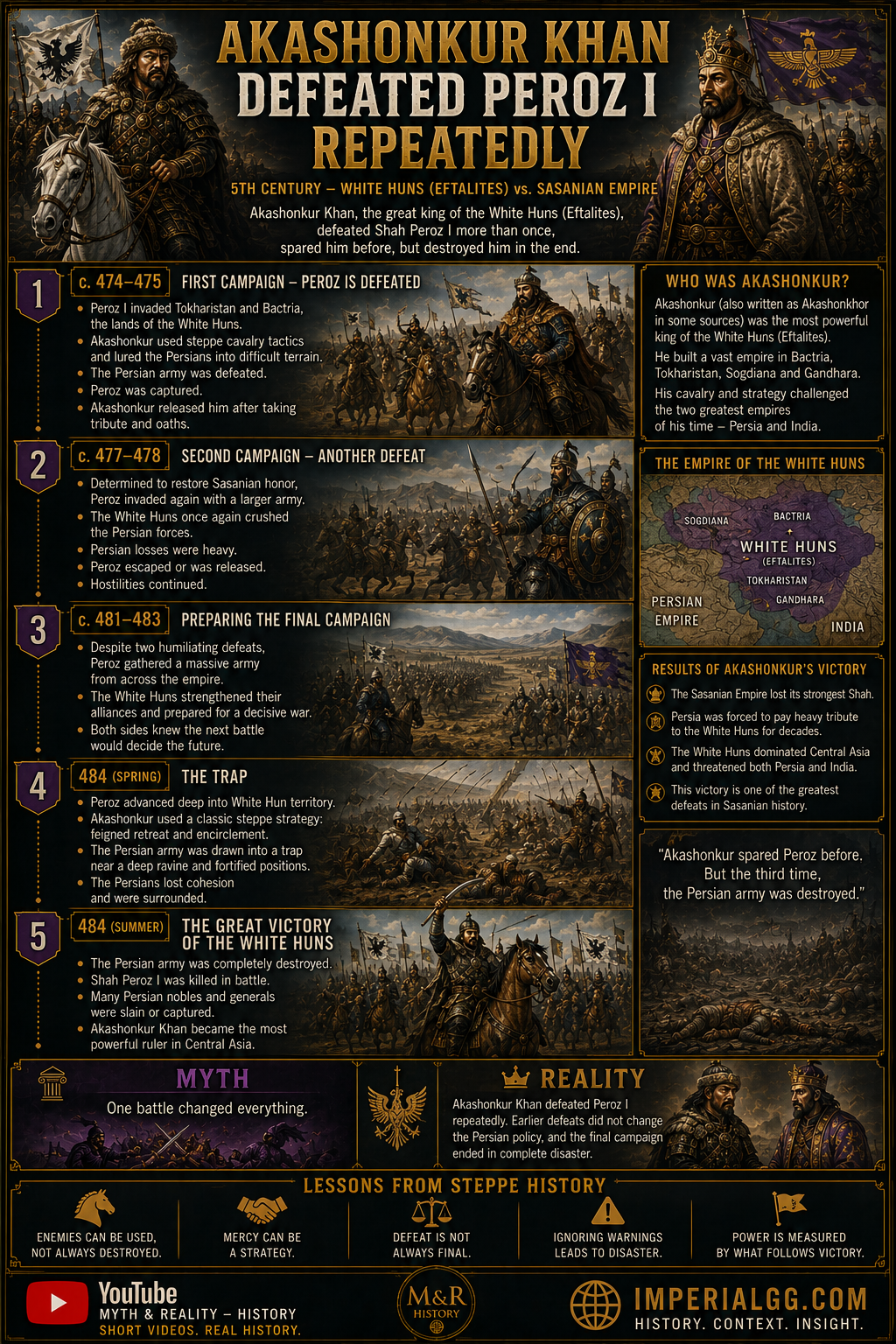
AKASHONKUR KHAN DEFEATED PEROZ I REPEATEDLY
5th Century – White Huns vs. Sasanian Empire
Akashonkur Khan defeated Shah Peroz I more than once, released him after earlier defeats, and ultimately destroyed the Sasanian army in 484.
Timeline
1. c. 474–475
FIRST CAMPAIGN — PEROZ IS DEFEATED
- Peroz I invaded the lands of the White Huns.
- Akashonkur used steppe cavalry tactics.
- The Persian army was defeated.
- Peroz was captured.
- He was later released after agreements and tribute.
2. c. 477–478
SECOND CAMPAIGN — ANOTHER DEFEAT
- Peroz launched another invasion.
- The White Huns defeated the Persians again.
- Persian losses were severe.
- Peroz escaped or was released.
- Hostilities continued.
3. c. 481–483
PREPARING THE FINAL CAMPAIGN
- Despite previous defeats, Peroz assembled a larger army.
- The White Huns strengthened their alliances.
- Both sides prepared for a decisive confrontation.
4. c. 484
THE TRAP
- Peroz advanced deep into White Hun territory.
- Akashonkur employed classic steppe tactics.
- The Persians were drawn into unfavorable terrain.
- The Sasanian army lost cohesion.
5. c. 484
THE GREAT VICTORY OF THE WHITE HUNS
- The Persian army was destroyed.
- Shah Peroz I was killed.
- Many Persian nobles perished.
- White Hun power reached its height in Central Asia.
MYTH:
One battle changed everything.
REALITY:
The White Huns defeated Peroz repeatedly. Earlier defeats failed to change Persian policy, and the final campaign ended in catastrophe.
“Akashonkur spared Peroz before.
The final campaign ended the war.”
LESSON FROM STEPPE HISTORY
- Diplomacy came before annihilation.
- Mercy could be a strategy.
- Defeat was not always final.
- Ignored warnings could become disasters.
- Power was measured by what followed victory.
THE HUN INVASIONS OF INDIA. HOW THE GUPTA EMPIRE FELL
1. c. 455 CE
SKANDAGUPTA STOPS THE HUNS
- The Huns crossed into northwestern India.
- Gupta Emperor Skandagupta defeated them.
- The Gupta Empire survived.
- The threat remained beyond the frontier.
MYTH: The Huns were crushed forever.
REALITY: They returned stronger.
2. c. 470–490 CE
THE ALKHON HUNS ENTER INDIA
- The Alkhon Huns established power in Gandhara.
- Gupta authority weakened.
- Frontier provinces were lost.
- Hun influence expanded into the Punjab.
3. c. 515 CE
TORAMANA CONQUERS NORTHERN INDIA
- King Toramana invaded deep into India.
- Malwa and Rajasthan were occupied.
- Gupta control collapsed across large regions.
- The Huns became a major Indian power.
THE HUNS WERE NO LONGER RAIDERS.
THEY WERE RULERS.
4. c. 520–530 CE
MIHIRAKULA AT THE HEIGHT OF HUN POWER
- Mihirakula succeeded Toramana.
- Hun rule reached its greatest extent.
- Contemporary sources describe him as a feared conqueror.
- Northern India came under heavy pressure.
5. c. 528 CE
THE HUNS ARE DEFEATED
- A coalition led by Yasodharman challenged the Huns.
- Mihirakula was defeated.
- Hun political dominance collapsed.
- Several Hun groups remained and merged into local populations.
MYTH: The Huns vanished overnight.
REALITY: Their political power ended, but their people remained.
LESSON FROM STEPPE HISTORY
- The Huns shattered Gupta power.
- Northern India was transformed.
- New kingdoms emerged.
- One invasion changed the political map of South Asia.
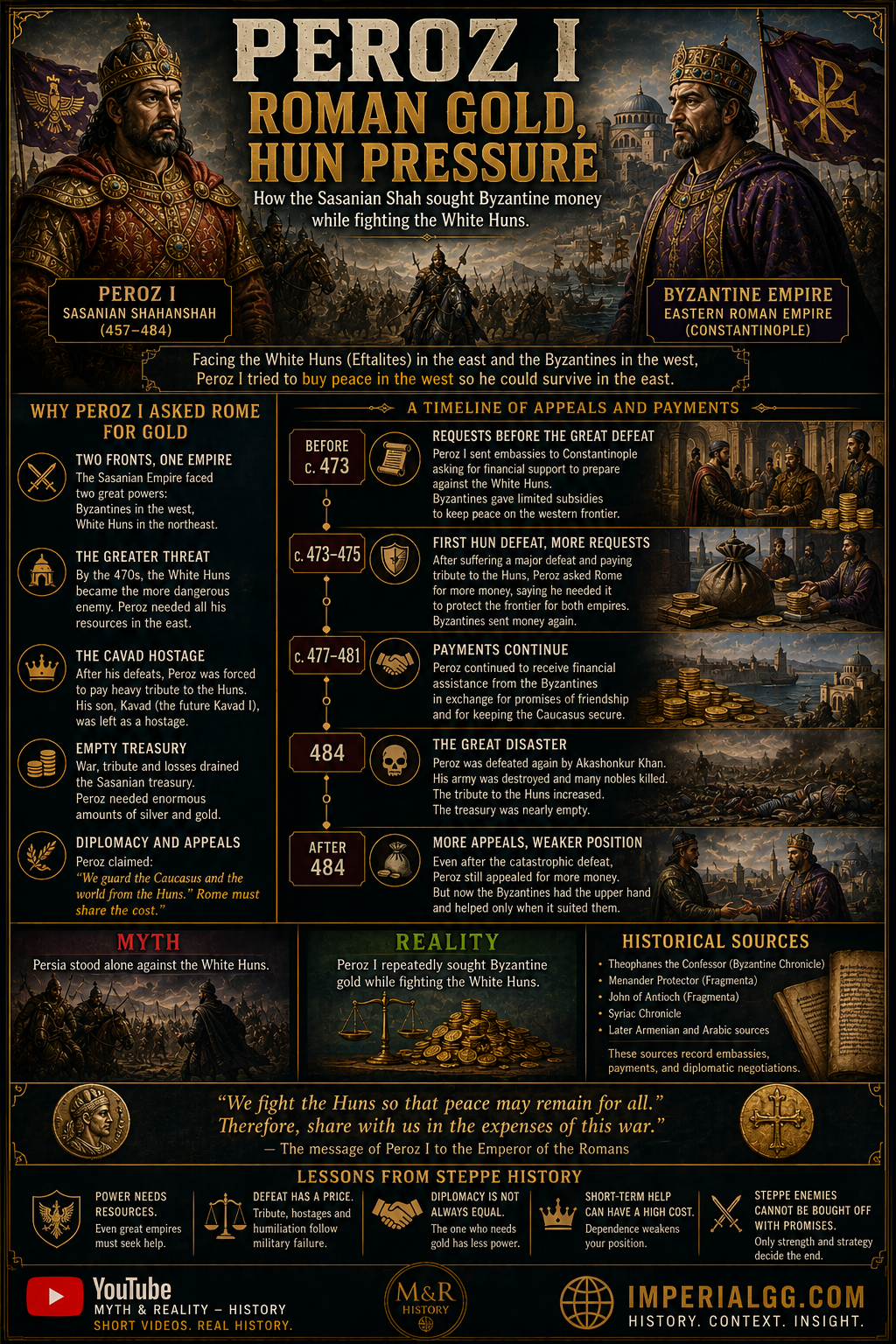
PEROZ I
GOLD FROM ROME, WAR WITH THE WHITE HUNS
How the Shahanshah of Persia sought Roman subsidies while facing the growing power of the White Huns.
INTRODUCTION
By the second half of the fifth century, the Sasanian Empire faced threats on multiple frontiers.
In the west stood the Eastern Roman Empire.
In the northeast, a new power emerged beyond the Oxus River: the White Huns.
Repeated wars against the White Huns forced Peroz I to seek financial assistance from Constantinople while attempting to preserve Persian influence in Central Asia.
WHY PEROZ NEEDED ROMAN GOLD
THE EASTERN FRONTIER
The White Huns expanded into Tokharistan and Bactria.
Their cavalry dominated the frontier regions north of Persia.
The Sasanians were forced into costly military campaigns.
THE COST OF DEFEAT
Several campaigns against the White Huns ended unsuccessfully.
Persia lost soldiers, nobles, horses, and enormous quantities of treasure.
The burden on the royal treasury increased dramatically.
THE HOSTAGE PRINCE
Following one of the settlements, Peroz’s son Kavad was reportedly left among the White Huns as a political hostage.
This demonstrated the growing leverage of the White Huns over Persia.
THE CAUCASUS ARGUMENT
Persian diplomats argued that they protected the Caucasian passes from northern nomads.
Therefore, they claimed that Rome should contribute financially to the defense of the civilized world.
TIMELINE
BEFORE 474
DIPLOMACY WITH CONSTANTINOPLE
Persian envoys approached the Roman court requesting financial assistance.
The requests were justified as contributions to common defense.
474–475
FIRST MAJOR DEFEAT
Peroz marched against the White Huns.
The campaign ended disastrously.
Persia paid tribute and negotiated for the release of prisoners.
Requests for Roman subsidies increased.
477–478
SECOND DEFEAT
A new invasion failed.
The White Huns remained dominant beyond the Oxus.
Persian dependence on diplomacy and external financing continued.
484
THE FINAL CAMPAIGN
Ignoring previous setbacks, Peroz launched another offensive.
The White Huns lured the Persians into unfavorable terrain.
The Persian army was annihilated.
Peroz I died in battle.
AFTER 484
A CHANGED BALANCE OF POWER
Persia entered a period of weakness.
The White Huns became the dominant power in Central Asia.
Roman diplomats observed the crisis carefully and gained greater leverage in negotiations with Persia.
MYTH
Persia stood alone against the White Huns.
REALITY
Persia repeatedly sought Roman financial assistance while fighting the White Huns.
The wars strained the treasury so severely that diplomacy became as important as military power.
QUOTE PANEL
“We guard the Caucasus and the passes against the northern peoples. Therefore Rome should share in the expense.”
— Persian diplomatic position toward Constantinople
LESSON FROM STEPPE HISTORY
- Great empires can become dependent on allies.
- Defeat is expensive long before it becomes fatal.
- Diplomacy often begins where military power reaches its limits.
- The rise of the White Huns transformed the balance of power in Central Asia.
- Even Persia needed help when facing a determined steppe empire.
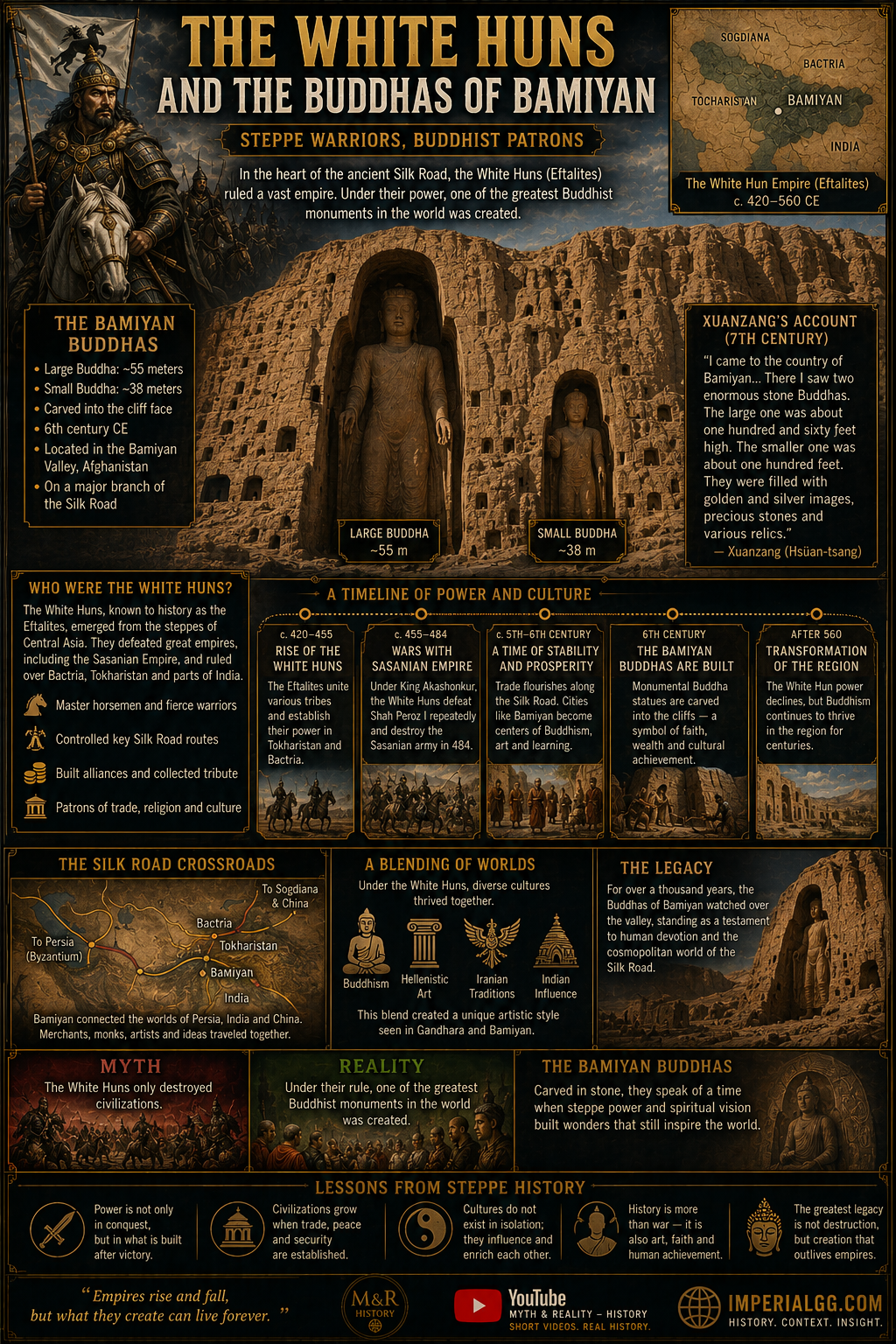
THE WHITE HUNS AND THE BUDDHAS OF BAMIYAN
STEPPE WARRIORS, BUILDERS OF MONUMENTS
For many people, the White Huns are remembered only as conquerors who defeated Persia and invaded India.
Yet in the heart of their empire, along the Silk Road, one of the greatest Buddhist monuments in human history was created. The Buddhas of Bamiyan stood for more than 1,400 years as symbols of faith, prosperity, and cultural exchange.
THE BAMIYAN BUDDHAS
A Monumental Achievement
- The Great Buddha stood approximately 55 meters high.
- The Smaller Buddha stood approximately 38 meters high.
- Both statues were carved directly into sandstone cliffs.
- Construction took place during the 6th century CE.
- The site was located in the Bamiyan Valley of present-day Afghanistan.
- Bamiyan was a major center on the Silk Road connecting India, Central Asia, Persia, and China.
- WHO WERE THE WHITE HUNS?
Known in historical sources as the Hephthalites, the White Huns built a powerful empire stretching across:
- Tokharistan
- Bactria
- Sogdiana
- Gandhara
- Parts of Northern India
They controlled major trade routes and became one of the strongest powers in Central Asia during the fifth and sixth centuries.
TIMELINE OF POWER AND CULTURE
c. 420–455 CE
RISE OF THE WHITE HUNS
The White Huns united numerous tribes and established their authority across Bactria and Tokharistan. Their cavalry dominated Central Asian warfare.
c. 455–484 CE
THE WARS WITH PERSIA
The White Huns repeatedly defeated the armies of Shah Peroz I.
In 484, the Persian army was destroyed and Peroz was killed.
The balance of power in Central Asia shifted dramatically.
LATE 5TH CENTURY
A PERIOD OF STABILITY
Trade flourished along the Silk Road. Merchants, monks, and travelers crossed the empire carrying goods, ideas, and religious traditions.
6TH CENTURY
THE BUDDHAS OF BAMIYAN ARE COMPLETED
The colossal statues became symbols of the region’s wealth and religious importance.
Bamiyan emerged as one of the greatest Buddhist centers in Inner Asia.
AFTER 560 CE
THE LEGACY ENDURES
The political power of the White Huns declined.
Yet the artistic and religious traditions that flourished under their rule continued for centuries.
XUANZANG’S ACCOUNT
When the Chinese monk Xuanzang visited Bamiyan in the seventh century, he described two enormous Buddha statues carved into the cliffs.
He recorded a prosperous Buddhist kingdom filled with monasteries, monks, and sacred monuments.
His account remains one of the most important descriptions of Bamiyan before modern times.
THE SILK ROAD CROSSROADS
Bamiyan stood at the meeting point of civilizations.
- Persia to the west
- India to the south
- China to the east
- Central Asia to the north
Ideas traveled alongside merchants.
Religion traveled alongside armies.
Art traveled alongside diplomacy.
A BLENDING OF CULTURES
The art of Bamiyan combined influences from:
- Indian Buddhism
- Hellenistic artistic traditions
- Iranian culture
- Central Asian steppe traditions
The result was one of the most distinctive artistic achievements of the ancient world.
MYTH
The White Huns only destroyed civilizations.
REALITY
Under their rule, one of the greatest Buddhist monuments in the world was created and preserved.
LESSONS FROM STEPPE HISTORY
- Great empires are remembered not only for conquest, but also for what they build.
- Trade and stability can produce achievements as significant as military victories.
- The Silk Road connected cultures rather than separating them.
- Nomadic empires were often patrons of religion, art, and commerce.
- The legacy of a civilization can outlive its political power.
QUOTE PANEL
“Empires rise and fall, but monuments can preserve their memory for centuries.”
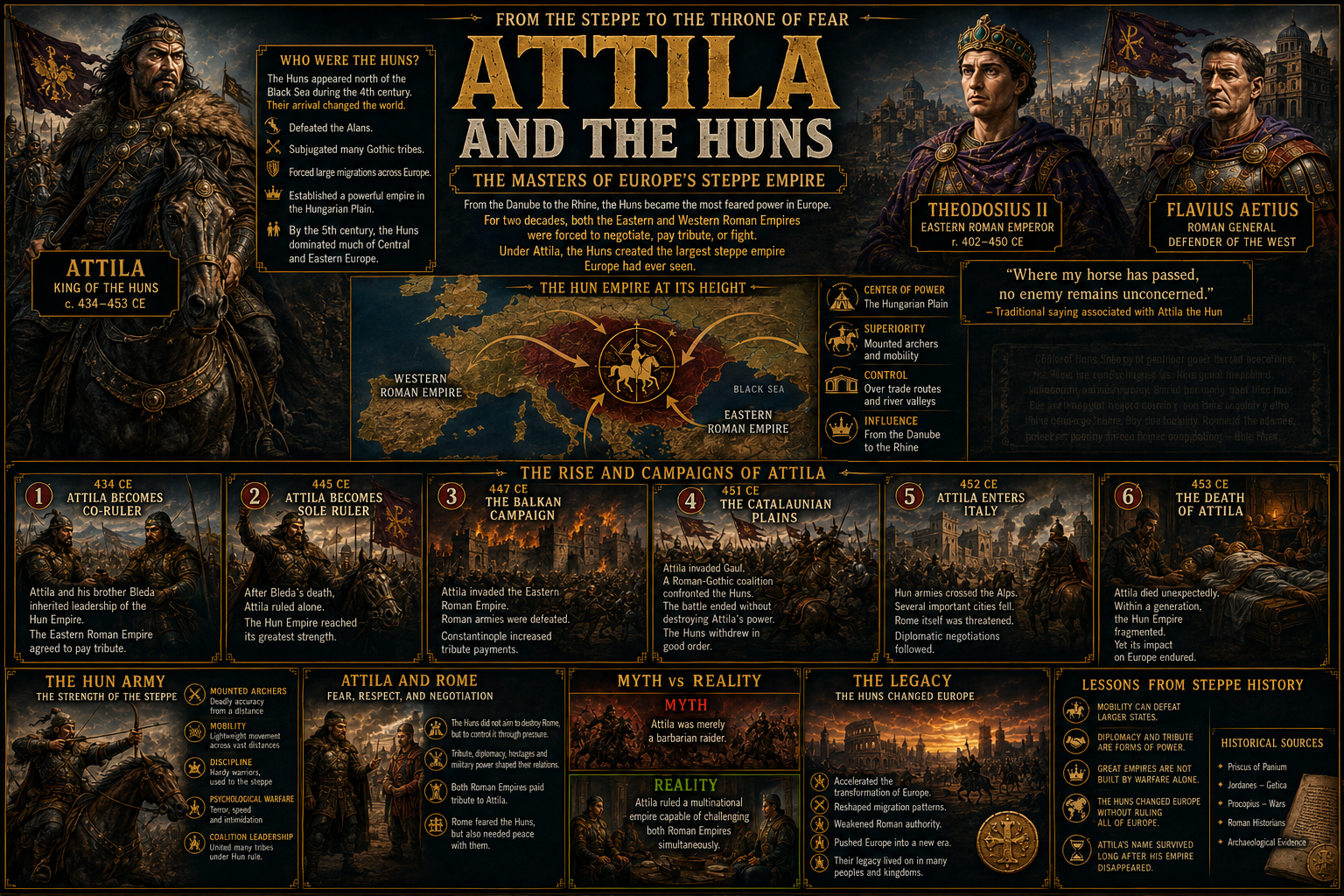
ATTILA AND THE HUNS
THE MASTERS OF EUROPE’S STEPPE EMPIRE
From the Danube to the Rhine, the Huns became the most feared power in Europe.
For two decades, both the Eastern and Western Roman Empires were forced to negotiate, pay tribute, or fight.
Under Attila, the Huns created the largest steppe empire Europe had ever seen.
WHO WERE THE HUNS?
The Huns appeared north of the Black Sea during the fourth century.
Their arrival transformed the political map of Europe.
They:
- Defeated the Alans.
- Subjugated many Gothic tribes.
- Forced large migrations across Europe.
- Established a powerful empire in the Hungarian Plain.
By the fifth century, the Huns dominated much of Central and Eastern Europe.
TIMELINE OF ATTILA’S RISE
434 CE
ATTILA BECOMES CO-RULER
Attila and his brother Bleda inherited leadership of the Hun Empire.
The Eastern Roman Empire agreed to pay tribute.
445 CE
ATTILA BECOMES SOLE RULER
After Bleda’s death, Attila ruled alone.
The Hun Empire reached its greatest strength.
447 CE
THE BALKAN CAMPAIGN
Attila invaded the Eastern Roman Empire.
Roman armies were defeated.
Cities across the Balkans were devastated.
Constantinople increased tribute payments.
451 CE
THE CATALAUNIAN PLAINS
Attila invaded Gaul.
A Roman-Gothic coalition confronted the Huns.
The battle ended without destroying Attila’s power.
The Huns withdrew in good order.
452 CE
ATTILA ENTERS ITALY
Hun armies crossed the Alps.
Several important cities fell.
Rome itself was threatened.
Diplomatic negotiations followed.
453 CE
THE DEATH OF ATTILA
Attila died unexpectedly.
Within a generation, the Hun Empire fragmented.
Yet its impact on Europe endured.
THE HUN ARMY
The strength of the Huns came from:
- Mounted archers.
- Rapid maneuver warfare.
- Strategic mobility.
- Coalition leadership.
- Psychological warfare.
Their tactics influenced later steppe empires for centuries.
ATTILA AND ROME
The Huns did not destroy Rome.
Instead they forced Rome to negotiate repeatedly.
Tribute, diplomacy, hostages, and military pressure became the foundations of Hun-Roman relations.
MYTH
Attila was merely a barbarian raider.
REALITY
Attila ruled a multinational empire capable of challenging both Roman Empires simultaneously.
LEGACY
The Huns accelerated the transformation of Europe.
They reshaped migration patterns.
They weakened Roman authority.
They demonstrated that a steppe empire could dominate the political life of Europe.
LESSON FROM STEPPE HISTORY
- Mobility can defeat larger states.
- Diplomacy and tribute are forms of power.
- Great empires are not built by warfare alone.
- The Huns changed Europe without ruling all of Europe.
- Attila’s name survived long after his empire disappeared.
“Where my horse has passed, no enemy remains unconcerned.”
— Traditional saying associated with Attila the Hun
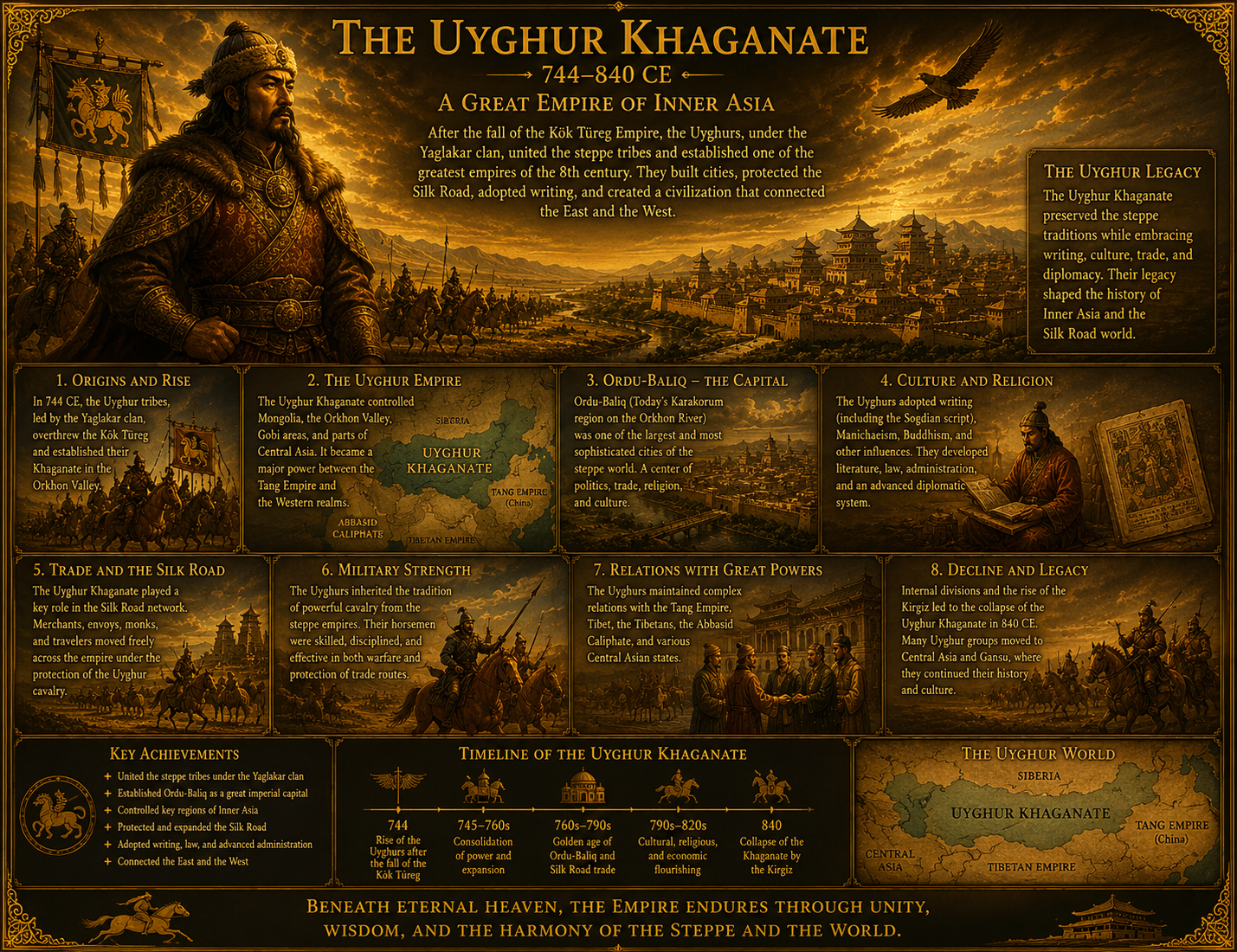
UYGHUR KHAGANATE
(744–840 CE) Foundation of the Empire Kutlug Bilge Kül Qaghan
- Defeated the last Guk Tureg rulers.
- Founded the Uyghur Khaganate.
- Established control over Mongolia and the Orkhon Valley.
Bayan Chor Khan (also Moyun Chur) r. 747–759 CE
- Expanded the empire across Inner Asia.
- Built the capital city of Ordu-Baliq.
- Strengthened Silk Road trade networks.
- Consolidated Uyghur imperial authority.
Tang Alliance and Steppe Power. Tengri Bögü Qaghan. r. 759–779 CE
- Assisted the Tang dynasty during the An Lushan Rebellion.
- Received enormous silk tribute and commercial privileges.
- Adopted Manichaeism as an imperial religion.
- Expanded diplomatic and commercial influence.
Later Uyghur Khagans. Alp Kutlug Bilge Qaghan. late 8th century CE
- Attempted imperial stabilization.
- Maintained frontier diplomacy and trade.
8th–9th Century Peak
- Uyghur cavalry dominated much of the eastern steppe.
- Silk Road commerce flourished.
- Ordu-Baliq became one of the greatest cities of Inner Asia.
Decline of the Khaganate. Early 9th Century CE
- Internal succession struggles weakened the empire.
- Harsh winters and famine damaged the steppe economy.
- Tribal instability increased.
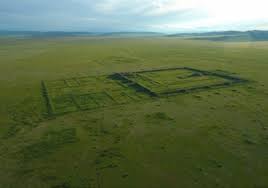
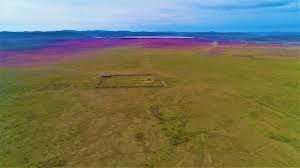
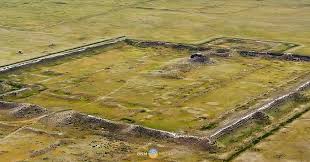
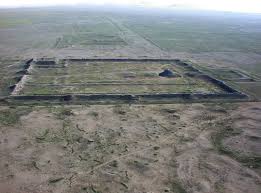
Located in Hotont district of Arkhangai Province, approximately 45 kilometers west of Karakorum, lie the ruins of Khar Balgas, the ancient capital city of the Uyghur Khaganate.
Khar Balgas, also known as Ordu-Baliq, was one of the greatest urban centers of the medieval steppe world and served as the political, cultural, and commercial heart of the Uyghur Empire.
Kyrgyz Khaganate
Lords of the Sayan–Urianhai and Yenisei World
(9th–10th century CE)
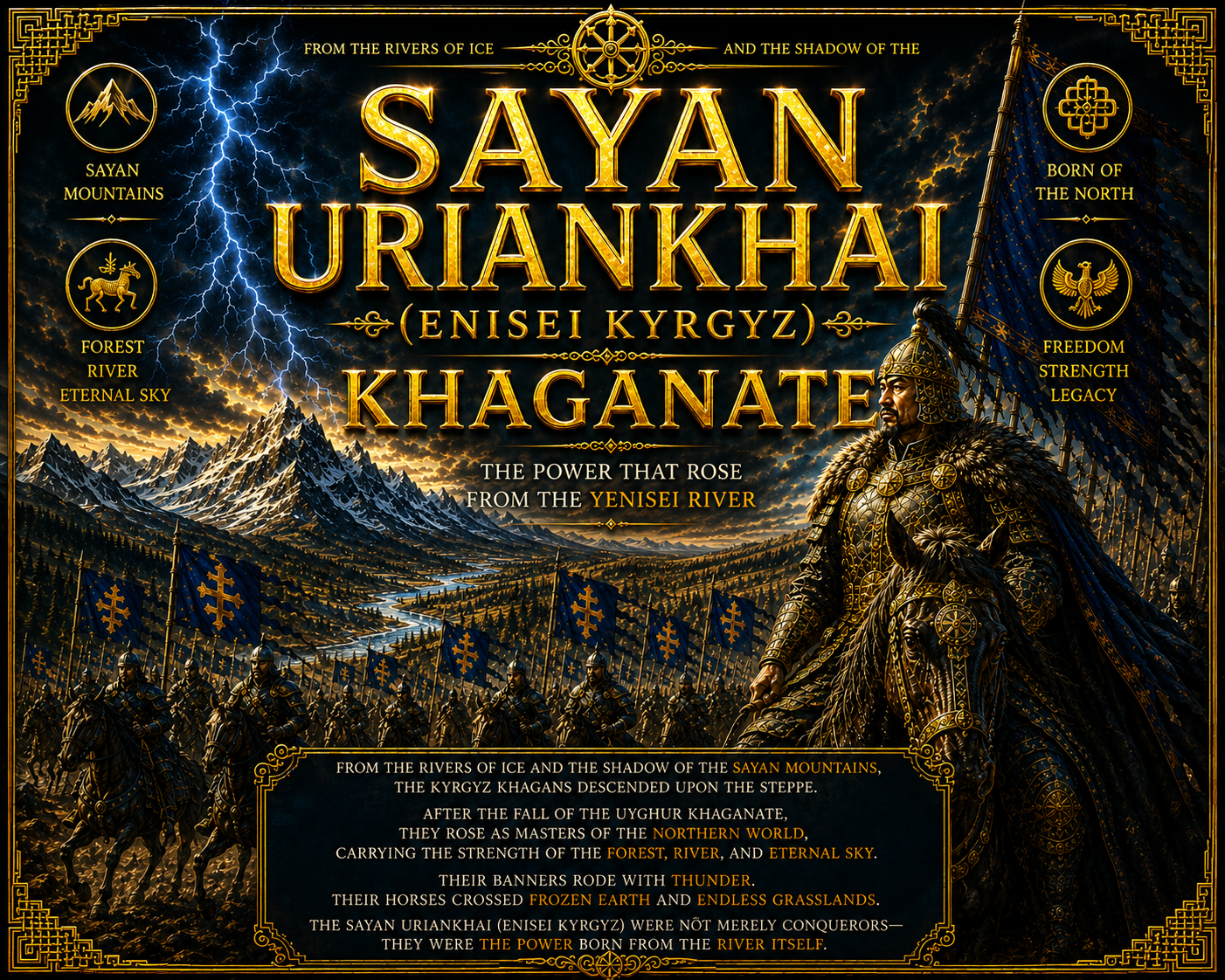
The Yenisei Kyrgyz Khaganate emerged as one of the major powers of Inner Asia after the fall of the Uyghur Khaganate in 840 CE. Centered around the upper Yenisei River, the Sayan Mountains, and the Urianhai regions of southern Siberia, the Kyrgyz ruled a vast northern steppe and forest frontier world connecting Mongolia, the taiga, and Inner Asia.
The Kyrgyz were renowned for their cavalry warfare, mobility, and ability to operate across both grassland and forest environments. In 840 CE, Kyrgyz armies launched a major invasion against the Uyghur Khaganate. The Uyghur capital of Ordu-Baliq was destroyed, and the Uyghur imperial order collapsed. This victory transformed the Kyrgyz into the dominant power of the eastern steppe.
Historical sources describe the Kyrgyz as rulers of the northern frontier world stretching from the Yenisei basin toward the Sayan and Urianhai regions. Unlike some earlier steppe empires centered upon large urban systems, the Kyrgyz maintained a more decentralized political order rooted in tribal alliances, mounted warfare, and regional mobility. Their rise reshaped the balance of power across Mongolia and Inner Asia after the fall of the Uyghurs. The Kyrgyz also maintained diplomatic and commercial relations with neighboring civilizations, including the Tang dynasty and various Central Asian states.
Although the Yenisei Kyrgyz never created a transcontinental empire comparable to the Mongols or the Gug Tureg, they remained one of the strongest powers of the northern steppe world during the 9th and 10th centuries. The history of the Yenisei Kyrgyz represents the continuation of the Great Steppe tradition within the forest-steppe and mountain regions of the Sayan–Urianhai world.
Khitan Empire
The Khitan Empire, also known as the Liao dynasty, was a powerful state established by the nomadic Khitan people in 907 CE in northern China and Inner Asia. It ruled over diverse populations across Manchuria, Mongolia, and parts of northern China until 1125, exerting major influence on East Asian politics and culture.
-
Founded: 907 CE by Yelü Abaoji
-
Capital: Shangjing (near modern Baarin Left Banner, Inner Mongolia)
-
Language: Khitan (with Khitan large and small scripts)
-
Religion: Syncretic mix of Buddhism, Confucianism, and shamanistic beliefs
-
Fell to: Jin dynasty in 1125
The Khitan Empire emerged from a federation of steppe tribes under the leadership of Yelü Abaoji, who unified the Khitans and proclaimed the Liao dynasty. Its administration combined Chinese bureaucratic systems in the south with tribal governance in the north, creating a dual structure suited to both sedentary and nomadic peoples.
Khitan rulers adopted Chinese-style court rituals and Buddhism while maintaining steppe traditions. They developed two unique writing systems, the Khitan large script and Khitan small script, to record their language. Art and architecture reflected a blend of Chinese, steppe, and Central Asian influences, visible in surviving pagodas and tomb murals.
At its height, the Liao dynasty dominated northeastern Asia, subjugating neighboring peoples and controlling trade routes between China and the steppe. It maintained a complex relationship with the Song dynasty, extracting tribute through the Chanyuan Treaty. The Liao model of hybrid governance influenced successor states such as the Western Liao in Central Asia.
The Khitan Empire fell to the rising Jurchen Jin dynasty in 1125. Surviving Khitan elites established the Western Liao (Kara-Khitan Khanate), extending Khitan influence into Central Asia. The Liao legacy endures in regional art, hybrid administrative systems, and the historical memory of steppe–Chinese statecraft.
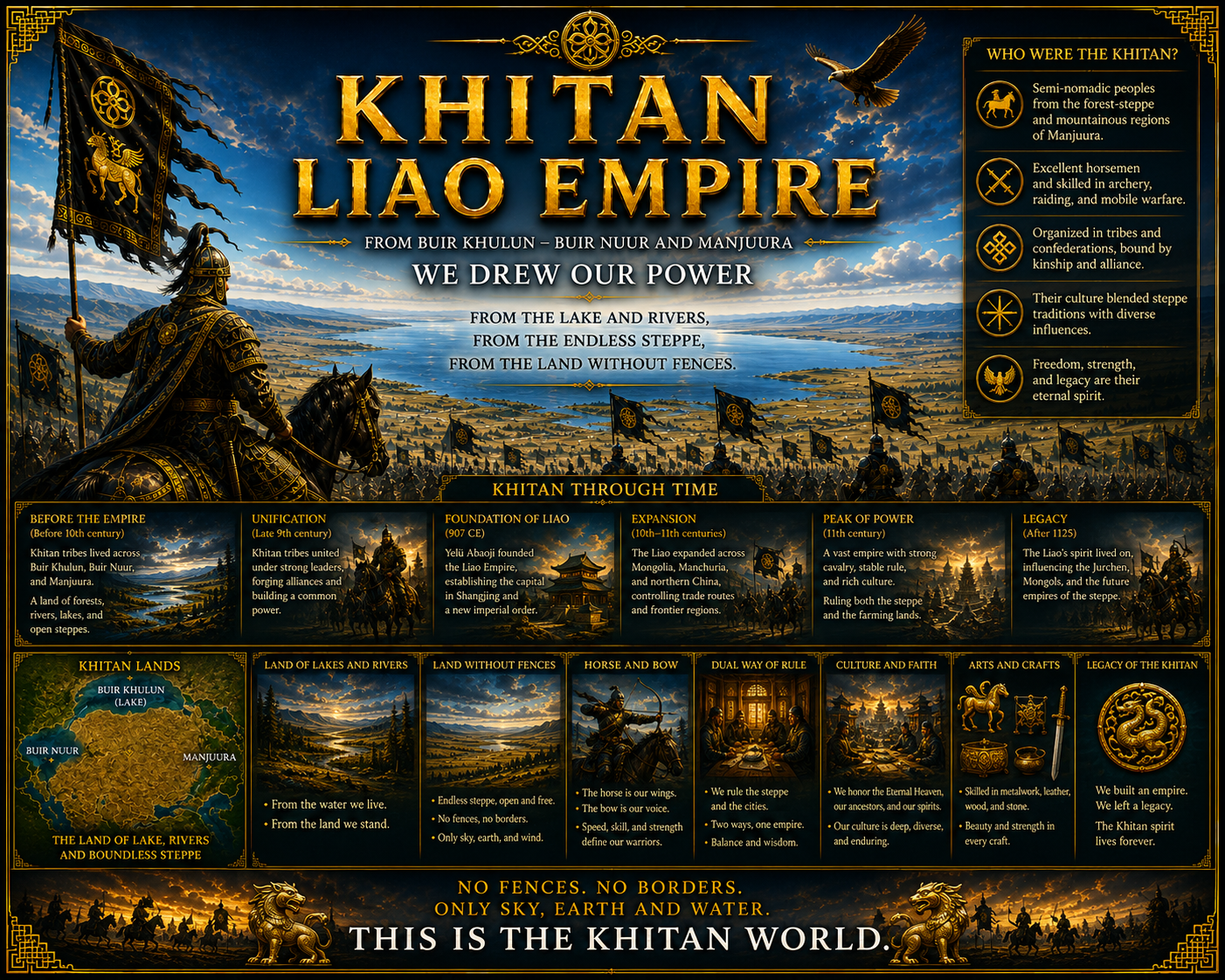
KHITAN EMPIRE (LIAO DYNASTY)
(907–1125 CE)
Foundation of the Empire
Abaoji (Emperor Taizu of Liao). r. 907–926 CE
- Unified the Khitan tribes. Founded the Khitan Empire (Liao Dynasty).
- Created the dual administrative system:
- steppe governance for nomads,
- imperial bureaucracy for settled regions.
- Expanded Khitan authority across eastern Mongolia and Manchuria.
Emperor Taizong of Liao. r. 926–947 CE
- Conquered the Balhae Kingdom.
- Expanded the empire southward.
- Temporarily occupied parts of northern frontier territories after intervening in Chinese dynastic conflicts.
Imperial Expansion and Consolidation. Emperor Shizong of Liao. r. 947–951 CE
- Attempted internal stabilization.
- Strengthened imperial administration.
Emperor Jingzong of Liao r. 969–982 CE
- Maintained frontier control.
- Continued military organization of the empire.
Empress Dowager Chengtian (Regency period)
late 10th century CE
- One of the most influential women in Khitan history.
- Directed imperial policy and military affairs.
- Strengthened the empire during succession transitions.
Wars with Song Dynasty. Treaty of Chanyuan. 1005 CE
- Peace agreement between Liao and the Song dynasty.
- Song agreed to annual tribute payments.
- Established long-term diplomatic balance.
Golden Age of Liao. 10th–11th Century CE
- Khitan cavalry dominated eastern Inner Asia.
- Trade routes expanded.
- Imperial cities and frontier administration flourished.
- Steppe and sedentary systems coexisted under one empire.
Decline of the Empire. Early 12th Century CE
- Internal political struggles weakened imperial unity.
- Rising Jurchen tribes rebelled against Khitan rule.
Rise of Jin and Fall of Liao. Aguda. 1115 CE
- Founded the Jin dynasty.
- Launched major campaigns against Liao.
Fall of the Khitan Empire — 1125 CE
- Jin armies destroyed the Liao imperial order.
- End of Khitan rule in eastern Inner Asia.
Western Migration. Qara Khitai. (12th century CE)
- Western Khitan groups migrated into Central Asia.
- Established a successor empire preserving Khitan traditions.
KHAGAN BEFORE THE KÖK TÜRÜK
By Altanbagana Baatar
DBA Candidate| Independent Historian
ImperialGG Historical Research Seriers
23 June 2026
THE ROURAN ORIGIN OF A TITLE OF INNER ASIAN SOVEREIGNTY
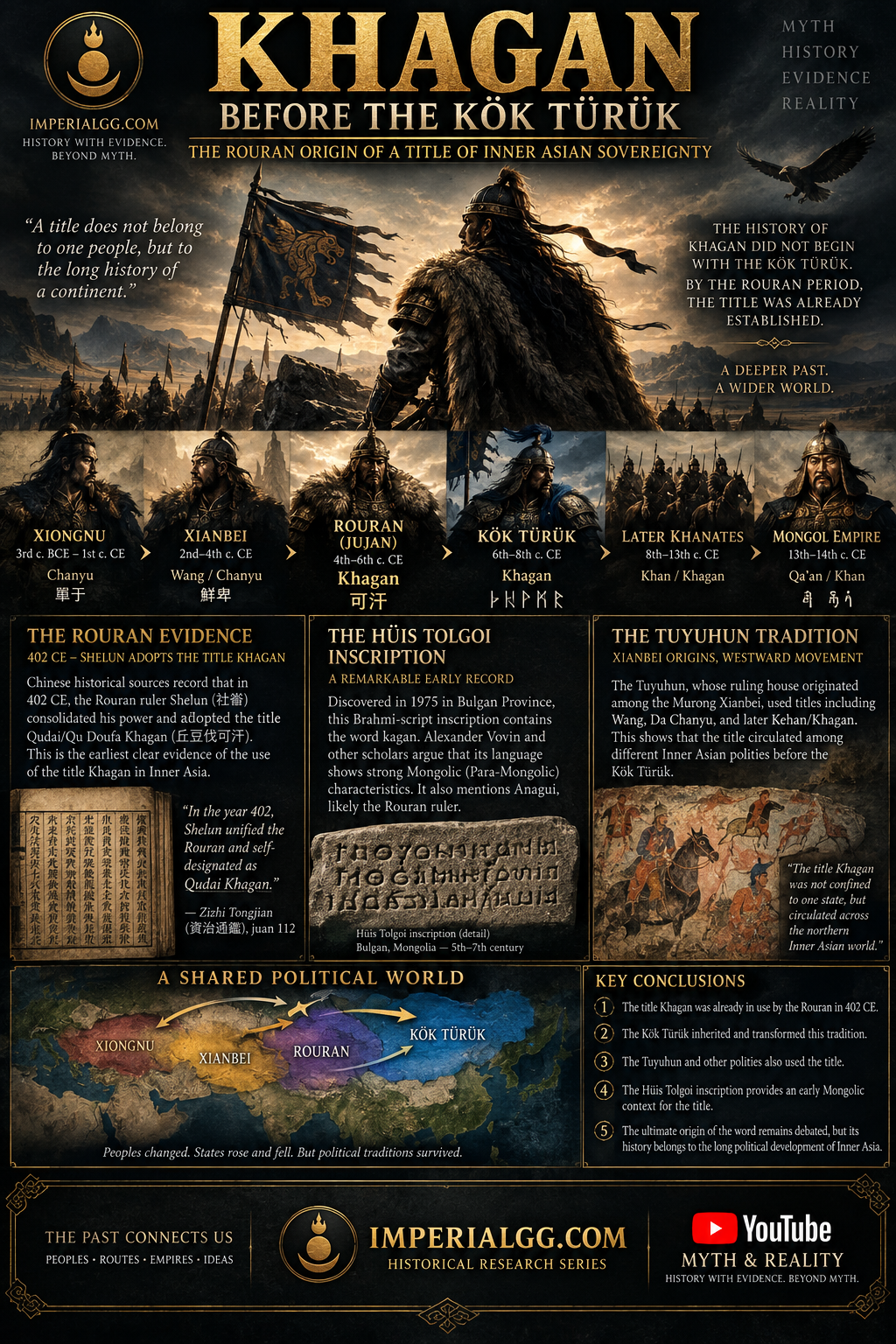
The title Khagan occupies a central place in the political history of Inner Asia. In later centuries it became closely associated with the great imperial traditions of the Kök Türük and Mongol worlds. Yet the surviving historical record points to a significantly earlier history.
By the beginning of the fifth century CE, the title was already being used by the rulers of the Rouran (柔然, Jujan) Khaganate on the Mongolian Plateau. This chronological fact is fundamental.
The Kök Türük did not create the institution of the Khagan from nothing. When the Kök Türük Khaganate emerged in the sixth century, it entered an Inner Asian political environment in which the title Khagan was already established. The history of the title must therefore be examined before the Kök Türük, particularly through the political history of the Rouran.
THE POLITICAL WORLD BEFORE THE KÖK TÜRÜK
The Mongolian Plateau had already witnessed the rise and fall of major political formations long before the Kök Türük Khaganate. The Xiongnu created an imperial political system beginning in the late third century BCE. Their supreme ruler was known in Chinese sources as the Chanyu (單于). After the decline of Xiongnu power, political authority on the northern frontier did not disappear.
Instead, new political formations emerged. Among the most important were the Xianbei, whose various ruling houses became major political actors across northern Inner Asia. From this environment emerged political traditions that later developed into the Rouran Khaganate. This sequence should not be understood as a simple succession of identical ethnic states. Rather, it represents a changing political landscape in which peoples, ruling houses, institutions, titles, and political practices interacted across the steppe.
The important point is that the Kök Türük Khaganate was not the beginning of Inner Asian imperial sovereignty. It was a later and extraordinarily influential phase of an older political tradition.
THE ROURAN AND THE EMERGENCE OF THE KHAGAN
The decisive evidence comes from the Rouran ruler Shelun (社崙). Chinese historical sources record that in 402 CE, after consolidating Rouran power, Shelun adopted the title Khagan. The Zizhi Tongjian records his assumption of the title 丘豆伐可汗, conventionally reconstructed as Qudai/Qu Doufa Kagan. This date is crucial.
It places the documented use of Khagan as a supreme sovereign title more than 150 years before the establishment of the First Kök Türük Khaganate in 552 CE.
The chronological relationship is therefore:
Rouran Khaganate — 402 CE → Kök Türük Khaganate — 552 CE
The title was already politically established when the Kök Türük emerged. This does not, by itself, answer the much more difficult question of the ultimate linguistic origin of the word. But it decisively changes the historical question.
We should no longer ask: “Did the Kök Türük invent the title Khagan?” The evidence indicates that they did not.
The more productive question is: “From what earlier Inner Asian political tradition did the Rouran inherit or develop the title Khagan?”
KHAGAN WAS AN IMPERIAL TITLE
The significance of the Rouran evidence is not merely lexical. Shelun was not simply adopting an alternative personal title. The Rouran had created a large political system across the Mongolian Plateau and surrounding steppe. The title Khagan therefore appears in association with a ruler exercising authority over a multi-polity and multi-ethnic imperial formation.
This helps explain the later meaning of the title. Khagan was not simply another word for a local chief. It became a title associated with the highest level of steppe sovereignty. This distinction would become increasingly important in later Inner Asian political systems, where multiple rulers and subordinate authorities could exist beneath a supreme sovereign.
THE ROURAN WERE NOT A POLITICAL VACUUM
The emergence of the Rouran Khaganate should not be interpreted as the sudden appearance of political organization on an otherwise empty steppe. The Mongolian Plateau had already accumulated centuries of political experience. The Xiongnu had demonstrated the possibility of organizing enormous populations across the steppe.
The Xianbei political world subsequently produced powerful ruling houses and states.
The Rouran inherited this broader political environment and developed it in their own historical circumstances. Consequently, the adoption of the title Khagan in 402 should be understood within a much deeper history of steppe sovereignty. The title may have been new in a particular political context. The institution of supreme steppe rulership was not.
THE TUYUHUN EVIDENCE
Another important piece of evidence comes from the Tuyuhun, whose ruling house originated among the Murong Xianbei. Traditional Chinese historical accounts describe the westward movement of Murong Tuyuhun during the third century CE and the subsequent development of the Tuyuhun polity in the Gansu–Qinghai region. The political vocabulary associated with Tuyuhun rulers later included the title Kehan/Khagan.
This evidence is significant because it demonstrates that the title was not confined to one later Kök Türük political tradition. It circulated among different political formations connected to the wider northern Inner Asian world. However, the Tuyuhun evidence should be handled cautiously. It demonstrates the use of the title in the Tuyuhun political environment, but it does not independently prove that the Xianbei invented the word. That distinction is essential in an academic discussion.
THE HÜIS TOLGOI INSCRIPTION
The Hüis Tolgoi inscription provides another extraordinary piece of evidence. Discovered in present-day Mongolia and written in Brahmi script, the inscription has attracted considerable attention because of the language in which it was composed. Research by scholars including Dieter Maue, Alexander Vovin, Mehmet Ölmez, and Étienne de la Vaissière has led to substantially new interpretations of the text.
Alexander Vovin has argued that the inscription’s linguistic structure shows stronger affinities with Mongolic than with Khitan and has proposed a cautious classification in the Para-Mongolic/Mongolic sphere. Most importantly for the present discussion, the inscription contains the title Khagan. It also contains names and historical references that have been connected with the Rouran political world, including Anagui, the final major Rouran ruler.
The inscription therefore opens a remarkable window onto the linguistic and political environment of the Mongolian Plateau during the centuries surrounding the transition from Rouran to Kök Türük power.
ANAGUI AND THE FINAL ROURAN AGE
Anagui was one of the last major rulers of the Rouran Khaganate. His reign belongs to the final phase of Rouran political power immediately before the rise of the Kök Türük.
If the identification of Anagui in the Hüis Tolgoi inscription is accepted, the monument provides a potentially important connection among:
Rouran political history — the Mongolian Plateau — an early local written tradition — and the title Khagan.
This does not settle every question surrounding the inscription. Nor does it establish an uncontested etymology for Khagan. But it makes the old assumption that the title belongs exclusively to a later Turkic political world increasingly difficult to maintain.
KÖK TÜRÜK: INHERITANCE, TRANSFORMATION, AND EXPANSION
The First Kök Türük Khaganate was established in 552 CE under Bumin Khagan after the destruction of Rouran supremacy. The Kök Türük rulers subsequently transformed the political geography of Inner Asia. Their inscriptions and diplomatic records provide some of the most important evidence for the political ideology of the steppe khaganate. But the chronology matters.
The Kök Türük did not enter a political world without precedents. They emerged directly after the collapse of the Rouran imperial order. The transition therefore deserves to be understood as:
Rouran Khaganate → Kök Türük Khaganate
not because the two states were identical, nor because their populations were identical, but because the second emerged within the political environment created by the first. The Kök Türük transformed the institution of the Khaganate into one of the most powerful imperial systems of sixth- and seventh-century Inner Asia.
THE TITLE SURVIVED POLITICAL CHANGE
One of the most revealing characteristics of Inner Asian history is the survival of political terminology across changes of dynasty and ruling population. A political title could outlive the regime that had made it prominent. The same applies to institutions.
A later ruling house could inherit:
- concepts of supreme sovereignty;
- systems of military organization;
- diplomatic practices;
- tribute relationships;
- administrative terminology;
- and imperial titles.
The history of Khagan therefore illustrates a broader phenomenon: Political traditions in Inner Asia were transmitted across dynastic and political transformations.
The Rouran disappeared as an independent imperial power. The Kök Türük later divided and fell. Yet the political vocabulary associated with supreme steppe sovereignty continued.
FROM KÖK TÜRÜK TO THE MONGOL IMPERIAL WORLD
Centuries later, the Mongol Empire inherited an Inner Asian political vocabulary that had already developed through a long history. The Mongol rulers used forms such as qa’an / qaγan alongside qan/khan, and these terms were rendered differently in Mongolian, Persian, Chinese, Arabic, and European sources. The Mongol imperial tradition therefore represents another stage in the history of Inner Asian sovereignty. The title was no longer simply a word used by one fifth-century steppe ruler. It had become part of an international imperial vocabulary.
This is why the history of Khagan belongs to a much larger historical continuum:
XIONGNU → XIANBEI POLITICAL WORLD → ROURAN KHAGANATE → KÖK TÜRÜK KHAGANATES → LATER INNER ASIAN KHANATES → MONGOL IMPERIAL TRADITION
This is a political and institutional sequence, not a claim of uninterrupted ethnic identity.
WHAT THE EVIDENCE DOES — AND DOES NOT — PROVE
A rigorous historical argument must distinguish between what can be demonstrated and what remains hypothetical.
WHAT CAN BE ESTABLISHED
The Rouran ruler Shelun adopted a Khagan title in 402 CE. That predates the Kök Türük Khaganate by approximately 150 years. The title was therefore already established within a major Inner Asian political system before the Kök Türük rose to power. The title also appears in other early Inner Asian contexts, including the Tuyuhun political tradition. The Hüis Tolgoi inscription provides further evidence for the use of Khagan in an early Mongolian Plateau context.
WHAT CANNOT YET BE PROVEN WITH CERTAINTY
The surviving evidence does not permit us to state with absolute certainty: “The word Khagan was invented by the Xianbei.”
Nor does it permit the equally simplistic statement: “Khagan was originally a Kök Türük title.” The first claim goes beyond the evidence. The second contradicts the chronological evidence. The historically defensible position lies between them.
THE REAL SIGNIFICANCE OF THE ROURAN EVIDENCE
The most important discovery is therefore not simply the date 402 CE. It is the political context. By the beginning of the fifth century, the Mongolian Plateau was capable of producing a ruler whose sovereignty was expressed through the title Khagan. That means that the political institution represented by the Khaganate belongs to the pre-Kök Türük history of Inner Asia. The Kök Türük inherited, transformed, and expanded this tradition. The Mongols later transformed it again. The history is therefore not a story of one people suddenly inventing imperial sovereignty. It is a story of political traditions developing across centuries of Inner Asian history.
CONCLUSION
The evidence forces us to move the beginning of the history of Khagan backward. The title was already in use under the Rouran by 402 CE, more than a century before the rise of the First Kök Türük Khaganate. That fact alone is sufficient to reject the idea that the Kök Türük created the title from nothing. The Rouran Khaganate must therefore occupy a central position in the history of Inner Asian imperial sovereignty.
The deeper question—whether the title originated among the Xianbei, Rouran, another earlier Inner Asian population, or through an even older linguistic tradition—remains open to philological debate. But the chronology is clear.
Khagan did not begin with the Kök Türük. By the Rouran age, the title was already there.
And the Mongolian Plateau was already a mature arena of imperial political development long before the Kök Türük and many centuries before the Mongol Empire.
REFERENCES
- Shiratori, Kurakichi. “A Study on the Titles Kaghan and Katun.” Memoirs of the Research Department of the Toyo Bunko 1 (1926): 1–39.
- Taskin, V. S. Materials on the History of Nomadic Peoples in China, 3rd–5th Centuries. Moscow: Nauka. The work remains important for the study of Chinese historical records concerning the northern peoples of late antiquity.
- Vovin, Alexander. Research on the Hüis Tolgoi inscription, particularly his linguistic analysis arguing for Mongolic/Para-Mongolic characteristics.
- Maue, Dieter; Vovin, Alexander; Ölmez, Mehmet; de la Vaissière, Étienne. Studies concerning the Hüis Tolgoi inscription, its script, language, and historical context.
- de Rachewiltz, Igor. “Qan, Qa’an and the Seal of Güyüg.” East Asian History. The study surveys the terminology and scholarly debate surrounding qan/qaγan in the Mongol period.
- Zizhi Tongjian (資治通鑑), entry for 402 CE. The account records Shelun’s consolidation of Rouran power and his adoption of the title Kagan.
- Peter B. Golden. Studies on the political and linguistic history of Inner Asia, including the development of Turkic and pre-Turkic steppe political traditions.
- Michal Biran. Research on Central Asia under Mongol and post-Mongol rule, particularly the transmission of political institutions across Chinggisid successor states.
IMPERIALGG HISTORICAL RESEARCH SERIES
KHAGAN BEFORE THE KÖK TÜRÜK
THE ROURAN AND THE DEEP HISTORY OF INNER ASIAN SOVEREIGNTY
🌐 ImperialGG.com
▶️ MYTH & REALITY — YouTube
HISTORY WITH EVIDENCE. BEYOND MYTH.
Qara Khitai
The Western Empire of the Khitan
(1124–1218 CE)
The Qara Khitai, also known as the Western Liao, emerged after the collapse of the Khitan Empire in eastern Inner Asia.
After the rise of the Jin dynasty and the destruction of the Liao state in 1125 CE, groups of Khitan nobles, warriors, and followers migrated westward across the steppe under the leadership of Yelü Dashi.
Traveling through Mongolia and Central Asia, Yelü Dashi gathered support from frontier tribes and established a new Khitan imperial state far from the old eastern homeland. The Qara Khitai empire expanded across large parts of Central Asia, including regions inhabited by Turkic peoples, oasis kingdoms, and Silk Road cities.
Unlike many surrounding powers, the Qara Khitai preserved important political traditions of the old Khitan imperial system while adapting to the multicultural world of Central Asia. Their rulers governed a diverse empire composed of:
- nomadic tribes,
- caravan cities,
- oasis states,
- and agricultural populations.
The empire became one of the strongest powers between China, the Islamic world, and the Eurasian steppe.
The Qara Khitai controlled important Silk Road trade routes and maintained diplomatic relations with neighboring states across Inner Asia. Historical sources describe their rule as relatively tolerant toward different religions and local traditions.
Although the ruling elite preserved Khitan identity and imperial customs, the empire itself became highly cosmopolitan, blending steppe traditions with Persian, Turkic, and Central Asian influences. During the late 12th and early 13th centuries, internal instability and regional conflicts weakened the empire.
In 1218 CE, the expanding forces of the Mongol Empire under Genghis Khan destroyed the Qara Khitai state.The fall of the Qara Khitai marked the end of the last major Khitan imperial successor and opened Central Asia to the great Mongol expansion that would soon reshape Eurasia.




Located in Bayannuur soum of Bulgan Province, Mongolia the ruins of “Chin Tolgoi” Fortress are believed to be a historical monument dating to the period of the Khitan Empire. Standing upon the open steppe of central Mongolia, the site preserves traces of ancient frontier fortifications connected to the medieval world of the Khitan and the wider civilizations of Inner Asia.
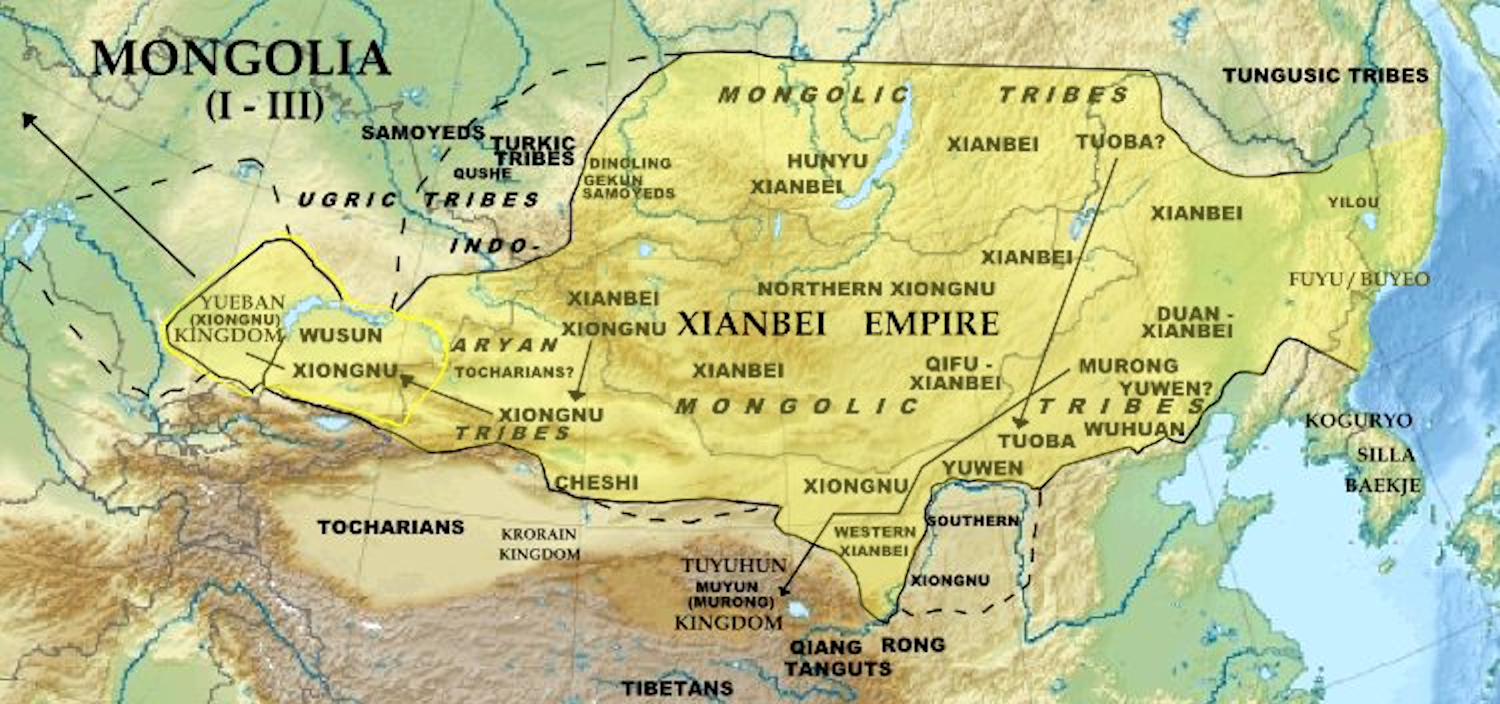
The Eurasian steppe has been home to a succession of powerful nomadic confederations and empires for more than three millennia. limitation of textual sources.
From the early steppes of the Xiongnu and Xianbei to the vast Mongol Empire and its successors, these polities shaped the political, military, and cultural history of Inner Asia. Their influence extended across Eurasia.
4800-Year Timeline of the Steppe: From Early Nomadic Cultures to Modern Mongolia
Chronological List
1. Jiuli (Confederation of Nine Tribes)
2600 BCE – 2300 BCE
According to Chinese legends, they were described as nomadic hostile enemies.
2. 2300 BCE – 1300 BCE (Dark Age)
This period is historically unclear. Some historians mention a people called “Melkhi,” but this remains insufficiently studied.
3. Guifang State
1300 BCE – 900 BCE
A nomadic confederation. After their decline, groups such as the Scythians, Massagetae, and the one-eyed Arimaspi migrated westward toward Europe.
4. Xianyun
1000 BCE – 700 BCE
A state that united remnants of the Guifang along with the Run and Di tribes.
5. Di
900 BCE – 800 BCE
A confederation consisting of Northern Di, Red Di, White Di, and Long Di tribes.
6. Jung Run (Zhongrong)
800 BCE – 700 BCE
A confederation including Lu Zhong, Mountain Rong, Dog Rong, and Western Rong tribes.
7. Beidi (Northern Di)
700 BCE – 300 BCE
A union of seven tribes, including the Mon and Di.
8. Northern Xiongnu
340 BCE – 209 BCE
A confederation of 24 tribes that united parts of the Beidi and most of the Jung Run.
9. Xiongnu Empire
209 BCE – 93 CE
A great empire that unified 36 states, including the powerful Donghu (Eastern Hu) and the western Yuezhi.
c. 1000–300 BCE
Early Steppe Nomadic Cultures
Ancient nomadic societies developed across the Eurasian steppe, forming early pastoral traditions, mounted warfare, and mobile political structures.
209 BCE
Xiongnu Empire Founded
Modu Chanyu united the nomadic tribes of the Mongolian steppe and established the Xiongnu Empire, the first major steppe empire in Inner Asia.
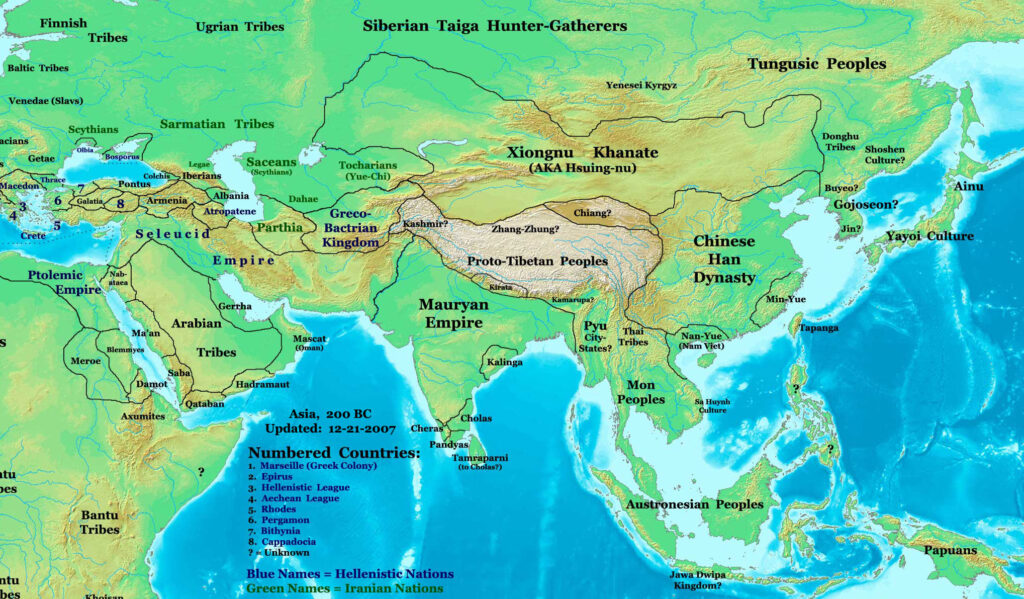
1st–2nd Century CE
Decline of the Xiongnu Confederation
Internal conflicts and pressure from the Han dynasty weakened the Xiongnu political system.
2nd–4th Century
Xianbei Confederation
After the fall of the Xiongnu, the Xianbei tribes became dominant across the Mongolian steppe and northern China.
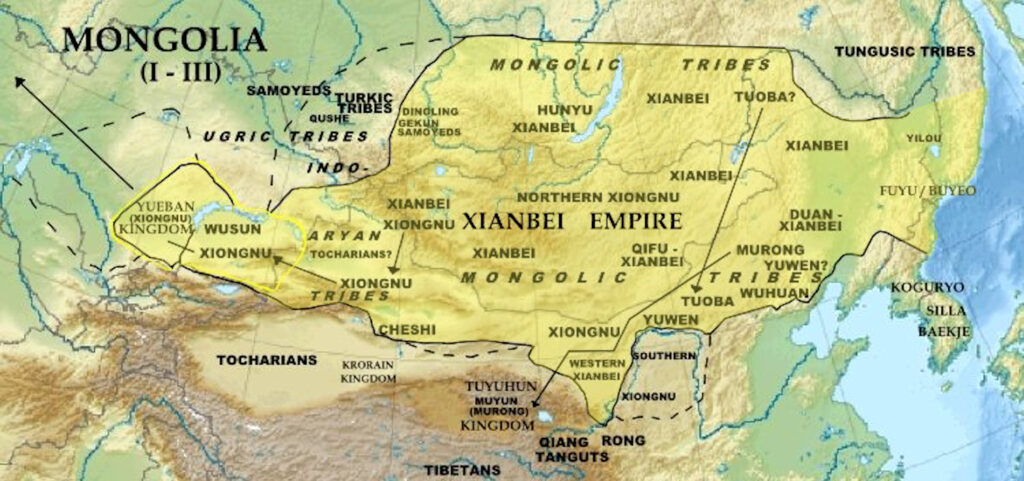
4th–6th Century
Rouran Khaganate
A powerful nomadic empire that ruled Mongolia and introduced the imperial title “Khagan.”
From the windswept grasslands of Inner Asia arose the great steppe empires—mobile powers forged through cavalry, discipline, and the mastery of distance. Long before the rise of modern states, confederations of riders united vast tribes beneath sacred banners and carried their influence across deserts, mountains, and seas. The rise of the steppe empires was not merely a story of conquest, but of movement, adaptation, trade, and cultural exchange. From the early nomadic confederations to the vast dominion of the Mongol world, the steppe became a corridor through which armies, ideas, technologies, religions, and civilizations were connected across Eurasia.